But What Does it Mean?

Readers know that I subscribe to the WSJ, and I do so because I expect it to maintain reasonably high standards for reporting on economic and financial matters. I mean – Wall Street, right?

WSJ manages to disappoint me on that score regularly. There is an Opinion column in today’s issue with this headline:

In Defense of the McDonald’s Cheeseburger

It’s cheaper than it was in 1948, when gauged on a sandwich-per-hour basis.

Um…..sandwich-per-hour basis? What the heck does that mean?

So of course I read the column to find out, and here is what it means to the writer, one Faith Bottum. The key paragraph from the article says this:

A cheeseburger in 1948 cost 19 cents, while the federal minimum wage was 40 cents an hour. Today Mac-Menus reports the price of a cheeseburger at around $3.89, depending on region. And McDonald’s workers average $12 to $14 an hour (with California’s minimum wage for fast-food workers at $20). Even with the lower average wage, that’s 3.1 cheeseburgers an hour today, as opposed to 2.1 in 1948.

Ok, so 40/19 = 2.1 and 12/3.89 = 3.08, or roughly 3.1.

That is Ms. Bottum’s arithmetic, clearly. What does that mean? She says it means a cheeseburger is cheaper than it was in 1948. I don’t think so….

If you want a read on whether a McD cheeseburger is cheaper for a buyer than it was in 1948, then you compare the rise in the price of a cheeseburger over the relevant time period with the rise in the general price index, known as the CPI. Or, even better, you compare the cheeseburger price rise with how much the average or median earnings of a worker have changed over that time period.

Doing the CPI calculation is easy. The US CPI stood at 24 in 1948 and at 330 at the start of 2026. So, the CPI went up by a factor of 330/24 = 13.75 over the relevant period, while the price of a cheeseburger went up by a factor of 3.89/0.19 = 20.47.

Sorry, Faith. From the viewpoint of a consumer, a McD cheeseburger has gone up in price at a much higher rate than the prices of consumer goods in general, making it a less good deal than other things a person might spend their money on, relative to what it was in 1948.

(Yes, I know, very few people who bought McD cheeseburgers in 1948 are still around to do so today. I did not pick that year, Ms. Bottum did.)

Ms. Bottum ends her little piece with this:

Maybe this is why I’ve always had a fondness for the fast-food chain and its cheeseburger. It’s both delicious and a pretty good bang for your buck.

Well, you may be fond of them, Faith, but your numbers do not support ‘good bang for your buck’.

Now, the calculation she presents is not useless, it just doesn’t tell us anything about the relative cheapness of a McD Cheeseburger today vs 1948. It does tell us something from the perspective of McD as a profit-seeking company.

In 1948, McD had to sell 2.1 cheeseburgers to pay for one hour’s wages for an employee. In 2026 it has to sell 3.1 cheeseburgers to cover one hour’s wages. That’s what Bottum’s numbers tell us, and I doubt that makes McD happy in any way. The reason for that is that the hourly wage McD must pay for its workers has gone up by a factor of $12/$0.4 = 30, much higher than the increase in the CPI over that period, which we calculated above as rising by a factor of only 13.75.

It’s actually kinda simple. If the wage you gotta pay workers by law goes up a lot, then you are gonna have to sell more stuff and/or at a higher price to pay that wage.

Ain’t economics fun?

Full Disclosure: My first-ever-real-job (paid by cheque, tax withholding, etc.) in 1968 was at McD’s. I earned $1.20/hr, and I recall a hamburger being $0.49 and a cheeseburger $0.59. On a busy Friday supper hour, there would be 15 or more pimply-faced teenagers in the restaurant cranking out burgers and fries to feed the masses. You will never see that many youngsters working in a McD’s at one time today.


Failing Econ 2129

Sometimes the world hands a blog-writer a topic on a silver platter. All one can do is say ‘Thanks, world’. Then write the article.

Reading the WSJ this week I came across a story with this headline:

Delta’s Ace in the Hole for Surging Jet Fuel Costs: Its Own Refinery

Airline’s 2012 acquisition of Pennsylvania refinery has been called both prescient and pointless

I taught Delta’s acquisition of that refinery as a case study on vertical integration in my Managerial Econ class back in the day. And, wouldn’t you know it, everyone who has anything to say about it in the WSJ article would have done rather badly in my course.

Here’s the sitch. Delta Airlines did indeed buy a (money-losing at the time) refinery in Pennsylvania in 2012. In principle, this seems to make some kind of sense. There is no doubt that fuel costs are an enormous fraction of the cost of flying people around in airplanes. So, the thinking goes, buy an oil refinery, and you can supply yourself with jet fuel from your own refinery, without the markup that other refiners would charge you. Instant savings.

The technical term for that argument is – ‘wrong’.

First, just think about it for a minute. If that argument is correct, then every airline should own a refinery, and every automaker should own a steel plant, not to mention a tire company, and every grocery chain should own dairy farms and cattle ranches.

And yet – they do not. There are some good reasons for vertical integration, some situations in which it can increase profit, but ‘cutting out the middleman’ ain’t one of them.

The reason is not that hard to see. Suppose Delta is flying planes and being charged the going price of $4/litre for jet fuel by its usual suppliers. That is a cost to Delta, and is revenue to the refiners it buys from.

Now it buys a refinery, and the idea is that it sells the jet fuel to itself for only the cost of producing the fuel, which is, say, $3/litre. It thus saves $1/litre, and if it buys 1million litres per month, it adds $1million per month to its bottom line because owning that refinery lowers its fuel cost that much. Its rivals are all paying $4/litre. Advantage, Delta.

But wait a minute, ‘Delta’ now consists of an airline and an oil refinery, and that reduced $1million in cost to Delta every month is also a reduction of $1million in revenue to the refinery. Why? If the going price is really $4/liter, it could sell those 1 million litres to other airlines at that price, but it does not, it sells it to Delta at cost.

The Delta division of the integrated company will have $1million in reduced costs and the refinery division will have $1million less of revenue each month. Not an advantage, just a change in the bookkeeping entries for the two divisions of newly-integrated Delta.

Now, there is a way for Delta to increase its profits at the expense of its rival airlines, and that would be to buy up nearly all of the jet fuel refining capacity available. That would make it a monopoly in jet fuel production, always good for the bottom line, and it could sell to itself at a price lower than it sells to other airlines.

Of course, the anti-trust authorities would not allow that to happen – or so I would hope.

Let’s go to the WSJ article, folks.

Ed Bastien is the CEO of Delta. Here’s a quote:

“We don’t know where fuel is going to go, but to the extent fuel stays elevated, that refinery will continue to help us,” Bastian told reporters this week. The airline said the refinery will boost its expected second-quarter earnings by $300 million.

Bastien runs the airline, not the refinery, so he need not mention that the refinery’s earnings will be down $300m. And of course, no one ever sees money you did not make, not even the accountants. Think how much better Delta’s earnings could be if their refinery paid Delta to take the jet fuel and burn it in their jets. I bet Ed never thought of that one.

Here’s another quote which is just complete nonsense:

Delta’s refinery is run by a subsidiary that sells its jet-fuel output to Delta at market rates. The arrangement allows Delta to avoid paying outside suppliers for the work of churning oil into fuel.

Um, if the subsidiary is selling the fuel at ‘market rates’, then Delta is paying the same price it would if it bought from another refinery. That is what market rate means. So then it is in fact paying the same as it would to an ‘outside supplier’. Like I said, those two sentences make no sense at all.

Fortunately, some economists are quoted in the piece also. They will sort things out for WSJ readers, I’m sure. Here’s one quote:

Ed Hirs, an energy economist at the University of Houston, said the refinery has been a costly mistake.

You tell ‘em, Ed.

Then he says this:

“They bought the bakery but not the wheat field,” he said.

Oh, dear. No, Ed, it does not matter that they did not buy the wheat field, which in this context means that they did not buy oil wells. My argument above holds, no matter how many stages back into the production of fuel – or bread – you go. It does not help profitability.

Happily, there is a second economist on the job, and he is quoted as such:

Philip Verleger, an energy economist, said the purchase made sense for Delta.

“Everybody was highly critical of Delta when they did it,” he said. “I thought this was a really smart decision. The oil companies treated airlines as cash cows.”

Folks, real economists don’t use the term ‘cash cow’. We prefer ‘customer’.

The thing is, economists do not have a guild, so there is no one I can write to and file complaints about Mr. Verleger and Mr. Hirs for engaging in economic malpractice. Anyone can claim to be an economist, and say any damn silly thing they like, it turns out.

I’m afraid that CEO Bastien and ‘economists’ Hirs and Verleger would have failed my Econ 2129 class. As did others, back in the day.


Debtor Nation?

I came across one of those ‘explainer’ stories in the Globe and Mail the other day, titled

Rather than paying down debt, Canadians are happily borrowing even deeper

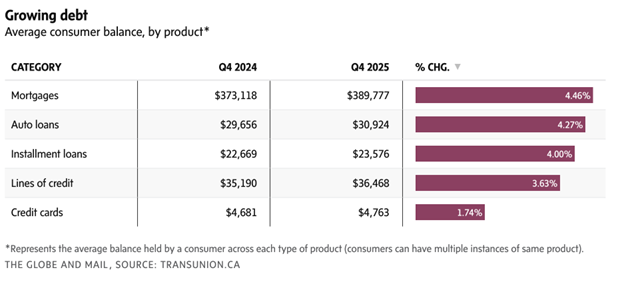
Being by now rather skeptical of anything the G&M publishes on matters economic, I thought I would see what it said. The theme is clear from the above headline; us crazy Canucks are borrowing more and more. Here is a graphic from the article:

The graphic above is about household debt. There is also some chatter about government debt in the article, which I will get to, but let me separate those two and start with us plain folks.

A. Household Debt in Canada and Elsewhere.

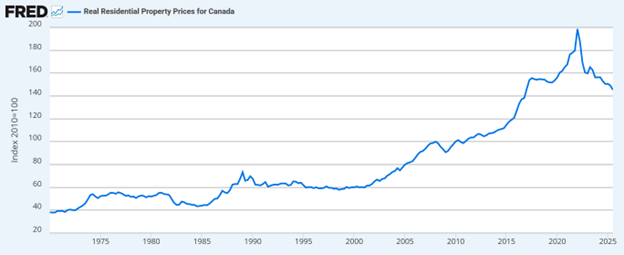
The clear lesson of the graphic above is supposed to be that Canadians were carrying more debt in ’25 than they were a year ago in all categories, although credit card debt showed the smallest increase. That mortgage debt grew the most is slightly surprising, as the graph below from good ol’ FRED indicates that average residential property prices in Canada, after hitting a peak in the first quarter of 2022, have since been dropping. Perhaps people are moving up in the size (hence price) of their houses, now. Hard to say. There are many reasons people might be carrying bigger mortgages, but it does seem they are, on average.

In any case, all that original graphic from G&M tells us is that household debt in Canada has increased some over the year from ’24 to ’25. Is that anything to be concerned about? Is that a big increase? Big compared to what? We need a comparison, so –

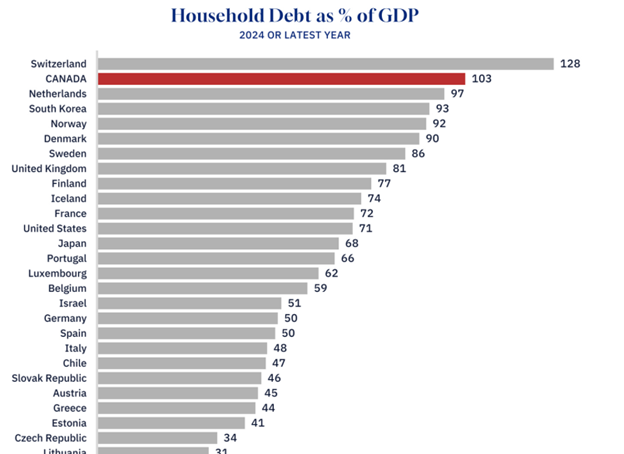
Here is an international comparison from an article in The Hub which is where much of the info in the G&M article came from, anyway:


I only included the data from the most-indebted countries here to save space. What this shows is the total household (not government) debt in a country relative to that country’s GDP, which is a measure of how much income is generated in that country. So, Canadians are, by world standards, very highly indebted, indeed, relative to the income they generate. On the other hand, they seem to be in good company. I don’t think that anyone is too concerned that the Swiss or Dutch are in trouble. Do note that Canadian households are much more indebted than those in the US, relative to GDP, however.

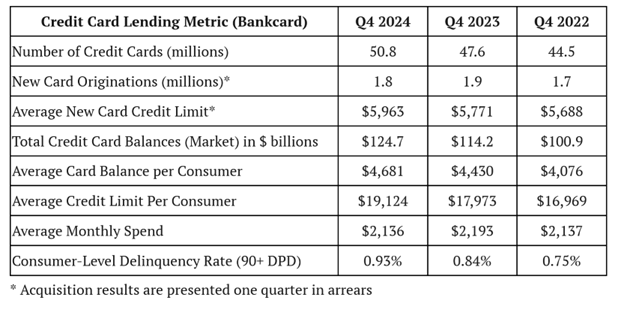
My own perhaps idiosyncratic view of ‘debt trouble’ is when folks start running up their credit card debt. That may be misguided, but here is some data on that for Canada from The Financial Post:

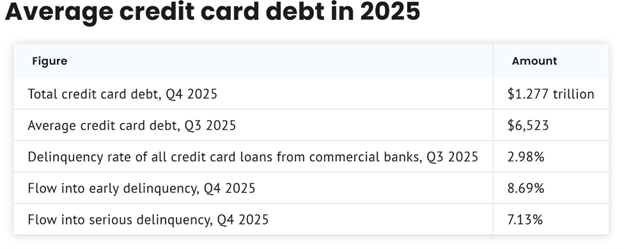
The average card balance per customer has risen some over this two year period, but the average monthly spend not at all, and the delinquency rate – the most worrying sign – is up a bit, but still very low, below 1%. It’s always good to compare oneself to others, so let’s see what the situation is for US credit card holders. The data for the US in the table below is from The Motley Fool, and not directly comparable, but still useful.

The average credit card balance is clearly higher than in Canada at $US6500, and the flows into early and serious delinquency look much worse, but I believe those numbers indicate the percentage of balances that have gone into delinquency rather than the percentage of customer accounts.

Anyway, the credit card situation of Canadians is, on average, not obviously worse than that for Americans.

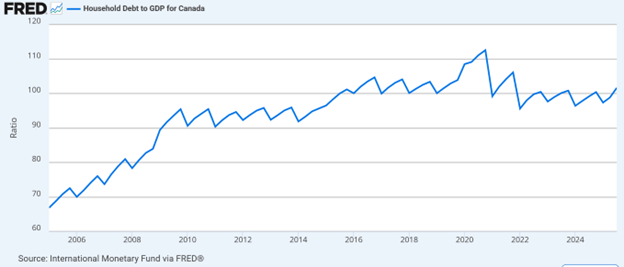
I am always interested in not just what the situation is, but how we got there. So, I got to wondering what household debt in Canada looked like in the past, and how it might have changed. As so often is the case, I had to go to FRED to get the info on this I wanted, and it is below.

So household debt in Canada was less than 70% of GDP back in 2005, climbed to over 90% in the next five years, and has continued to tick up slowly after that, with some ups and downs along the way.

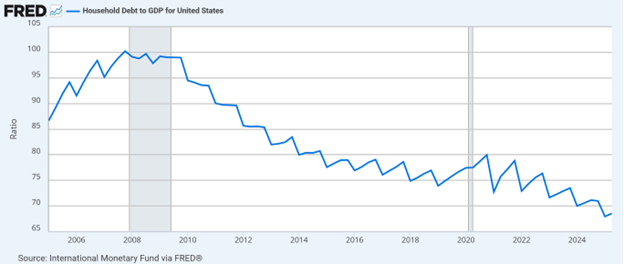
What about the USA households? Well……

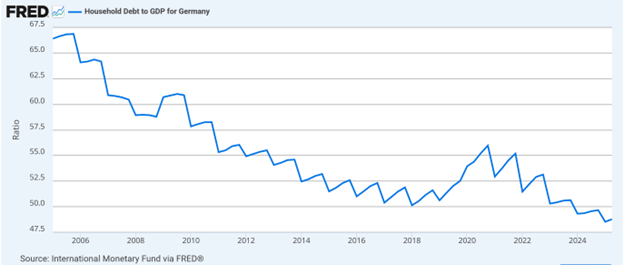
This is a very different history than Canada’s, to say the least. Household debt was very high in the US up until the 2008 debacle, and since then it has trended down, to sit at its current 60-something percent. This got me wondering, so I kept digging. Here is the same info for Germany:

There was no run-up in the years prior to 2008 in Germany, just a long slow decline, except in the years just following the pandemic. The UK looks much the same as the US and Germany. The only developed country I found data on that had that long upward trend was Canada,  although I did not check every country, of course.

So….WTF? Canada’s household debt to GDP ratio is very high by international standards, and it got there via a run-up over 20 years during which other advanced economies saw household debt declining as a percentage of GDP. And, the increase in Canada started well before the run-up in real estate prices.

There is one other fact worth mentioning here. Canada’s GDP, and even more, its GDP per capita, has not been doing well in recent years. This is well-known and much lamented, but it certainly raises the possibility that the reason Canada’s household debt history looks so different from that of other countries is not due to debt itself increasing so much as its GDP (the denominator in those graphs) doing so poorly.

B. Government Debt in Canada and Elsewhere

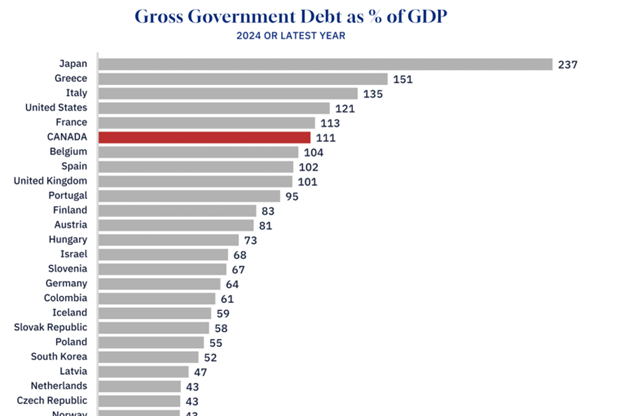
As you might guess, the G&M article went on about government debt in Canada, also. Here is a graphic analogous to the one I started this article out with:

Once again, Canada seems to be a world leader in indebtedness (government this time) although no country comes close to Japan’s 237% of GDP.

However, there is something hidden in those numbers which is worthy of your attention, I think. I discovered this about a month ago after an evening out with the Diners group. We do talk about many things, and on this evening, someone at the table commented on the massive government debt being carried by the good ol’ US of A. I responded that I was pretty sure Canada was in a similar position, and afterwards went to find data to see if I had stuck my foot in my mouth (a not uncommon occurrence).

I came across some info much like what you see above, which indicated that as a percentage of GDP, Canada’s debt was not much below that of the USA. Vindication for Al…..but there’s a but.

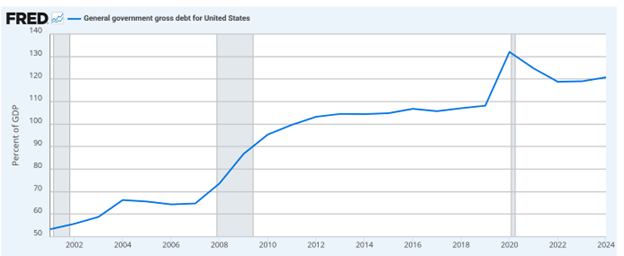
I will turn to more historical data from the ever-reliable FRED to show you that – once again – it’s complicated. Below is FRED’s tracking of the history of general government debt in the USA as a percent of GDP.

It has surely skyrocketed since 2002, but here is the thing. This is debt by governments at all levels, including the US States. I could also show you a graph of just the Federal US government debt-to-GDP ratio, but it would not look much different from the above. A bit higher, but a tiny bit higher in recent years, because US States don’t borrow much. Indeed, many of them have ‘balanced budget clauses’ in their state constitutions that prevent them from running deficits.

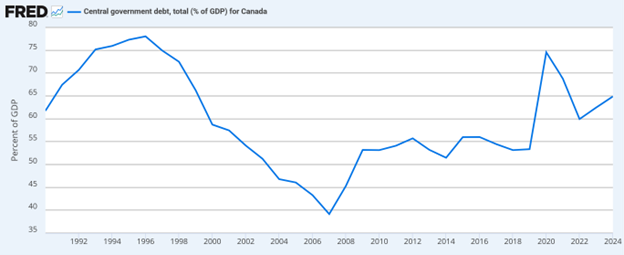
Now let’s have a look at Canada. Below is FRED’s historical data on the borrowing by Canada’s central (i.e., federal) government as a percentage of GDP.

Notice that in 2024 it was around 65% of GDP, not the over-100% we saw in the graphic above. That is because that graphic above is for the total debt of all levels of government. Canada’s provinces, unlike US states, are big borrowers. According to the Fraser Institute, a generally reliable bunch of mostly-economists (I know, I know) the federal government held just over 60% of total government debt in Canada and the provinces just under 40%.

Here is an interesting twist on this. Ok, interesting to me.

If there is a reason to worry about growing government debt, one is that the need to service that debt – that is, to pay the interest on it – begins to override other government spending possibilities. People like to say that governments are not like households but actually, they very much are. If a household borrows too much, eventually its interest payments chew up its income to the point that it cannot afford to spend on, you know, food and shelter. Government is the same. To illustrate the point, here’s a nice cogent line from an article in the National Post from last August:

In 2024/25, the federal government alone spent a record $53.8B on debt interest — more than the $52.1B it paid to the Canada Health Transfer.

As the ‘alone’ in that sentence suggests, the provinces were making significant debt service payments, too.

Now, if that debt service gets too big, and this has happened to governments from time to time in history, what can be done? The Feds have two options. One, default, and two, print money. Not with a printing press, but the Bank of Canada can certainly create more. This second approach is known as ‘inflating the debt away’, or ‘monetizing the debt’. The Provinces have only the one option, as they have no Bank of Ontario, etc, which is in control of the money supply.

Oh, and another often-heard bit of silliness is ‘government debt doesn’t matter because we owe it to ourselves.’

First of all, Canadian government debt is held by all kinds of people and orgs, many of which are not Canadian. You can be sure it matters to them if Canada’s government(s) take the first option and default on their debt. More to the point, if I lend money to my brother, and he decides not to pay it back, in what sense does that ‘not matter’? I was expecting my $20 back, and if I do not get it, it matters, even if it was my brother who bailed on the loan. You probably have Canadian treasury bonds in your pension fund. Would it not matter to you if Canada’s government decided to default on those?

A Summary – sortof…..

I started this out with an investigation of Canadian household debt, and the one clear finding from that is that Canada’s households do seem to be carrying world-class levels of debt, and they got there over the last 20years, while other countries’ households were contracting theirs. Why the difference? Right now, I dunno, but the possibility that this is mostly driven by Canada’s crappy GDP growth cannot be discounted.

Canada’s various governments also hold world-class levels of debt, but what is unique here is that so much of it is the responsibility of provincial governments. One might wonder – if, say, Ontario’s government got to the point of having trouble servicing its debt, what, if anything, would the Feds do to help them out? Again, I dunno, but I am confident that no one else does, either.


Doing the Reciprocity Shuffle

The things you can learn by reading a book. I have been working my way through The Penguin History of Canada lately. It has been on my bookshelf for ages, and I have no memory of how or from where I got it. It was published in 2006, so it ends with the first Harper minority Conservative government, but starts waaay back with what is known about the first humans to inhabit the current territory of Canada.

It is not a great book by any stretch, and rather condensed, covering hundreds of years of recorded history in just over 500 pages. Still, one can learn things from such a book, and one thing I recently came across that was illuminating was a discussion of The Canadian–American Reciprocity Treaty of 1854, also known as the Elgin-Marcy Treaty.

Now, despite that name, this was legally a treaty between the US and Great Britain, as Canada was not yet a country in 1854. The chief negotiators were James Bruce, the 8th Lord of Elgin for Great Britain, and William L Marcy, Secretary of State for the US, and it did concern trade between the US and what would later become Canada.

Britain’s North American colonies had up to 1846 done most of their trading with the mother country. Britain in those years had high tariffs on most imports, including those of food and timber, due to what were known as The Corn Laws. The Colonies were given ‘Imperial Preference’ in England, however, and so escaped the tariffs that the Brits imposed on, say, wheat imported from the US. However, in 1846, seized by a fit of ‘Free Trade-itis’, Britain axed the Corn Laws, which meant US grain and other products could be imported free of tariffs, also. This put a big dent in the amount of staples of all kinds that Britain imported from Newfoundland, the prairies, and Upper and Lower Canada.

This gave the merchant and agricultural interests in those colonies the idea to see if they could get access to the US market for their products, which was in those days also protected by pretty high import tariffs. The remarkable thing was that it worked. An agreement was reached, and listed most colonial raw materials and agricultural produce, most importantly timber and wheat, as goods to be admitted duty-free to the US. The treaty ended the US 21% tariff on natural resource imports, at least those from north of the US border.

In exchange, the Americans were given fishing rights off the East Coast. The treaty also granted navigation rights to each other’s lakes and rivers.

In those days, the treaty was championed by the Democrats in the US, but the Republicans, the party of business, opposed it. It should be said also that at this point the Democratic party in the US was the pro-slavery party, while the Republicans would soon nominate Abe Lincoln, the Great Emancipator (as some call him) for US President, marking the start of the Civil War.

I have read a claim, hard to substantiate, that this was one of only three trade treaties signed and ratified (by the Senate, as must all treaties be) by the USA in all the years between 1789 and 1931. That’s a long time.

The general consensus seems to be, as far as I can tell, that this treaty didn’t have much effect on the already-larger US economy, but it did do a lot for colonial exports. They grew by some 33% in ten years, while the US exports north grew by only 7%.

Part of this was due to the fact that when the US Civil War broke out in 1861, the British colonies did a nice business in keeping the northern states of the US supplied with agricultural and raw materials. It is often said that war is good for business, if not for human beings. That being noted, it should also be pointed out by your former-economist correspondent that it is quite difficult to determine how much of that increase in exports to the US can really be attributed to the treaty. There was a lot going on, on both sides of the border in those years.

However, nothing is either all-good or all-bad. The treaty reduced tariff revenues to both the British colonial governments and the US federal government, in an age when tariffs were the primary source of tax revenue for both. Further, the increase in north-south trade reduced east-west trade in Canada to some extent, which reduced the profitability of the recently built canals in the future Canada.

The treaty was set to have a ten-year term, after which it could be abandoned by either side with one year’s notice. In fact, the treaty was abrogated by the US in 1866, a year after the end of the Civil War, and a year before Confederation. I can find nothing coherent regarding why that happened, although it was certainly the case that the Republican Party was the party in power in the US at that point, still.

Whatever the reasons, one source I consulted suggested the abrogation in 1866 did not have all that much effect on British North America. Here’s an extensive quote from one retrospective study in The Journal of Economic History from 1968:

Trade with the United States briefly declined from the stockpiling peak of 1865 but by 1870 was as high as ever. Among the British North American colonies trade expanded rapidly, with exports from [Upper and Lower] Canada to the Maritimes rising from $935,000 in 1863 and $1,571,116 in 1865-1866 to $3,418,000 in 1866-1867. Exports to Britain doubled from 1867 to 1874, and Dominion revenues reflected this prosperity, also doubling over this period. Customs revenues increased by $5 million to $14 million and tax returns increased 60 percent.

Hey, maybe there’s a lesson here. Trade deals with the US might not be the most important thing for Canadian prosperity. Really.

Notably, after Confederation both the US and the new country of Canada put up significant trade barriers. A second reciprocity treaty was negotiated between the US and Canada in 1911, over 40 years later, between Sir Wilfred Laurier’s Liberal government and the US administration of William Howard Taft. Ah, but then…..politics – Canadian politics.

The Conservatives made reciprocity the central issue of the 1911 Canadian Parliamentary election, warning that this new reciprocity treaty would turn the economy over to American control. The Liberals were decisively defeated in that election, and Robert Borden’s new Conservative government refused to sign the treaty.

Ya just never know, eh?


The Great Alabama/Canada Battle: Round 1

I haven’t written anything geeky in a while, and this article was prompted by a non-geeky article in the Friday Globe titled

How Canada became poorer than Alabama

That sounds just wrong, doesn’t it? I mean, the very idea that Canada is ‘poorer’ than Alabama.

So, let me get the easy part out of the way first. What the article means by that ‘poorer’ adjective comes from comparing the GDP per capita of Alabama to that of Canada. To quote from the article itself:

After adjusting for foreign exchange and some cost differences in both countries, the average for Canada’s 10 provinces was estimated at US$55,000 in 2022, the same as Alabama. Shortly after, the IMF found Canada had actually fallen behind the southern state.

If you click on the link in that quote above, it will take you to an article in The Hub, about these numbers.

The Globe article in itself is said to be an ‘In Depth’ one. It’s quite long, and the writer actually went to Huntsville, Alabama, so you know they put some resources into this.

What I want to do here is just suggest a couple of better ways to compare the typical economic situation of someone in Alabama to someone in Canada (which is, by the way, muuuuch bigger and more diverse in climate and geography than Alabama).

Yes, economic prospects are not the only thing that matters to people, but let us just focus on those for this discussion.

First, what is this GDP/cap number anyway? The article says this:

To measure this, they calculated gross domestic product (GDP) per capita. In simple terms, it’s the size of the Canadian economy in a given year divided by the population. The same was done for Alabama.

Ah, jeez. Typical G&M. That’s not ‘in simple terms’, it’s confusing. ‘size’? How does one measure the ‘size’ of an economy? Is that in square inches or square kilometres?

So….GDP is a calculation of the dollar value of everything produced in a country (or state) in one year. Then you divide that dollar amount by the population. So, it gives you the dollar amount produced per person.

Is a comparison of those numbers for Canada and Alabama a useful thing to do to determine which place is ‘poorer’?

It’s not useless, but there are certainly issues.

If some company produces $1million worth of stuff in a year and sells it, then that money is used to pay out profits to shareholders and wages to workers and to pay suppliers, who in turn use that money to pay their shareholders and workers. Fine, but – even if the company is in Alabama, some of those shareholders are almost certainly not in Alabama. Same with the suppliers. So, $1million in sales by an Alabama company does not necessarily translate into $1million of income to Alabamans.

Presumably, if you want to do a ‘poorness’ comparison, you want to compare incomes in the two places, and GDP doesn’t quite do that. GDP tells you how much income is being generated per Alabaman, but not how much is being earned. If you are deciding where you would rather live (unlikely, I know) it is what you might earn that matters to you.

But, stats are available on incomes in these places, too. However, I am going to here suggest that we do not really want to compare income per capita (that is, average income) in the two places. Average income in two places can be the same yet it might be very differently spread around. To ease that problem a bit, I suggest we try to find out how median incomes compare in the two places. The median income for a jurisdiction is the income such that half the income earners earn more than that, and half earn less. Thus, it gives you some information about how incomes are distributed to all individuals. Not a lot, to be sure, for that you want to see the entire income distribution for Alabama or Canada, but that is complex to compare. We’re trying to keep things fairly simple here. [I’ve put in an example at the end of this post for those not familiar already with median vs average.]

Comparing earned incomes has its own issues. Like with GDP, you have to adjust for the exchange rates, but beyond that, income data is typically gathered in a number of different ways. Income per earner and income per household are the two biggies, with the latter including all the incomes earned by anyone in a household. Ya gotta compare apples to apples to learn anything.

So, I went looking, and as usual, finding what I wanted for Alabama was easy, as it is in the US, and that country is full of orgs that work hard at compiling and displaying such data. Canada is always tougher.

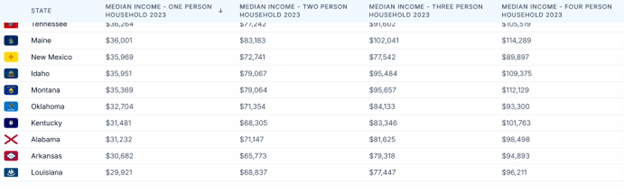
Below, first, is data I took from a site called World Population Review, which says the original data comes from the Current Population Survey, which is administered by the US Census Bureau. Below I only present the data for a selection of US states that includes Alabama. As you can see, they give different numbers for different size households. In 2023, for a two-person household they say the median income is $71,147.

Median income in US states, selection, 2023

In Canada, StatsCan does not gather or display the data in the same way. This makes comparisons tricky. Canada uses the concept of ‘economic family’, which includes singles living alone as well as households of various sizes. They do say the following –

According to StatsCan: Median market income for Canadian families and unattached individuals was $68,700 in 2023, a 1.5% increase from $67,700 in 2022.

Of course, that is in $C, and so the 68.7k is notably less than the $US71k for Alabama, for a household of two people, which seems to be as close as we can get to the Canadian ‘family’ concept. Ideally, one wants to use a ‘purchasing power parity’ exchange rate to ‘accurately’ compare these numbers, but I am not going to go there. I think what I show below is more revealing.

A factor which the G&M article mentions in passing is history. Whatever might be the exact comparison between Canada and Alabama right now, what do these two places histories’ look like, and how do they compare?

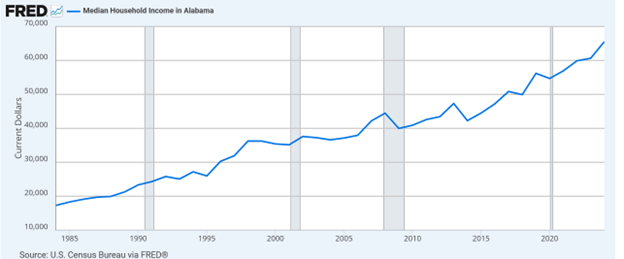
I did some more digging, and below is a graph from the always reliable St Louis Federal Reserve:

This depicts the median household income in Alabama from 1985 to 2024 in constant 2025 dollars, meaning with inflation taken out. It is a notable path, starting at around $17k way back when, and hitting $65,560 in 2024.

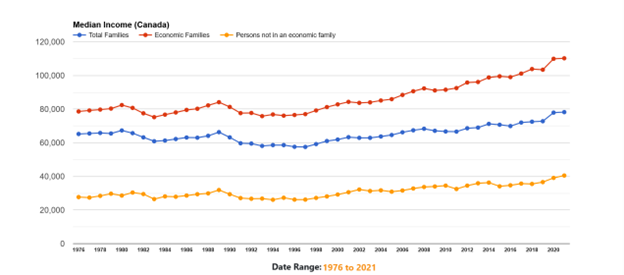
Here is a roughly comparable graph for Canada as a whole: (this is in constant dollars, but I can’t tell which year)

The graph we want to look at is the blue one, which is for all families, since the FRED data is for ‘households’. The time frame is a bit different, starting back in 1976 and ending in 2021, again in constant dollars. The median in 1976 was $65,200 and in 2021 it hit $78,200. Once again we have a currency rate to consider, but let’s just ignore that, and ask ourselves the following – in their own currencies, with inflation factored out of both, how have median incomes changed over this time in Alabama and Canada?

A quick use of the calculator (yes, I still have one) tells us that the real median income in Alabama increased by some 280% over 40years, whereas in Canada it increased by some 20% over 45 years.

Now, it is a matter of arithmetic that it is easier to get big percentage increases in something when you start from a low number, as is true for Alabama. Still, that comparison is so one-sided that, independent of exchange rates and all the other things that happened over that long time horizon, it does answer one of the questions in the G$M article; what happened? On purely economic grounds the economic case for moving from Canada to Alabama in, say, 1980, would have been hard to make. In 2025, it’s a very close call. What happened is that Canada chugged along in a perfectly acceptable fashion, while Alabama just took off.

Now, the hard question, as always, is why did that happen? That it did is hard to argue against.

Appendix: Mean vs Median

Imagine a very small place with 5 people in it, all earning income. The four poorest folks earn annual incomes of $10k, $15k,$25 and $30k per year. The one rich guy earns $100k per year. So, total income earned is $180k/year, and the average, or mean annual income is $36k.

However, the median annual income is only $25k/year.

And, more importantly, if the rich guy’s income doubled to $200k/year while everyone else’s stayed the same, the mean income would go up to $56k/year (280/5) whereas the median income would stay at $25k.


Who Has the Tickets?

It has been a long time since I attended a big-time event for which tickets were sold by Ticketmaster. I go to hear a lot of live music, but these days that is always at a smallish local venue that either collects a fee at the door or uses its own devices to sell tickets.

The local Junior A hockey team, the Knights, play in an arena that is full to its 9,000+ seat capacity for every game, and if you want to try and get one of those seats, you are sent to a Ticketmaster site. I did that today just for fun and it indicated it had 14 seats available for today’s later game, out of those 9,000+. Prices were $56 each, plus a $5 fee.

I used to go hear the Toronto Symphony Orchestra quite frequently back in the day, so I also checked out some of their ticket prices. TSO has its own ticket sales site, and a ticket to hear Stravinsky’s Firebird and Brahms’ Piano Concerto #1 will run you just under $150 for a decent seat, plus an $8 service charge. This notion of adding a ‘service’ charge is also a regular feature of event ticket sales. It is curious, no? Can you imagine being charged a $15 fee when you buy your next microwave oven? Or a pair of jeans?

Anyway, this article is prompted by, and largely based on, of all things, a Powerpoint presentation I ran into on the web, put together by one Eric Budish, an Econ Prof at the U of Chicago’s Booth School of Business. He notes on the first page of the presentation that he bought his first scalped ticket in 1986 to see a New York Mets baseball game.

Ticket-scalping, which economists refer to as ‘secondary market sales’, and what to do about it, is the topic of his PP presentation.

Budish starts his slides with a story about a lecture given in Boston in 1867 by one Charles Dickens. Folks stood in line to buy tickets, and a limit of 12/buyer was imposed, to prevent ‘ticket speculating’. None the less, scalpers were soon selling tickets for up to $20 each, according to a story in The Boston Journal.

Scalping is an old phenomenon, is the point, but the second point he makes is that this ‘secondary market’ really went crazy once ticket sales moved to the internet. His talk is ultimately aimed at making some proposals for getting the event-ticket market to work better for fans and artists.

Before I get to that, it will be useful to go back over how things worked pre-internet, and what economics had and has to say about it.

When folks stood in line to get tickets for events, or made phone calls, some of those buyers were indeed speculators, who bought the tix with the intent of re-selling them at a profit. This was indeed speculation, since if the event was not all that popular, profitable resale would not be possible. You can’t re-sell tickets at a profit if there are plenty available at the original face value. However, what seemed to happen was that re-sale was always profitable for most well-known artists. Why? Economists saw this as in indication that the artists and their managers intentionally under-priced concert tickets. If it can always be anticipated by the scalpers that tickets can be re-sold at higher prices, why did the artists not set prices higher at the box office? Why let the ticket speculators make all that money, when higher face values would mean more money to the artists (and the venues)?

The typical explanation for this (from economists) was that the artists did not want to alienate their fans by extracting the highest prices possible from them. If a fan paid a high price to a scalper, that fan understood it was not their favourite artist who was profiting, hence no bad feelings.

Another possible explanation was the idea that the ‘best’ fans to have at the event, the ones who would cheer and dance the most, were not the ones who could afford high prices. (People who attend Toronto Maple Leaf hockey games tell me there is much to this. Leafs tickets are very expensive, and most fans are corporate types who sit on their hands. I have no personal recent experience of this.)

Anyway, the idea here in the pre-internet era was that this ‘under-pricing’ was in the long term interests of the artists and maybe even the venues.

Then ticket sales moved almost wholly to the internet for artists of any stature, and this introduced an old concept that was new to this old market, which changed things hugely: economies of scale. Now it was possible for a single operator to buy tickets for events all over the world and re-sell them. And it therefore paid such operators to invest in ‘bots’ and low-wage overseas workers to ‘get to the front of the electronic line’ and to defeat any safeguards put in place to limit sales to any one buyer.

Budish supplies a number of stories of how this changed things.

– Hannah Montana tour tickets in 2007 selling out in minutes, and dads paying $3,000 so their pre-teen daughters could attend a show.

– In 2018 tickets for an Ed Sheeran show sold out in 5 minutes, but here is the kicker – his management admitted they themselves sold tickets directly to re-sellers.

– Tickets for a three-day run of Grateful Dead ‘Farewell Tour’ shows in Chicago were offered for sale for $114,000 each on Stubhub.

– Lin-Manuel Miranda wrote an op-ed in the New York Times in 2016 titled ‘Stop the Bots from Killing Broadway’. By this point Ticketmaster had put anti-bot safeguards on its ticket site, but claimed that none the less a ‘bot army’ bought 30,000 tickets to performances of Hamilton.

As Budish says, the ‘secondary market’ had pretty much become the true market, with Ticketmaster saying that 20% of all tickets used by fans were bought on the secondary market, with the percentage hitting 90 for some events.

Things are now at the point where most of the money is being made by the organized re-sellers, like Stubhub, Seatgeek and Ticketmaster’s own secondary-market platform. There is an estimate (the slide does not specify which year) that some $15Billion in tickets sales happened on the secondary market, with Stubhub getting nearly $5B of that and Ticketmaster another $2B.

So – what to do? Budish has some ideas.

One, outlaw fees. If the fee must be paid no matter what the buyer does, then it is part of the price, and so must be stated that way. No adding fees when one gets to the point of giving credit card info.

That one is easy, and is not really related to the secondary market issue. The London Knights and Toronto Symphony sites I looked at both told me there would be a ‘service fee’. What I do not know, because I didn’t actually buy, is whether any other fees would have appeared when I got to the point of paying for the tix.

To shrink the secondary market, Budish proposes a technological fix. It is possible now to restrict re-sale of tickets by making them wholly electronic. If you buy a ticket to an event, it is downloaded to your online device (typically a smartphone) in a way that it cannot be transferred to someone else’s device. Sellers pair this with a limit to how many seats can be downloaded to any one device, and this (it is assumed) kills the resale market.

The curious part of his presentation is that he seems to think that with this technology in place, artists will naturally choose one of two scenarios.

One, they will restrict re-sale as just described, and set low box-office prices so their ‘true’ fans can afford tickets and come to the shows.

Two, they will not restrict re-sale and will set high ‘market-clearing’ box-office prices.

I do not understand why an artist who wants to set high box-office prices would not also employ the no-resale technology. When an artist and their management decide on concert prices, they can always get it wrong in either of two ways.

A, they set prices too high in the sense that tickets sit at the box-office unsold. An artist/maager who sees this happening as the date of the concert approaches can, I presume, lower prices for the remaining seats to try and sell them. This might piss off those fans who bought earlier, if they find out.

B, they set prices too low, and tickets go fast and end up on some re-sale market. Well, if artists really don’t want that to happen, then why not use the no-resale tech anyway? If you set prices too high it won’t matter, but if you set them too low it keeps money out of the hands of the scalpers.

It also seems to me that Budish assumes that artists don’t want to help ticket scalpers make money. Lin-Miranda’s op-ed suggests that may be true for him, but it is less than obvious to me that feeling is universal.

As noted above, in the pre-internet era, artists set low prices, (small-time) scalpers made money re-selling tickets, and the artists seemed mostly fine with that because they didn’t get blamed for the high prices.

It is clear that with the no-resale tech in place, the artists can set ‘low’ box-office prices without helping scalpers get rich. This is already how airlines sell their tickets pretty much. Pre-internet, airlines did this by requiring the ticket buyer to provide a full name that was included on the printed ticket. Airlines required you show a passport with a matching name when you boarded.

I just don’t see why artists who want to set high prices – whatever that means – won’t also put the no-resale tech in place.

However, another part of what Budish at least thinks about is how artists who want to set ‘high’ box-office prices might do that, and one option he considers is that they hold an auction. Or, more likely, some outfit like Ticketmaster would do it for them. You would go online to some site where you could bid the amount you were willing to pay for four Taylor Swift tix, for example. This should defeat the re-sellers, since in an auction the only way to insure getting lots of tix is to be willing to pay a lot, which pretty much kills any hope of profitable re-sale. Economists have done a lot of theoretical and practical work on auctions since I joined the profession in the 80s, and there is a consensus that auctions work much better than they used to because of their contributions. However, so far as I know, ‘work better’ mostly means auctions today generate a lot more revenue for the seller than they used to. I’m not sure that doing that for concert tickets will feel like an improvement, but Budish is an economist, so I expect he is in favour. And, it would mean that all that extra revenue would go to the artists and venues, rather than re-sellers. I suppose that is preferable.

Anyway, an artist that sells concert tix via an auction will have pretty much killed off any hope of a secondary market operating at even higher prices. Thus, they will indeed have no reason to also adopt the no-resale tech for their tix, so far as I can see. That would mean that someone who got a ticket in an auction but then had to miss the show, say due to illness, could re-sell the tix for something, at least.

One added note on the ‘hidden fees’ part of this. My strong intuition is that this is a pure internet phenomenon. A clothing retailer could certainly add a $5 ‘processing fee’ when you go to the cashier to pay for your new shirt or slacks. They do not do so only because they do not want their sales  personnel to face the customer’s anger when that happens. When paying for something on an internet platform, there is no one to feel your anger; you just pay it or cancel the transaction, and since it’s ‘only’ $10 almost everyone pays it.

That being said, there are exceptions. It’s been a while since I bought a new car, but I do recall that once you sat down with the ‘Sales Manager’ to sign the papers, all sorts of things could appear. ‘Destination charge’ rings a bell,, as does ‘Dealer Prep’. So perhaps part of it is that the amount of the extra charge be ‘small’ relative to the price you are already paying. Small enough that you don’t walk away.

Back to Budish’s techie solution to the secondary market taking over ticket sales, I absolutely hate it for the obvious (to me) reason that it makes us even more prisoners of online-enabled devices. (It also assumes that the same geniuses who figured out how to employ ‘bot armies’ won’t also figure out ways to defeat it. There are billions of $ to be made from doing so, apparently.) And, there is nothing on earth that would induce me to participate in an auction to get tickets to any concert by any artist. There’s lots of great music to be heard here at The Richmond Tavern, and all I have to do is drink a couple of beers and drop a 20 in the jug when it comes around.

I will never attend a Taylor Swift (or Rolling Stones) concert, but might one day again want to hear the TSO play. My refusal to own a smartphone or participate in an online auction will perhaps make that impossible.

So, from a personal point of view, the ban on ‘charges’ aside, I am not convinced Budish’s ideas will make the ticket market better. Bad in a different way, perhaps.

But, hang in there, folks, if they have their way, grocery and other retail stores will soon be doing ‘surge’ pricing, and ‘personalized’ pricing and all sorts of cool things that will really piss us off – and we will be powerless to avoid. It’s all about extracting the maximum Benjamins from us, as the internet enshittification of life continues.


Unexpected Cross-Border Grinchiness

I came across a short article in the Globe today which in turn sent me to a recent report by Canada’s Fraser Institute (it’s full of economists) that said this:

The percentage of tax-filers in Canada who gave something to charity declined from 21.9% in 2013 to 16.8% in 2023.

It also finds that:

The percentage of aggregate income given to charity in Canada has ranged between 0.52% and 0.55% over that same 10-year span.

So, giving as a percentage of income has been pretty stable, but it has been a decreasing percentage of filers who have donated, implying that those who still do donate are giving more than they did in the past.

Another surprising aspect of that first statistic is that the percentage who do donate has been declining very steadily over that period, with no blips up or down, not even during the pandemic year of 2020. (I cannot reproduce the graphs from the report here, but you can read it yourself here and check out their graphs for yourself). There has been a steady downward trend in the percentage of donors.

Now the writer of the Globe article suggests that one thing that is going on here is that some Canadians have switched their giving from charities to crowdfunding campaigns over time. The Fraser report says nothing about that, and I am very dubious about that explanation. Show me some numbers, man – do we know how much has been going to crowdfunding campaigns over time, and do they typically fund things that could be seen as substitutes for what charities do? I doubt it.

Well, not surprisingly, this made me curious about the trend in other places, so naturally I went to find numbers on the US. I will first say that Americans have forever given more to charities than Canadians by any measure. But it is the US that is the outlier here, the US is so far as I know the most philanthropic society on planet earth.

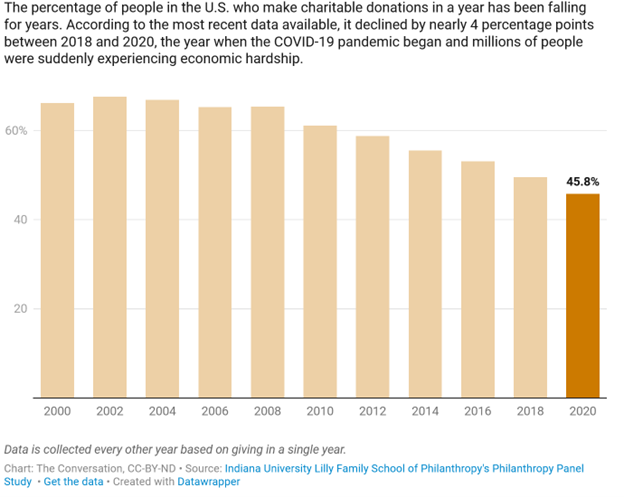
Still, one can wonder what is the trend in the US, and I did find some info. As you can see, the data for the  chart below came from the Indiana University School of Philanthropy, an organization that was kind enough to fund a sabbatical I spent in Indianapolis a hundred or so years ago.

So, let’s consider carefully a comparison of this with the Canadian numbers. First, it is on a different time frame, starting in 2000, with the data being collected every two years only. Second, as I expected, the percentage who give to charity is waaaay higher than in Canada, but that fact needs to be treated with care. The Canadian numbers come directly from income tax records (anonymized, of course) and so are quite accurate. People who give get a deduction, you don’t want to fake donations you didn’t actually give on your tax form, and even if you give $10 you can declare it if you got a receipt.

Things are much different in the US tax system. To get any charitable deduction you must have enough total deductions to make it worthwhile to itemize them all. That is not true for most filers, so the percentage of tax filers who claim a charitable deduction would greatly understate the true percentage who donate. The numbers above – as noted under the graph – come from a survey the Center does. That is always dangerous to take literally, as if you ask people if they did something virtuous – like give to charity – they may say ‘yes’ even if they did not. So, the percentage of actual givers may be somewhat less than in that graph, but still – those percentages are waaaaay above the Canadian ones even if you discount them some.

That being said, note that the downward trend is the same, fewer Americans are donating to charity than in the past, also. hmmmm……

[One thing this suggests is that the title of the original Globe article ‘Canada has become a nation of charity grinches’ is perhaps unwarranted. Something international in scope is going on, perhaps.]

But wait – there’s more.

Below is a graph from the IU Center on the total value of giving to charity over the same period, adjusted for inflation.

Now, this is not quite the same as the Canadian graph of giving as a percentage of total income, but it tells the same story. The total value of donations is up slightly, even though the number of donors is down, implying that those who still give are giving more.

Hmmmmm…… again.

There is an easy story to explain this. Easy doesn’t mean ‘correct’ of course, but here it is –

If people at the top of the income distribution are seeing most of the gains in total income over the last 10 or 20 years, then this would suggest that they might give more, while those at the bottom of the pile give less. Those at the bottom of the pile would have been giving less than those at the top anyway, so this overall trend results in fewer givers but a pretty steady total amount given.

Sorting that out in detail would require more data-analysis.


No Limits

So I open up my morning copy of The London Free Press on Friday, and here is a story headline from one of the inside pages:

LHSC cutting mental health benefits to staff in ‘26

The story also appears in the online version of the paper, with a rather more striking headline:

Staff decry LHSC move to cut unlimited mental health benefits

“It’s really hard to feel like you’re being supported, and we are a No. 1 trauma centre,” an employee said.

As discussed often here, online newspapers are all about click-baiting, so the difference in the two headlines is not surprising. ‘Decrying’, indeed.

The facts of the story are that LHSC, the local provincial hospital corporation, has been paying for an unlimited amount of mental health benefits for its employees, and these will now be limited to a set amount of spending per year. The amount depends on the employee group, ranging from $400/year to (still) unlimited, the last being for those who are in a union that had the foresight to get the ‘unlimited’ benefits into a collective agreement.

Here’s a quote from the email to LHSC staff about this change, which the Freeps said it obtained:

“Since the voluntary introduction of unlimited mental health benefits in 2024, we have seen costs rise exponentially,” the email said, citing expenses exceeding $3.1 million in 2024 and estimated the figure would exceed $5 million in 2025.

And here is a quote from the Freeps article itself:

A non-unionized social worker affected by the cuts, who asked not to be identified, called the decision “a gut-punch.”

“I just can’t wrap my head around that. I just can’t feel comfortable knowing that we had this option and now it’s being taken away, and there’s no other alternatives being proposed,” they said, noting their unlimited mental health benefits as a non-unionized employee will be reduced to $1,500 a year.

Yes, it’s terrible for people to not feel comfortable.

What I actually find most striking about this is the apparent surprise voiced in the email from LHSC. They made something freely available with no limit and ‘we have seen costs rise exponentially’. Goodness, whoddathought that would happen?

Economists are as capable of being full of shit as any social scientists, but there are things people in my former profession say and believe that have unquestionably stood the test of time. One of them is – ‘If you give something valuable away for free, there will be no end to the demand for it’.

And in this case, one must add in the 21st century view that humans are so fragile that it is a wonder anyone can get through their day without a mental health professional helping them out. (I add that social workers like the one quoted above are in the vanguard of that view.)

As it happens the (more serious) The Free Press referenced an article in The Atlantic dated Dec 3 on what is essentially the same phenomenon, and one on which I have written in the past; the granting of special accommodations to university students with ‘disabilities’.

The Atlantic article TFP references is titled Accommodation Nation and is behind a paywall, but for some reason they let me read it for free – an early Christmas gift, perhaps.

Anyway, here is a key quote from the article:

The surge itself is undeniable. Soon, some schools may have more students receiving accommodations than not, a scenario that would have seemed absurd just a decade ago. Already, at one law school, 45 percent of students receive academic accommodations. Paul Graham Fisher, a Stanford professor who served as co-chair of the university’s disability task force, told me, “I have had conversations with people in the Stanford administration. They’ve talked about at what point can we say no? What if it hits 50 or 60 percent? At what point do you just say ‘We can’t do this’?” This year, 38 percent of Stanford undergraduates are registered as having a disability; in the fall quarter, 24 percent of undergraduates were receiving academic or housing accommodations.

I predict they will not be able to say no at any percentage, and the reason I say that is contained in this other quote from the article:

Tarconish sees the growing number of students receiving accommodations as evidence that the system is working. Ella Callow, the assistant vice chancellor of disability rights at Berkeley, had a similar perspective. “I don’t think of it as a downside, no matter how many students with disabilities show up,” she told me. “Disabled people still are deeply underemployed in this country and too often live in poverty. The key to addressing that is in large part through institutions like Berkeley that make it part of our mission to lift people into security.” (One-third of the students registered with Berkeley’s disability office are from low-income families.)

Yes indeed. Only their accommodations are preventing that 38% of Stanford students from ending up underemployed and in poverty.

A monster has been created, and it is feeding an entire bureaucracy of people with titles like ‘assistant vice chancellor of disability rights’, whose livelihood is based on the existence of disabled people. If Stanford or any other U (including my former employer) were to try to pull back on the granting of special accommodations to students, the ‘activists and advocates’ will pour into the streets (and classrooms) and onto social media until the LBOs cry uncle. And they always cry uncle in response to such pressure. This we have seen many times.

This is the part of giving things away that economists have missed. In the 21st century governments giving things away generally creates a class of people (those advocates and activists – and bureaucrats) who have a vested interest in said things remaining free. This, coupled with that ‘gut-punch’ feeling of people who were getting the free stuff, makes stopping the give-away a political grenade.

As a parting shot, the Atlantic article also points out that it is the already-privileged who benefit from this disability industry. Another quote:

As more elite students get accommodations, the system worsens the problem it was designed to solve. The ADA was supposed to make college more equitable. Instead, accommodations have become another way for the most privileged students to press their advantage.

(You can also be sure that ‘assistant vice-chancellor for disability rights’ is making well into six figures, btw.) Along those same lines, people who work for LHSC are also mostly well up in the salary distribution. No one there is working for minimum wage, you can be sure, and few employees of any organization get unlimited anything. Indeed, I betcha London’s cops and firefighters don’t get unlimited mental health benefits.

One more (impending) example of this general phenomenon came across my desk the same week. The headline at the very top of the first page of my (on paper) London Freeps Friday morning was this:

Micro-shelter plan takes shape

Our brilliant city leaders have hatched a plan to ‘bring 60 micro-shelters for London’s homeless to a southeast farm field’.

I here predict that this will go one of two ways.

One, it will turn out, to our city leaders’ surprise, that no homeless person will go willingly to live waaay down in south London, miles from everything. Then the city will be faced with either writing off the whole thing as a bad idea, or forcing people to live there in order to receive other things. (The advocates and activists will hate that second option. Count on a human rights case.)

Or, two, if they do find people willing to live in them, it will turn out that no matter how many of these the city builds, no matter where they build them, and no matter how much they spend on providing free accommodation to homeless people, it will not be enough. The activists and advocates will be explaining in the Free Press forever that the City ‘needs to do more’.

[I’m betting on option one. A photo of the site for these shelters, taken from the Freeps, is below. It’s just off Cheese Factory Road. Really.]

Now, one might say in this instance – ‘But Al, clearly this does not benefit the well-off, this spending is clearly of benefit to the truly desperate among us’.

I will cite another quote from the Freeps article:

It was also revealed Wednesday that the site will be operated by Xpera, a national emergency management and security firm, which has a office in London.

In an interview with The Free Press, [London Mayor] Morgan cited the firm’s experience in crisis response, logistics, security, first aid and de-escalation training.

“So, a well trained professional firm which has a lot of experience doing this, a lot of experience with site management, site security, and they are the successful proponent and will be operating the site,” he said.

The article does not mention how or how much Xpera will be paid, or how many employees of theirs will be involved. It does say this:

The early estimate to set up and operate the site until April 2027 is $7 million, funded from a city reserve fund. The latest report outlines the shelters cost $1.2 million before HST, and the city will enlist J-AAR excavating firm to construct the site at a cost of around $725,000.

I got $100 in my pocket that says that ‘early estimate’ comes up waaaay low. Anyone want to take the other side of that bet?


Why, Indeed?

‘It’s all about the Benjamins, man.’

That’s a line from a pretty old movie, I think, but damned if I can remember which one.

Anyway –

This morning’s WSJ had an opinion piece in it titled ‘Why CEOs Get Paid So Much’, with the sub-headline – ‘Doug McMillon’s success at Walmart shows the value of corporate leadership’.

It’s not a long piece, and the gist of it is easy to lay out. McMillon took over as CEO of Walmart in 2014, and is about to step down and retire. In that time, according to the article:

“Walmart’s annual revenue has grown on his watch from nearly $486 billion to $681 billion in its latest fiscal year. Walmart’s shares have risen some 310% in his tenure, while the company has increased wages and benefits for Walmart’s 2.1 million employees.”

Now, as a number of the WSJ readers who commented on this piece point out, the fact that one CEO of one company did well (assuming that those numbers indeed imply ‘doing well’, as no comparisons with other retailers are offered) does not constitute an answer to the question that is implicit in the article’s title.

One commenter on the piece also made the very astute observation that McMillon’s actual compensation is never stated in the article. Sources tell me it was $US27million last year.

So, the implicit claim the article is making is that, given how well Walmart did during his term, McMillon’s pay package was perfectly reasonable. In a phrase, he was worth it. Again, hardly a proof that CEO pay is reasonable in general; I do expect better arguments from the WSJ.

However, I write mostly to say that this whole discussion goes against the way (most) economists think about pay. The only answer economics can give to the question ‘What is that employee worth?’ is the same as they give to the question ‘What is my house worth?’. It is worth whatever someone is willing to pay for it.

That is not a normative, or ethical, claim. Rather, it follows from the belief that there simply does not exist any notion of objective, intrinsic value for, well, anything. ‘One man’s trash is another man’s treasure.’ I am well aware that this attitude flies in the face of much common sense and/or talk about such things, including often my own. I, too, wonder how Vlad Guerrero Jr’s prowess in baseball (much as I love watching him play) can possibly be ‘worth’ paying him a half billion (big US) dollars over the life of his contract.

A friend of mine pointed out during the World Series that, based on the claimed average price the Jays were getting per seat during the WS, they were raking in close to $100million per game, thus going a long way toward paying for Vlad. But of course, Vlad did not get them to the WS on his own, and there are all the other costs the Jays had to pay and…..

To an economist, that is all beside the point. The Jays org agreed to that contract, therefore he is worth it – to them – and they are the ones paying him.

This attitude also runs against any number of progressive slogans about workplace justice, like, ‘Equal pay for work of equal value’.

The economist’s objection to that slogan is ‘how does one assess what work is of ‘equal value’. Well, lots of bureaucracies do try to do that, and one way it often shakes out is to insist that people with the same job title must be paid the same. Anyone who has spent more than five minutes in the world of work knows that not all people with the same job title (first baseman, assistant professor, millwright, on and on) are providing ‘equal value’ to their employer – or to their fellow employees.

On top of that, there is no way to assess what ‘value’ any particular employee has to his employer, as economists insist that it is all ‘team production’ and quite impossible to separate out the contributions of the different team members. That holds for CEO McMillon, too. However well or badly Walmart did over his term, there is no way to determine how much of that is due to him and how much to other team members, not to mention everything that happened outside the company over which he had zero control.

All of the above could be taken to imply that no matter what or how anyone is paid, in any company, there is no way to improve the situation. It should not. In particular, there are aspects of how CEOs (and others) are selected and paid that do bear scrutiny, imho.

First, there are some incentive structures that are often built into CEOs’ (and others’) pay that seem to me to be clearly counterproductive.

Economists think incentives matter, although they do not believe that only financial incentives matter. Consider the occupation of restaurant server. It is typical that they are tipped by the customers. (I know there are those who think tipping is an awful practice, but I am much in favour of it, a topic for another post). The idea is that if the server does a better job the tip gets bigger; that is certainly how I approach tipping. However, a restaurant is still a team operation, so the server can only do a good job if the bar staff and kitchen do their job well, too. So, in recognition of this, many restaurants require servers to turn over some proportion of their tips to be divided between the bar, kitchen and busboy staff. This isn’t perfect, but it is a recognition of the fact that it is a team effort, and that still, incentives matter.

[Aside on the non-financial incentives in the workplace. One of my university-era summer jobs was as a short-order cook on the breakfast and lunch shift in a diner along I-75. The servers did not tip out to me in those days, but they sure let me know if I was doing my bit to help them keep customers happy, both when I did well and when I did not. Those incentives matter too, the question is whether the employer can augment them in some way.]

Not all incentive structures seem productive to me, however. In Ontario labour law, if an employee is terminated by an employer whose payroll is greater than a stated minimum, they are entitled to severance pay, unless they ‘are guilty of wilful misconduct, disobedience or wilful neglect of duty that is not trivial and was not condoned by the employer’.

Fair enough. However, it seems that many CEOs hired by large companies (like Walmart, etc) have negotiated into their contract some kind of ‘golden parachute’ that pays them a large sum in the event the Board of Directors fires them. Now, if a Board fires a CEO, it is invariably because they are not happy about the company’s performance. So, why should said CEO then get paid some amount that dwarfs any statutory severance pay when they have just been fired?

The answer is almost always said to be that the company could not have hired said CEO in the first place without including such a parachute in their contract. In other words, the market standard is that such clauses are always offered to new CEOs, so the only thing to negotiate over is its size.

Sorry. It seems to me a winning strategy here is to say to a potential CEO ‘If you are confident of your ability to run this company, such a clause won’t matter to you, because we are going to build into your contract all kinds of good things that you will get if the company does well’. A CEO candidate who turns that down is maybe not the person you want to run your company.

I admit that this has come to mind in no small part because of my awareness that this golden parachute infection is spreading.

Two cases in point.

a) Our local city council recently entertained a resolution that city councillors who lost their re-election bids should be paid some amount (I forget how much) of severance pay. Jeezus, Mary and Yosef. As if not being re-elected is not the ultimate dismissal with cause. In the end the Council voted itself a 30% raise in salary (J,M & Y again!), but did not approve severance for themselves.

b) NCAA football coaches with big-time multi-hundred-million-dollar programs now routinely have such clauses in their contracts.

You can read the whole sorry story here, I will give you just the last three lines of it:

“This season, LSU leads the way with a $53 million buyout for firing Brian Kelly, followed by Penn State’s $49.7 million buyout of James Franklin. The largest buyout ever remains the $77 million Texas A&M agreed to pay Jimbo Fisher in 2023.”

Yes, those are the payouts given to those three fired football coaches by those three (try not to laugh) non-profit, state-supported institutions.

By the way, Texas A&M’s football team this year, two years after firing the coach who they could not possibly have hired without that $77M clause, has a 10-0 record and is ranked 3rd in the country. Wonder what the new coach’s buyout clause looks like?

Ok, I’m being a smart-ass here, but I have a real point: such clauses seem to me like an incentive to fail. CEOs and football coaches get a big payment if things go badly enough that the Board/Athletic Director fire them. I get why you would want such a clause if you are the CEO or coach, but not why it is agreed to by the other side(s).

My second concern is not about an incentive problem per se, but rather about something that has crept into hiring all kinds of high-level people.

To illustrate, here is another quote from the WSJ opinion piece regarding Mr. McMillon:

“He’s spent more than 40 years at the company, rising from a part-timer in a Bentonville, Ark., Walmart garden center to the C-suite.”

That, my friends is a rare thing, so far as I can tell. Very few CEOs of major companies these days actually worked at that company at all before becoming CEO, let alone for 40 years. They are mostly ‘headhunted’ by professionals who are paid by the hiring company to find and vet potential hires.

So, here’s an idea the WSJ article never considers: maybe the reason for Walmart’s success is that they had as CEO someone who knew the firm from the ground up over a career of 40 years.

Suppose you are such a CEO, and the Board decides you are not doing the job, the company is not thriving, so they fire you. Having worked there for many years, and being paid very handsomely as CEO, you would quite naturally be entitled to a considerable severance package in that case. Seems sane and fair to me.

Another observation based on my own career. It has become common practice to do the very same thing at universities in both Canada and the US, in the following sense.

The two highest level positions at a university are that of President and Provost. The former is the CEO, the guy at the top, and the latter is the person in charge of academics, which is, of course, what a U is supposed to be about. Both positions are always held by people who started out as professors, doing what I did for 42 years.

My former employer did not have a President who had risen from its own professorial ranks for the entire time I worked there. And, during my career, we had, so far as I can tell, exactly two Provosts who were appointed to that position from the institution’s own professoriate.

Early in my career, when I had been around long enough to be known outside of UWO, I would occasionally get correspondence from colleagues at other institutions saying they were looking for a new Chair/Dean/Whatever and asking me if there was anyone I knew who might be a suitable candidate. In later years, when I got such emails they were always from a headhunter firm.

So, we have universities that are run by people who neither know nor give a shit about the institution’s history, strengths and weaknesses. They are all on the ‘administrative career ladder’, not having done a regular professor’s job in perhaps twenty years. All the head-hunted Provosts are hoping to be appointed President somewhere else one day, and the Presidents are all hoping to be appointed President at some more prestigious university. They are all looking ahead, and not to the university’s future, but to their own.

Much that is wrong with today’s PSE institutions can be laid at the feet of that simple fact, and I cannot see that it is any different for profit-making companies. To deny it is to deny that knowledge of the institution you are running is important for running it well.

Whither Goest The Middle Class?

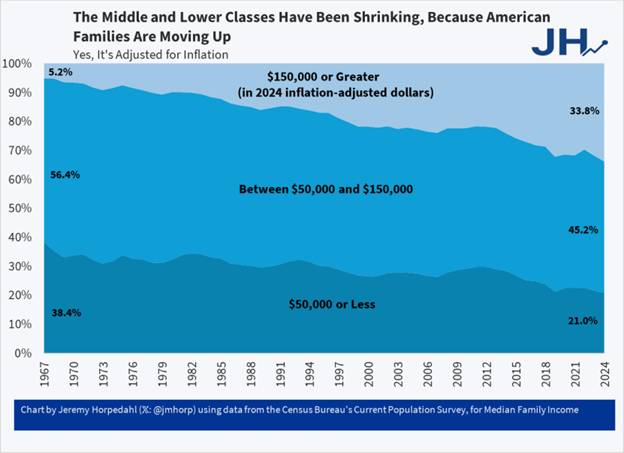
One can write only so much about a 34-year-old with zero experience, even if they are a mayor-elect, so let’s turn to something a bit more hard-nosed, some income statistics. The graph below is from the blog Marginal Revolution, written by economist Alex Tabarrok, but credit where due, I first came across it in an article from The Free Press.

Now, let’s be clear about what this shows. It is based on data from the US Census Bureau’s CPS, which has been about as reliable as large data sets get for a very long time. It shows the change in the proportion of families in the US that are in three different annual income ranges: below $50k, above $150k and in between those two annual incomes. Thus, note that all families have to be in one of these three ranges.

The key point here is that the percentage of families in the bottom two groups have decreased between 1967 and 2024, while the percentage in the top group has increased. Very importantly, this is all measured in constant 2024 dollars, so this is not the result of inflation, which has of course been considerable over that period.

Thus, we have the caption – American families have been moving up.

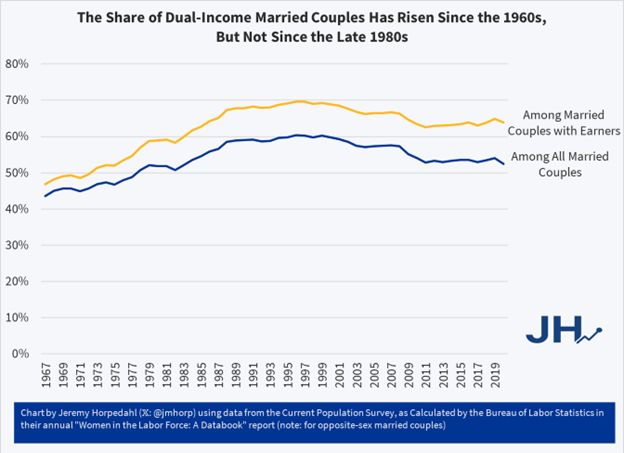
There are other questions to ask about this surprising (to me) graph, however. For example, since this is household (i.e., ‘family’) income, is all this just a reflection of the fact that more and more households have come to have two earners in them over this time frame?

Well, Tabarrok considers this, and his answer is ‘yes, but only partly’. He provides a link to another economist’s blog, where you can find the graph below:


What this shows is that the percentage of married couples with two income earners did rise from 1967 to the late 90s, but after that it actually dropped a bit. So, the increase in household income shown in the first graph can reasonably be the result of more two-earner households up to the 90s, but after that it is simply because earners, whether one or two, are earning more in real terms.

So, the bottom line seems to be, for the US, if the middle class is truly disappearing (meaning those families in the middle income group), it is because they are moving into the higher income group. And, of course, the lower income group is shrinking in proportion too, as those folks earn more.

This is a surprise to me, but I suppose only because we all read so often in the media how everyone is suffering these days. Also, I wonder very much whether anything like this is true in Canada. As always, data of this quality is much harder to find for Canada, but I will keep looking and report back if I find anything. For now, let’s just say that reports of the relative impoverishment of families in the US middle class seem to have been rather exaggerated….unless I am missing something here.

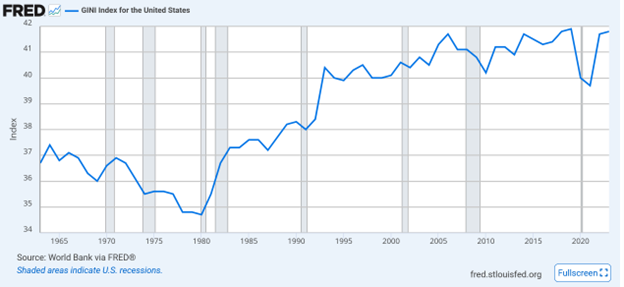
Before closing this off, I will mention one more thing. Below is another graphic covering almost the exact time period as those above. It comes from the US Fed, and it depicts the Gini coefficient for income in the US over this period. The Gini is a long-used index of how unequally is income distributed in any population. A higher Gini index indicates a more unequal distribution. This graph is a bit odd in that the Gini is typically given as a decimal number between 0 and 1, and here it is a whole number. If you just put a decimal point in front of the numbers on the vertical axis you get the usual thing.

So, it is clear that income is distributed more unequally today in the US than it was in the 60s, and that the big increase in this measure occurred between 1980 and 2005. Since then it has bounced around. However, note that the actual change has not been a lot over that period – it went from 0.36 to almost 0.42. Secondly, given what we saw in the first graphic, one could ask whether this trend is even worrying. That is, if almost everyone is seeing their income increase in real terms, does it matter that income is distributed somewhat more unequally? What I suspect is going on here is that for the group with incomes above $150k, incomes have been growing more than for those in the two lower income groups. That would increase the Gini as we have seen, but still be consistent with more families moving into that group.

A final point, about which I have little to say, so far. The first graph above is about gross incomes, that is, before tax, and I think the Gini numbers are, also. Now, the US is a low tax country by any standard. The Tax Policy Centre notes that “In 2021, taxes at all levels of US government represented 27 percent of gross domestic product (GDP), compared with a weighted average of 34 percent for the other 37 member countries of the Organisation for Economic Co-operation and Development (OECD).”

However, it may be that over the period covered in the graphs above, that tax percentage went up, in which case the disposable incomes of US households may not have increased as much as did their gross incomes. This is harder to track, but I did find data from the same Tax Policy Centre indicating that US federal income tax rates have not changed much since the 1980s, and that the rate paid by those in the lowest income quntile has actually dropped noticeably. This of course only considers federal income taxes, not taxes levied by other levels of government or sales and other commodity taxes.