Reading, Writing, no Rithmetic

Some weeks back one of my hiking buddies sent me and some others this article: Who is Blake Whiting?

It’s from something called American Scholar, of which I was previously unaware. You can click the link above and read it all yourself, but the gist is this: Blake Whiting is a ‘historian’, who, as the article says –

‘In one week alone last fall, he published 13 books on a host of complex archaeological and historical subjects, ranging from the collapse of Near Eastern civilizations in 1177 BCE to the recent discovery of a huge Silk Road–era city in Central Asia.’

To get right to the punch line, no human can do that, and indeed, BW is a LLM. Moreover, it is an LLM which produces books that are pretty straightforward rip-offs of the work of actual people, and then are sold on Amazon. What the LLM appears to do is appropriate but re-word the stolen material, never using quotation marks but also never citing the stolen work. Plagiarism, by any other name.

The books are not copyrighted, because copyright belongs to a person, and there is no Blake Whiting. Amazon was contacted by the author of the piece, and here’s a quote from the Big A’s spokeswoman:

“We have content guidelines governing which books can be listed for sale and remove books that do not adhere to those guidelines, whether AI–generated or not,” Amazon spokesperson Jennie Bryant said. She declined to comment on Whiting’s works.

Of course she did. What could she say? I mean, the fact that this ‘person’ published 13 books in a week, that didn’t violate any of Amazon’s guidelines, apparently.

So, LLMs are now being used to rip off actual authors to produce fundamentally plagiarized books for sale at a speed that no actual human researcher can match. And Amazon has no hesitation in selling these rip-offs at a profit.

As another quote from the AS article puts it:

If an AI program accesses your just-completed dissertation and salts it with data and text from other sources, then that book you planned to write for a general audience, based on years of research, might be available online before you can get your proposal to a potential publisher.

But wait, there is more good news about LLMs and publishing, this time from my own personal experience.

I read a lot of history, and one such book I read recently was titled ‘The Last Days of the Ottoman Empire’, by Ryan Gingeras, published in 2022. The Ottoman Empire lasted for hundreds of years, and at its height included the Christian and Muslim Holy Lands, Greece and the Balkans in Europe, a large chunk of North Africa and Egypt. It was centred in what is now Turkey, and by the time of the First World War, it had been in decline for some time. The book details those last years, from WWI into the 1920s, when it finally broke apart completely, leading ultimately to the formation of the modern state of Turkey. The Ottomans made the (perhaps understandable) mistake of siding with Germany and Austro-Hungary in WWI, so things fell apart fast from 1918 on.

It’s a fascinating read. The many languages, cultures and ethnicities involved, with all the conflicting motivations those engendered, make it a highly complex narrative to follow, but Gingras does a pretty good job, and for an academic, he is a decent writer.

Consider this passage, detailing what happened in Istanbul in 1920, after a French military force was forced to abandon its garrison at Marash by a Turkish military force fighting to create an independent Turkish state.

Three days later, British and French troops fanned out across Istanbul. By the afternoon, leading members of The Chamber of Deputies were placed under arrest. With the aid of British troops, many of them Muslims from South Asia, key ministries were stormed and occupied. In the days preceding the takeover, the Allies had given no public hint of this coup. Yet in moving against each of the principal arms of government, British and French forces brazenly asserted that Istanbul now fell under their authority…In making their presence felt, British officials arrested eleven of the most outspoken Nationalists in the capital, including Rauf Orban and Kara Vasif, co-founder of the Karakol organization. All were then deported to Malta for internment.

The Empire had been ruled by a religious figure, the Sultan. Gingeras further writes:

How the Sultan greeted the occupation of his capital is not clear. Mehmed VI, according to British intelligence sources, was delighted at the apprehension of so many prominent Nationalists. The Allied seizure of power likely saved the Sultan from attempting ‘a similar “soft” coup with inferior forces and a considerable risk of failure’.

Even in this one episode we see many players, and complicated motives and moves. But it is clear from the passages quoted what happened here, right? The French defeat at Marash induced the British and French to respond by staging a coup in the capital of Istanbul, arresting Deputies, taking over Ministries and deporting Nationalist leaders. The Sultan, wanting to maintain his own position, is perhaps not too unhappy at having these Nationalist leaders out of the way. The Nationalist movement was a secular one, after all, and not likely to keep the Sultan in charge if they prevailed.

Ok, decent book, not up to the standard of John Keegan or even Victor Davis Hanson, but a good read, on a topic of which I was largely innocent. It taught me stuff, and there is no higher praise than that.

Some while after finishing this book, I saw a review of a book in the TLS called Mafia: A Global History. The review is written by one Ian Thomson, and although I did not notice it at the time, the author of this book is none other than Ryan Gingeras. This book got a pretty good review from Thomson, his last words being: ‘….Mafia is an excellent history of all things murderous and mobster.’ His one complaint was about some ‘clunky generalizations’ in the book.

Now, I pay little attention to reviews, but I bought a copy of this very recent (2026) book because the topic seemed fascinating. It was not until I started on it that I actually noticed the author was Gingeras. Bonus, I thought – this should be good.

Wrong. The writing is miserable. It resembles the kind of writing  I used to get from a mediocre university student whose idea of doing research is to look up a bunch of hopefully relevant things in Wikipedia, then string them into a barely cohesive list of sentences.

Here is Gingeras writing about San Francisco:

Since its heyday as a mining hub, the town had developed a reputation for crime, corruption, and loose morals. Single men seeking to strike it rich in the nearby Sierras gave rise to hundreds of gambling establishments in the city. Local card halls and betting parlors attracted gamblers as well as legions of thieves and ruffians. Casual violence was commonplace at the many saloons and dance halls of the city’s core. By the 1870s, several neighborhoods fell under the influence of gangs comprising young miscreants and petty crooks. San Francisco’s prostitutes attracted the greatest attention.

Um….attracted the greatest attention from who? The press? The city government? The public? Those gangs of miscreants and crooks? And I know what a thief is, someone who steals things, but just what the heck is a ‘ruffian’?

And, by the way, the first sentence clearly should read ‘During its heyday as a mining hub….’

Then comes this sentence, sitting all alone and friendless in the middle of a paragraph:

Xenophobia and other anxieties, such as widespread alcoholism and opium use, colored local impressions of those involved in “trade”.

Why did xenophobia color anything? Were most of the prostitutes from foreign countries? Nothing is said about that.  What is meant by calling alcoholism and opium use ‘anxieties’? Is he suggesting they were not really all that widespread, yet people were anxious about them? Hell, could he even be bothered to tell us how widespread they were in San Francisco in those days?

From slightly later in the book, here is a passage, which seems like it ought to be quite central to the book’s thesis. In 1909 a fellow named Theodore A Bingham wrote about criminal organizations in New York City, and he stressed that these were not just a disconnected bunch of criminals, but were ‘thoroughly organized’.

Here is what Gingeras writes about this:

Bingham’s conclusions correspond to a critical moment in the formation of modern-day mafias. Since the beginning of modern Western efforts to control or eradicate vice, many presumed that the forces of law could prevent the masses from indulging in prostitution and gambling. By the early twentieth century, it appeared in many places, first perhaps in the United States, that this was wrong. The state itself was part of the problem. But why petty officials and local policemen allowed vice to go unchecked spoke to something more than political corruption. As “organized crimes”, illicit gambling and prostitution drew upon the support and complicity of a range of conspirators, including representatives of the state. The development of the white slave trade showed that the laws of supply and demand were making prostitution an increasingly globalized trade. What appeared to drive vice was not simply venality, but the profits it could generate. Vice had become an industry.

That paragraph is a string of ideas with no attempt to develop any connection between them. Further, the paragraph has no apparent connection to Bingham’s central point – crime in NYC is ‘organized’. One might expect a discussion of what Bingham meant by that term, and what were the facts that at the time suggested he was right – or maybe wrong. Instead we get this disjointed paragraph.

Here are the separate ideas laid out in the paragraph –

  1. Something changed in the early 20th century regarding the control of ‘vice’, first in the US.
  2. Officials of the government could be bribed to look the other way when crimes were committed.
  3. supply and demand globalized prostitution.
  4. vice was driven by both venality and profit.

Let me start with 3. First, is it the case that prostitution became globalized in the early 20th century? The only thing I can imagine that meaning is that there were women from country A practicing prostitution in country B. Was that true? If so, did that really start in the early 20th century? Gingeras seems uninterested in offering up any evidence or explanation for this claim.

As to 4, does Gingeras really wish to assert that vice being driven by the profits it could generate first became apparent in the early 20th century? You can say the demand for prostitution and gambling is driven by venality if you wish, but surely since the beginning of time, their supply was motivated by profit. There are not and never have been any non-profit brothels or gambling houses.

Similarly, regarding 2, I am willing to bet a lot that officials have been looking the other way during the commission of crimes since money was invented. No, actually, since before that.

There is a connection one could make between vice being profitable and officials being willing to overlook it, but Gingeras cannot be bothered to be explicit about it, so I will take up the task.

If vice is profitable, then it is also surely profitable for criminals to bribe officials to leave your operation alone, since that increases the likelihood that you can go on making those profits, rather than ending up in jail. The two things are connected, indeed. If Gingeras realized the logical link, he did not bother to lay it out for his readers.

Again, a paragraph like the one quoted above I would have categorized as Wikipedia writing back in the day. A string of assertions, with no attempt to provide a coherent logical argument.

But this is 2026, and although I ran into no LLM writing back in my days as an instructor, I have seen it since. My strong suspicion is that Gingeras used an AI chatbot to do much of the writing of this Mafia book. I can see no other explanation for the steep drop in the quality of writing since he wrote the Ottoman book, as that was back when chatbots were neither very good nor very available. A key reason for my believing this is actually my first remark above, noting that Gingeras wrote ‘since’ when logic indicates he should have written ‘during’.

It is a hallmark of LLM writing to get it just ‘a little wrong’ in that way. To use words that are ‘close’ to correct, but not really. The book is bristling with that kind of prose.

If I’m right, then the Blake Whiting example shows that he could do even better if he just got out of the way and let the chatbot do all the work. 13 books in a week. Way more impressive than two in four years.

Now I know almost nothing about the TLS reviewer of this book, Ian Thomson, but he is supposed to be an author himself. Given that, I also suspect that he had a chatbot write his review. How anyone could read the entire Mafia book and then write that the book is ‘excellent’ is beyond me. I quit reading maybe halfway through. The continuing stream of barely connected and not-quite-right sentences felt like someone was throwing warm oatmeal at my face, and I was not learning a damned thing.

Postscript: Just before I posted this, some days after writing it, I had another thought. Perhaps another explanation for the drop in quality in Gingeras’s writing from 2022 to 2026 is that in the early 2020s, his work was edited by someone at his publishing house. By 2025 or so, Avid Reader Press was not willing to pay for a (human) editor, so Gingeras was on his own, or, worse – he or his publisher employed an LLM editor.


 

You Better Believe It!

I spend most of my time with Canadians since retiring, and rather little with Americans. My old Dept had a fair number of Americans in it, as NAFTA meant that if you were going to hire foreigners into any academic position, it was easier to hire Americans than Europeans or other nationalities. And, given the scarcity of Canadians with PhDs in Econ, it was pretty much necessary to hire non-Canadians to fill vacant positions. So, I spent a lot of time in a world swimming with Canadians and Americans, and we all got along just fine.

Living in this – shall we say – more purely Canadian environment since retirement has caused me to notice more the rather knee-jerk tendency of Canadians to rag on the US and Americans. Not on me, personally, just on the country and the way ‘those folks’ go about things. This hit me in particular at the last session of my retiree learning group, which is what got me thinking about writing this piece. Well, that and another thing. See below…..

Any regular reader here will know that I am neither an apologist nor a cheerleader for the US of A. Their current President is an ignorant asshole, and the country has plenty to answer for going back decades.

That being said, the US has also had some excellent ideas at times, and just as importantly, has managed to avoid taking on some truly terrible ones. In particular, there is no such thing as a ‘hate crime’ in the US, nor do they have any so-called Human Rights Tribunals.

Which brings me to the other igniter of this article: John Cleese.

Yes, that John Cleese – one of the funniest men to ever walk the planet. If he had done no more than be part of Monty Python’s Flying Circus we would owe him much, but of course after that he went on to some great TV and movie roles (A Fish Called Wanda, anyone?) and a career as a stand-up comedian.

What does this funny Brit have to do with anything – I know you’re wondering.

This morning’s National Post included a story with the headline Cleese opts to avoid BC over gender ideology.

Yes, Mr. Cleese is about to do a comedy concert tour of Canada, and has gone on record as saying he would do no shows in the lovely province of British Columbia.

Why? Well, the BC Human Rights Tribunal decided on February 18 that one Barry Neufeld, a former school trustee, should pay the amount of $750,000 to ‘an unnamed consortium of transgender teachers’ because he has questioned the province’s policy that an individual’s gender is whatever he or she declares it to be.

The Tribunal decision apparently goes on for 143 pages, noting, among other things, that Neufeld  had engaged in ‘extremely serious and damaging speech’.

I know nothing of Mr. Neufeld, but unless he is massively wealthy, that amount is bankruptcy territory.

The NP story also notes that the terms of the decision make it clear that it was not Neufeld’s role as a trustee that generated it. Anyone in BC who were to express the same view would be subject to the same sanction under the BC Human Rights Code. The same dollar amount? I expect that would depend on the case, and the attitude of the BC Human Rightists regarding it.

Hence, we have Mr. Cleese’s decision. The NP article notes that he once wrote in a post that ‘deep down, I want to be a Cambodian police woman. Is that allowed, or am I being unrealistic?’ I find that funny, and on point. The BC Rightists would not, I expect.

So, I guess he figured it was either sanitize his jokes to avoid running afoul of the BC Human Rightists, risk a fine, or just stay away; he picked door number three. Probably wise.

Here is my absolute favourite quote from the Rightist Tribunal’s decision in the Neufeld case, as quoted by the NP:

A person does not need to believe in Christianity to accept that another person is Christian. However, to accept that a person is transgender, one must accept that their gender identity is different than their sex assigned at birth.

What that first sentence does not say, but we know, is that if you choose to not believe a person’s claim to be a Christian, the Rightists will not come after you. That is to say, if someone you think is a mendacious asshole says ‘I am a Christian’ and you reply ‘The hell you are’, they will get nowhere filing a complaint with the BC Rightist Tribunal. Substitute ‘Muslim’ for ‘Christian’ in that sentence and….well, I dunno. ‘Indigenous’? Hard to predict. I wouldn’t chance it if I were you.

What the second sentence makes clear, without quite completing the syllogism, is that we must believe whatever someone says about their gender. Disbelief is not an option if you don’t want trouble. Well, just as in the Soviet Union in days of yore, you don’t actually have to believe it – just don’t say so. It was, after all, Mr. Neufeld’s speech that was ‘extremely serious and damaging’.

Which brings us full circle. In the US of A, you are free to believe any damn fool thing you like. And other people, hearing of your belief, are free to tell you that you are full of shit.

Call me a non-Rightist, but I think that’s the way it should be.

Hark the Avenging Angel Sings

I was reading the NP insert of national news in this morning’s London Freeps and came across a story with this as the first line:

“A Simon Fraser University shuttle bus driver has lost a freedom of speech appeal after he was fired for stopping on the job to tell a construction flagperson she was beautiful.”

My spell-checker doesn’t like that word ‘flagperson’, but that is the quote. Anyway, the rest of the story is that said bus driver did indeed do what is written there, and said flagwoman apparently took offense, and did something about it. She reported him to the university’s security people, who also took a statement from another witness. SFU then informed the driver’s employer, one Luxury Transport, and they in turn fired the fellow two weeks later.

Here is what the article says LT wrote to the driver in the termination letter:

“What is of great concern to us is that you do not believe that there was anything remotely wrong regarding your comments….”

“You continue to hold that view. You do not seem to understand or care that your comments had a negative impact.”

The other details in the story are that SFU did not tell LT to fire the driver, but informed them that he was not allowed to drive on campus any more. LT then offered him another route, which he refused, so they fired him. In response, the driver filed Freedom of Information requests with SFU for the material related to this and got back sheets of paper that were entirely blacked out. The driver also filed numerous complaints against SFU and LT and others, asserting they had violated his right to privacy and to free speech.

Clearly, the driver was a pain in the ass once this got going, and was determined to fight every step of the way.

My interest here is in the original incident, and the flagwoman’s response. The driver’s name is given in the story, but not hers, so I will refer to her as AA – Avenging Angel. Having the driver do what he admits he did, it is well within AA’s rights to be offended. Not all women would be, but if she was, so be it. A perfectly sane and – I will say proportionate – response to the driver’s unwelcome comment would be to yell something along the lines of ‘Fuck off, Asshole’. Crime, meet punishment. He said something to you that pissed you off, or offended you, return the favour. Like I said, proportionate.

But no, not today. AA decides to call in Big Brother to teach this fellow a lesson. She notes the logo on the bus and goes to SFU security and files a complaint. They in turn find another witness, or maybe AA brings one along with her, and there the tale of righteous revenge begins. I would bet $100 that somewhere in AA’s statement is the phrase ‘I felt unsafe’, but we already know that bet can never be resolved. All we will ever be allowed to see of said statement is a blacked-out page.

SFU in turn does not insist the driver be fired, their lawyers would at least know that they have no right to demand that, so they insist he not drive on their ‘safe’ campus. It is probably true that the driver could have kept his job had he apologized – at least to his bosses – and taken another route. Cojones, or just stubborn? You can decide for yourself.

I have to imagine that AA is pleased with herself, and that the SFU bureaucracy feels it has done what it must to keep the campus a safe place, free of comments with a ‘negative impact’, for flagwomen and others.

What’s In A Word?

Those of you who live in Canada will be aware that the employees of Canada Post – members of CUPW, the Canadian Union of Postal Workers –  are on strike, yet again. They have been negotiating with the Corporation over a new contract for what seems like eons, and this is the third strike they have called. The first one ended when the government passed so-called ‘back to work’ legislation, but that was temporary.

After more fruitless negotiating, they went back on strike again when the government directed the Corporation to make plans to stop door-to-door mail delivery for all households and to close some rural post offices. (We are told that about 1/3 of Canadian households still have delivery to their door, the other 2/3 have to walk to ‘community mailboxes’ to get their mail.)

The latest move by CUPW is to change to ‘rotating strikes’ which means that every now and then some mail shows up in my mailbox. This seemed a mad strategy to me, guaranteed to piss off the average Canadian even more than a full strike, until a hiking buddy of mine who used to work for Canada Post pointed out CUPW’s likely reason for the change in strategy-they are running out of money. That is, CUPW’s strike fund has likely been depleted, so going back to work a few days per week or month is a way to keep their members getting some amount of income.

Makes sense, I get it. Don’t like it, but I get it.

However, this post is really about something else.

Canada Post is a Crown Corporation, meaning it operates as an independent entity with some level of government oversight. It has a CEO, and it earns revenue by charging for delivery of both first-class mail (letters and such) and packages.

The CBC is a Crown Corporation also, with a CEO, and it earns revenue by selling advertising on (some but not all) its radio, TV and online programs.

Canada Post has a monopoly on the delivery of first-class mail, but competes with private companies in everything else it does.

The CBC competes with private entities in everything it does.

In a story on CBC.ca in April of this year, titled ‘Carney pledges $150Million boost to ‘underfunded’ CBC’ (the CBC put those quotes around underfunded, not me), CBC writes:

‘CBC received an estimated $1.38-billion in 2024-25.’

Then, in a story from May of last year, the CBC wrote:

 ‘Canada Post is reporting a $1.3-billion loss in operating expenses in its 2024 annual report.’

So, why is the $1.3B Canada Post needed from the government called a ‘loss’ and the $1.38B the government gave the CBC called ‘funding’?

Poverty

In the gym at the Y one morning I noticed that two of the lockers in the changing room had locks on them, as well as having a piece of paper taped to them on which was printed the following:

ATTENTION

Lockers are for day use only. You have 24 hours to remove this lock and your belongings,

or we will do so and the contents will be bagged up.

Then, in writing, at the bottom:

‘This lock will be cut on June 6, 2025.’

The thing is, I saw these two lockers with this sign attached on June 8. So, the signs must have been attached on June 5 at the latest, but still no cut locks, just the warning.

I imagine that the Y was worried about causing padlock poverty. If the locks are cut off, they are, of course, useless, and then the person involved, if they care, would have to purchase another lock. (The Y also has signs saying that locks can be purchased at the front desk, but you can buy one at most any hardware store, or Canadian Tire.)

This is how things go at the Y. Lots of cajoling, lots of signs, but…..consequences? No. Consequences are, I suspect, thought to be oppressive. There are signs all over the place that bags and street shoes and such must not be left lying about in the workout area or in common areas, but stored in a locker. (Just not overnight.) I thought of that as I asked a young fella if he would move his gym bag so I could put a mat down and do my leg stretches on that same day.

Back to those padlocks, there are so many kinds of poverty to think about these days. I don’t think I have written previously about the tampon and sanitary napkin dispensers that were installed a year or so ago in the men’s restroom on the fourth floor of the SSC on the UWO campus. I have seen them in all the men’s restrooms on campus I have entered. I can only imagine they are in the ladies’ too, but I have not been in any of those. Entering one of those would be – well – wrong.

I will leave you to think about why those machines are in the men’s bathroom, but that they dispense these items for free is of course to combat the scourge of menstrual poverty. Or, as it is sometimes called, period poverty, although that second term suffers from non-specificity. It could, after all, refer to the use of too many run-on sentences.

I was amused to see, sometime after those dispensers appeared in the dudes’ bathroom, that they began sporting stickers that said ‘Do not take these items unless you need them’.

So, at what level of tampon dispensation in a guys’ – or for that matter gals’ – bathroom does one assume that people are taking them when they don’t need them? I cannot imagine. Well, actually it is kind of fun to imagine the discussion that must have ensued at the high-level UWO administrative meeting at which one agenda item was the rising level of depletion of menstrual products from free dispensers. I mean, just because we’re giving them away doesn’t mean they’re free, people. Economists have a pretty good idea of what happens when things are sold at a price of zero, but I suspect to administrators it came as a surprise. Much of what normal people find obvious comes as a surprise to most of the people who work in universities.

But, the administrators responded as administrators do – with stickers. Anything else would have been thought oppressive, I suppose.

All this got me thinking about poverty more. I get my hair cut by a very nice woman who also cuts ladies’ hair. A cut costs me $25, all in. I am sure no woman escapes from her or any other salon with so small a payment.

So….hair poverty. (Salon poverty?) I look forward to UWO opening a salon for women’s haircuts at a vastly reduced – perhaps zero – price. Justice must be served.

I expect to be back in the Y locker room in a couple of days. It’s an even money bet those ATTENTION notices are still taped to the same lockers, and that I’ll have to ask another person to move their gym bag so I can do my floor exercises.

It’s good to have things in life one can count on.

Bureaucratic Safety


As I’ve mentioned, I still get official sorts of email from my former employer’s bureaucracy, and from all levels of that bureaucracy. The most amusing – or, often, disturbing – come from the high-level bureaucrats, but they all have a particularly stilted way of seeing the world.

A recent example came from a lower level – that of my former department. I got an email  from the Dept staff containing a pdf file setting out the agenda of the next dept meeting. (The dept adheres to long-standing tradition of having exactly two department meetings per year. September and May. As a retiree, I no longer attend, but I still get the relevant emails, which I do appreciate.)

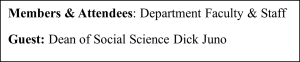
Below I have reproduced the first several inches of the pdf file containing that agenda – I have changed the names in it to protect the innocent. This agenda is in the same format and contains the same information as such documents have since I started my job 45 years ago. Back in the day the agenda arrived in your mailbox on paper instead of as an email attachment, but otherwise it is the same. Except, see below. Anyway, here is what it looks like.


DEPARTMENT MEETING

Thursday, May 15, 2025, at 1 pm in SSC 0000

A G E N D A

  1. Chair’s Welcome                                                                                                                Jim Really
  2. Dean’s Presentation                                                                                                           Dick Juno
  • Q & A with the Dean
  1. Minutes of Departmental Meeting – November1, 2024                                            Jim Really
  2. Graduate Program                                                                                                             John Gradchair
  • past cycle of admissions to the program

 ________

There were more items of business, of course, but they all followed this pattern. A Dept meeting is primarily a forum for reports from people in the Dept on the various aspects of the Econ Dept for which they were responsible. The one unusual item on the agenda is number 2, ‘Dean’s Presentation’. For most of my career, Deans never came to a dept meeting. Such meetings were about dept business, and it was the Dept Chair’s job to report to the dept on anything going on at the level above that his colleagues needed to know about.

I think it happened once or twice during my Chair term that the Dean wanted to come to a meeting, and then after that it started to become more common. I think most deans would prefer to do away with Dept Chairs entirely and have depts run by a member of their own staff. Something like that will almost certainly happen eventually, but that’s not the point of this post.

This is the point……

After getting the above document, but before the meeting happened, I got another email, announcing that a REVISED agenda for the meeting was attached. There was some minor change to the items on it, but that was not noteworthy. What was notable was that the format had changed completely.

Now the actual agenda part of the Agenda looked like this


Agenda Items Nature Presenter Tim
1. Welcome and Announcements Jim Really 5 min
2.Dean’s Presentation Q&A with the Dean Dick Juno 30 min
3.Minutes of Departmental Meeting – Nov 1, 2024 Jim Really
4. Graduate Program Cycle of past admissions to the program John Gradchair 10 min
5. Undergraduate Program Summer Research Fellowships Jane Unchair 10 min


So, everything is now in boxed columns, for whatever reason.

Moreover, each ‘Presenter’ – even the Dean – is on the clock. (I left in the Tim typo, which clearly should read Time.) The thing is, my old dept does not like meetings, a fact which makes it rather unusual in the academic world, where a chance to talk in front of others is generally relished. No meeting ever went more than an hour, all in, at which point we would happily adjourn and go for beer at the Grad Bar. Time limits are hardly necessary in my old Dept’s agenda, and I doubt their presence in this new agenda was a Departmental innovation.

Still, the truly remarkable part of this revised agenda is what changed above the actual list of agenda items. It was chock full of boxes also, of varying sizes. Here are the interesting ones….

Apparently people need to be told that the Meeting Leader will be the Dept Chair. Whatever. Then…..

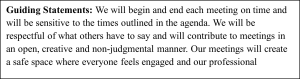
More important info, I guess. Another box noted who would be the Note taker for the meeting, also very important, but my absolute favourite box was this one, at the very top of the document…..

This Dept has been having meetings for more than 50years, but the current crop of bureaucrats has apparently decided, in its wisdom, to impose the inclusion of this at the top of every Dept agenda. Cuz, ya know, if the very saintly folks at the top don’t impose this, there is a great chance that the Members and Attendees at the Dept meeting will break out into – well, I dunno – disrespect, the creation of unsafe spaces.

Of course, there is an easy conspiracy theory regarding where this all came from. The Dean was not at the meeting just by happenstance, it had been well advertised that he was there to talk about – and be questioned about – The Budget.

It is, according to the university administration, in Bad Bad Shape. I am pretty sure they have something in the neighborhood of half a Billion dollars in the bank (yes, that’s Billion and no that is not the endowment, that is separate), but don’t pay any attention to that. Their line is that if something is not done to cut costs, revenues will start to fall short of costs, and We Cannot Have That. And We Cannot Spend any of that Rainy Day Money in the bank. It ain’t raining yet, you see.

So, the Dean was in the Dept, as the lowest man on the Admin totem pole, to explain what is going on with the U budget and to answer questions. I am going to bet that he would not be announcing the laying off of twelve associate vice presidents. That, I suspect, is why that last box is at the top of the revised agenda, and why there is a tim limit on every ‘presenter’. After 30 minutes, no matter how many questions might be left, and no matter how pissed off the Members and Attendees might be, the Dean will be out of there. And don’t you be showing him any disrespect, no matter how ridiculous is what he says, or he will leave….and maybe report you to HR.

Universities are not places for robust disputation, argument, disagreement. That would be….judgemental. Not to mention unsafe.


Oh For Crap’s Sake, G&M

I was at a gathering of mostly family (not my family, I was a guest) over the weekend at which someone said to me ‘I blame the media for much of what is wrong with the world today’.

An extreme statement, but one with which I find it hard to disagree. It is bad enough that little contemporary journalism provides us with facts, but what is really infuriating to me is that absolutely misleading horseshit shows up so often in mainstream (as well as much not-mainstream) media.

I offer you exhibit A, a Globe and Mail article titled ‘Are Canadians getting their money’s worth from their health system?’ authored by one Frederick Vettese, and marked as both ‘Opinion’ and ‘Special to the Globe and Mail’.

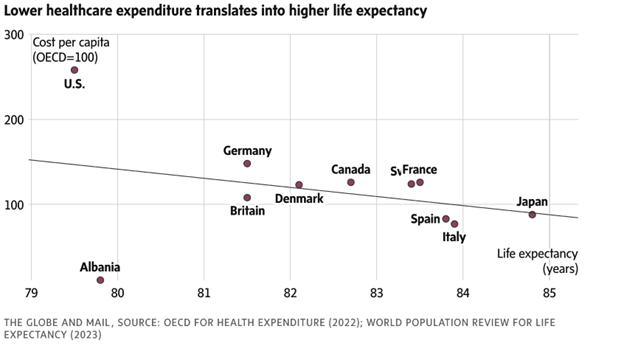
Special, indeed. The piece is centred on the graphic below –

I hardly know where to begin, but let me start by saying that many of the comments that were submitted on this article by Globe readers exhibit a lot more wisdom about the topic than that shown by the author.

Let’s start with something mildly technical: what data on what countries was used to draw that downward-sloping line? If it was just the 11 countries actually labeled in the graph, then this is cherry-picking data of the highest order. As a commenter pointed out, if that is the case, and you take the US out of the data, the line almost certainly slopes upward. On the other hand, if you leave the US in and take out Albania, it will have a much more negative slope.

The author does not think it important to say anything much about just what data is in there.

Let us give him the benefit of the doubt, and assume the line was drawn using data from every country on planet earth. This brings us to the caption on the diagram.

‘Translates into’??

What is that supposed to mean? Many of the commenters (as well as myself) took the caption to be suggesting that higher health care expenditure causes lower life expectancy. But god forbid a journalist use clear language. That one cannot infer such causality from this diagram, whatever data was actually used to draw it, is again clear to most of the commenters, and I hope to you, gentle reader. One very basic and relevant reason is that both health care expenditures and life expectancy are surely driven by other factors. Imagine a country in which disease rates are high, for any reason. This is going to decrease life expectancy as well as induce higher health care spending by both governments and individuals. Bingo, downward-sloping curve.

As they say – duh.

Also, I doubt anyone with a lick of sense thinks that increasing life expectancy is the only goal of health care. However, if one wanted to actually begin to understand what influences life expectancy, there are about a million other things that one ought to include in any statistical assessment, starting with per capita income, moving on to incidence of chronic disease, urbanization (hello, Albania), educational attainment, poverty rates….I could go on.

Thus, the author’s sentences:

“It is reasonable to expect that spending more on health care should lead to better overall health and hence longer life expectancy. If this is true, the trend line in the chart should be a straight line sloping upward from left to right.”

are baloney. Or, bologna. There is no reason to think it should be upward-sloping when all those other things are ignored.

The author also writes

“More spending certainly seems to be counterproductive. But more likely, the additional spending is not being put to good use.”

So, he truly does appear to be clueless. No, your graph does not ‘certainly’ imply that more spending is counterproductive, Mr. Vettese, nor does it provide any evidence about how well health care spending is being used in Canada or anywhere else. The efficacy of money spent in health care is a devilishly hard to measure thing, and your simple-minded graph tells us nothing about it. Nothing.

Indeed, nothing in this sad little article tells us anything about the answer to the question in its own headline.

Another F- in informativeness for the Globe and Mail.

Exciting Experiences

[I know, I know, I promised a post on academic fraud. It’s coming, but it’s messy and it’s been a busy week in the non-blog part of Al’s universe.]

I offer in the meantime another observation on the behaviour and thinking of bureaucrats. Those of you who have worked in a bureaucratic org may not find this informative or all that interesting, I suspect, but I do. The disconnect between how bureaucrats write about things and how normal people outside the bureaucracy see them is fascinating to me. I understand that it is possible that bureaucrats think about things in the same way as those outside, but are forced by the culture of their organization to write and speak in ways that are silly and artificial. I kinda doubt that, but there is no way to know. Thinking cannot be observed, only writing and saying can.

Anyway, I had forwarded to me, in my role as an old fart professor, an email that had this as the Subject:

               Exciting Update: Name Change for International Student Services

Right off, I think: a name change is exciting? To who?

The body of the email itself has the appearance of a press release, and its heading is:

            Important Update: Name Change for International Student Services

So ‘exciting’ has been replaced now by ‘Important’, but I remain dubious that a name change can be either.

Then we get into the body of the press rel….er, email, and the first three sentences are as follows:

I’m excited to share an important update with you. Western International is streamlining our services under one unified brand, and as part of this transition, the International and Exchange Student Centre (IESC) name has been retired as of March 17, 2025.

Going forward, this key pillar of Western International will be known as International Student Services (ISS)—a name that better reflects our mission and enhances the experience for students and the campus community.

Now we have an actual someone who wants us to know that they are excited, and that along with the name change we have some streamlining….why the term ‘brand’ is being used at a university I cannot imagine. Food companies have ‘brands’, not universities. McDonald’s has a ‘brand’, Starbucks and Tim Horton’s have ‘brands’, I suppose Motel 8 has a brand.

Importantly, we now see what the old name was and what it has been changed to, along with the reason for the change – ‘a name that better reflects our mission and enhances the experience for students and the campus community’.

First, if this new name does better reflect their mission, and given the use of the term ‘streamlining’, if I were an exchange student I would have to infer that I should no longer expect anything from this new ‘brand’. I would see this as telling me that my kind have been streamlined right out of their name and therefore out of their consideration, and man, they are excited about it.

Second, how does a name enhance anything? It’s a bloody name, for god sakes. And it is impossible not to notice how ubiquitous the term ‘experience’ has become at this university. What does that word refer to? The Faculty of Social Science now has an Assistant Dean for Student Experience. What does that person do?

My theory – academic bureaucrats love that word because of its passivity. An ‘experience’ is something that happens to you. You have an experience, whereas you acquire an education. If someone says they acquired something, it is possible for others to check on that, to see if indeed anything was acquired. But an experience, well those can happen at Disney World or on a drug or at the seashore, and they happen if you say they happened. Easier for university bureaucrats to say we provide a great ‘experience’ here than to say you can acquire a great education here. Better to have the world ask of your grads ‘how was it?’ than to ask ‘what did you learn?’

But here’s my favourite part of the press release, in bullet point form, cuz bureaucrats do love bullet points:

What’s Changing

  • Website & Branding: The IESC website and materials have been updated to reflect the new name. The new URL is now live, and we kindly ask you to update any references on your website accordingly.
  • Email Address Update: The IESC email (iesc@uwo.ca) has changed to iss@uwo.ca.

So, two bullet points worth of changes, but they get it up to two only because they made the email address update a separate bullet point. Having exactly one bullet point would be a bit embarrassing, even to a bureaucrat.

You can be sure that a committee was struck somewhere in the university to hold meetings to consider this important and exciting name change. People with six-figure salaries sat in those meetings and had earnest discussions about all this. Whether or not exchange students were discussed we will never know.


Silence is Golden – So Shut Up     

This is about the City of London Council, whose members’ behaviour and policies often irritates me deeply. In this case it has made a decision that is reflective of a much wider problem in 21st century government – the culture of Shut Up Already.

Susan Stevenson is the 1st-term city councillor representing the Ward that contains Old East Village in London, the area that has seen the most serious depredations by lawless individuals. Last time I was there was with friends going to a bar, and we walked down its main street Dundas to get there, having to pass at one point a ‘Mission’ outside of which some 20 people were injecting drugs, nodding off, presumably from having just injected drugs, and generally lying about on the sidewalk. It was what I would term a shit show.

A group of OEV merchants showed up at a recent Council meeting at which was discussed issues related to homeless encampments. The merchants made it clear they were fed up with what was being allowed to happen in their part of the city, that it was hurting their business and their lives.

Ms Stevenson’s job is to represent those people, and the City Council has just voted to dock her 30 days pay (just over $5,000) for the way she has done that. This is not the first time she has run afoul of the Council, as  she was previously taken to task (but not fined) for posting photos on social media of the sort of scene I described above from her Ward.

Her sin this time is that she put up a post featuring quotes from a city bureaucrat about homeless encampments. The charges against her adopted favoured 21st century words – ‘bullying’, ‘targeting’ and ‘harassment’ of this staff person. The step of docking her pay was recommended in – get this – a ‘report from Principles Integrity, the firm hired by the city to act as its integrity commissioner’, according to a London Free Press story.

Those terms for Stevenson’s behavior also come from that report. Council then voted to carry out the recommendation of 30 days loss of pay, after a debate, in an 8-6 vote.

I think this paragraph from the same LFP story is key:

“The report found Stevenson editorialized the quote with “provocative emojis,” unnecessarily identified Dickins, and appeared to suggest he was responsible for homeless encampments in the city, leaving him vulnerable to attacks from the public.”

I cannot read that without getting angry.

As I noted, I have walked through the shit show on Dundas East that is the very direct result of City Council policies, and more than once. People who live and work in OEV must do this on a daily basis, and that is by no means the only part of the Ward where such shit-shows reign.

I will also say that I did not actually fear for my physical safety on said walk, as I think the people starring in those shit shows are pathetic rather than dangerous. That walk is highly unpleasant, and it makes me despair for my city.

But this ‘Integrity Commissioner’ thinks that this city bureaucrat should not be subjected to ‘provocative emojis’ on a social media post. And, Stevenson ‘appeared to suggest’ something? What does that even mean? I read the guilty post, I saw no such suggestion in it, and I don’t know if a case could be made. But the more basic question is: why should Stevenson not suggest he is responsible for the situation if she believes that to be the case? Because he might be subject to ‘attacks from the public’? Why should he not be attacked by the public if they think he is responsible? If you are in a job in city government and you go out and get yourself quoted about city issues, then why on earth should you not be called to account for what you say by councillors and/or the public?

This is the utter disconnect of our current governmental bodies. Nothing wrong with people shooting drugs on a city street in broad daylight, no councillor should have their pay docked for that happening, but suggest that a highly paid city staffer’s quote is problematic and a $5k fine is the result. And, of course, 8 fellow councillors voted for Stevenson to be penalized.

City politicians and bureaucrats should never be made to feel ‘unsafe’, no matter how silly the supposed reason for that feeling – provocative emojis, indeed. But London residents – you’re on your own, folks.

Yea, it enrages me every time I read about it.

The Freeps and CBC London stories on this – there are many – include many quotes from Stevenson and her council colleagues. I’ll discuss those in a separate post, so stay tuned.


AI and the End of Thinking

I hypothesize that the topic that comes in second after the US election in the news is AI. So, this post is about me….cuz in most fonts, Al and AI are indistinguishable.

This was prompted by a long article in last Saturday’s Globe and Mail Opinion section, titled

The Automation of Writing is Almost Here

Followed by the tag line:

‘But what will happen to us, Michael Harris asks, if we cede our written language to AI?’

It is a long article, and Harris makes a number of points, all of which I basically agree with.

As to what is wrong with AI writing, he says “There is the shape of meaning and yet nothing solid.”

I would only add that this can also be said about most bureaucratic writing from universities, government, corporations. Indeed, AI makes all writing sound bureaucratic – only the shape of meaning.

He typifies the coming of AI as the third great revolution in communication, the first being writing itself, the second the invention of the printing press.

Another quote: “Passing around pre-fabricated blocks of text is efficient, to be sure, but it also makes a mockery of the word ‘communicate’….”

Again, I cannot disagree, except perhaps to wonder at what ‘efficient’ means in that context. It is easy, yes, but efficient?

As someone who taught a lot of what my employer deigned to call ‘Essay courses’ (simply meaning student grades were determined by my evaluation of a minimum number of their written words), I said to those students often that ‘writing is thinking’. I meant it, even though most of them didn’t like what that implied. Thinking is hard, so writing well is also hard. Students….no, humans….are pretty ingenious at avoiding things that are hard. That’s not necessarily a moral failing. Well, it is when it gets people hurt or killed, but it is also probably part of our evolutionary heritage. Struggling along on the savannah, smaller. slower and weaker than most of what we wanted to eat, our ancestors absolutely had to conserve their energy in any way they could, so as to have a hope of winning a battle against a tougher, stronger and faster opposing animal.

The instinct to conserve energy seems to have survived, the need to best superior predators, not so much.

There is another vein of thought about AI and language that I have read about but which Harris ignores. So far as I understand it, it is that AI generated language is destined to turn into meaningless mush, eventually. It has something to do with the fact that AI will increasingly find itself training itself on a mountain of verbiage out there on the web which it has increasingly generated itself, and this process is inherently unstable. Here’s two sentences from the Abstract of a paper about this, titled ‘The Curse of Recursion’

“What will happen to GPT-{n} once LLMs contribute much of the language found online? We find that use of model-generated content in training causes irreversible defects in the resulting models, where tails of the original content distribution disappear.”

It doesn’t say what those ‘irreversible defects’ are but some simple examples in the paper suggest that as a LLM (Large Language Model) is trained successively on text that it generated itself, the output it produces becomes what we would now call gibberish.

Given what I write below, I would call that good news.

My own concern with these LLMs follows from what I see their owners selling them for already. It is an extension of the same concern I had the few times students used AI for their writing in the last years of my career. I came upon these recent AI sales pitches because I watch sports online, and the commercials are mostly those that are broadcast on US TV. The ones I am going to talk about below are all, so far as I can remember, from Apple Intelligence, the cleverly named AI wing of Apple.

I recall three such TV ads.

  1. A guy enters a business meeting, sits down, and quickly realizes he has no idea what is going on. He quietly scoots his wheeled chair out the door, checks on his phone for what I assume was the original emailed materials for the meeting, and hits the ‘AI’ button on his program. The algorithm immediately gives him a ‘summary’ of said material. He smiles, slides himself slowly back into the meeting, and says ‘OK, let’s get into the prospectus’.

Lesson: You don’t have to prepare for anything, and you certainly don’t have to study. AI will prepare you in seconds.

  1. A guy is sitting at his desk, thinking out loud about something that is never clearly described. He speaks some garbled thoughts into his phone, hits the AI button, and his gibberish is turned into a paragraph of clear prose, which he sends to someone (his boss, it appears). Boss reads it, looks up and says something like ‘This is from Gibberish-guy?’.

Lesson: You don’t have to write or even think clearly, just say something, anything, and AI will make it brilliant.

  1. A guy (natch) is incensed about someone stealing his pudding cup from the office fridge, and he is writing an inflammatory email to the entire office, castigating whoever was asshole enough to steal it, and promising dire consequences if it is not returned. Before hitting Send he looks at the Teddy Bear sitting across the office from him (No, there were no teddy bears in the office when I worked, either) and hits the ‘Kindness’ button on his AI program. The email is duly transformed, he sends it, and a young lady walks over to his desk, says ‘Such beautiful words.’ and returns his stolen pudding cup.

Lesson: You don’t have to emotionally regulate or understand proportionality, AI will make you seem like a nice (and articulate) person.

If AI is going to self-referentially crash some day, I say bravo. I fear however that the message to most of my fellow humans prior to that is that it will eliminate the need for them to think, be articulate, prepared, or an adult, and that will be too attractive to resist. However, I will have to interact with those people in situations in which they cannot rely on AI. In line at the grocery store, out for a walk, sitting at the bar. Doing so will be extremely unpleasant, because without their AI they will be ignorant, inarticulate and angry.  Unless they let their phone do their talking for them.

That’ll be great.


Dammit, This is Important!

This is going to be a rant – unusual for me, I know – but a short one. I am working on a much longer rant for the coming days, so you’ve been warned.

I refer you to The London Free Press, November 21, Letters to the Editor. One letter is headed Timing Offensive.

The author is offended that the Freeps published an article headlined ‘We don’t want to know about abused men’ on Nov 9. I quote from the outraged letter:

“You have 11 other months of the year to publish that article, and yet you chose to run it in the one month dedicated to the Shine The Light on Women Abuse campaign.

Are the editor and editor-in-chief that insensitive, or worse, misogynistic?”

Misogynistic, clearly. I mean, it’s obvious, right?

I surmise that it was the publishing of an article about abuse of males during a month when someone decreed that we should focus on abuse of females that drew the writer’s ire. Would an article about the Movember prostate cancer thing have been equally offensive? I surmise not, as I suspect there were articles in the Freeps about Movember that did not outrage the letter-writer. No, I haven’t looked…..

More fundamentally, what is the actual nature of the offense, here? As far as one can tell from the letter, most of which I have reproduced above, as it was not long, the offense is thinking about, writing about, and publishing an article about, other types of abuse. So, our attention must not stray from the abuse of women during November, not even for the length of time it takes to read that offensive article.  And apparently, if the Freeps had published the article on Dec 1 the author would not have been upset, December presumably falling under the ’11 other months’ designation.

However, it is also true that someone somewhere, I know not who or how, did designate November as a month to support/discuss/sympathize with (I really don’t know what we’re supposed to do beyond growing a moustache) men who have prostate cancer. Should I then be offended if the Freeps publishes an article on breast cancer this month? What about skin cancer? I won’t be, but is that lack of outrage a moral failing on my part?

Sadly, this is pretty much how many people see things. They have a cause. The war in Gaza, misogyny, racism, cruelty to animals. This then becomes the most important thing there is to think and talk about, not just for oneself, but for everyone.  One then patrols their chosen territory assiduously, outraged by any and all perceived actions by anyone anywhere that might suggest that one’s favourite issue is not supremely important. (There are also people for whom this is a job description. They’re called ‘advocates’, they get tons of media attention, and are a topic for another post someday.)

Students camp out on the concrete beach (ok, how many were actually UWO students is not clear) and harass passersby and graduates because nothing is more important than their stand on the war in Gaza. Not your fellow students, not the ability of other people to live their lives without being shouted at, and never mind that your silly encampment and juvenile harassment has zero chance of having any impact on what happens in Gaza. This issue is important to me, to the exclusion of all else – including going to class or earning a living – and so it must be equally important to all right-thinking people. Any person who does not see the paramount importance of my issue, well – they must be a, a, a….misogynist.

So it is with this offended letter writer. It does not occur to her that if the appearance of that story in the Freeps (of all places) actually had any detrimental impact on the Shine the Light campaign, maybe said campaign is doomed.


Just Don’t Say It

I read a story in the Sept 27 print segment of the National Post that comes inserted into my London FreePress that had an odd headline. Well, it was odd if you think it was supposed to be a news story.

“Survivors….deserve to heal.”

The first sentence of the story:

“An NDP MP tabled a bill Thursday seeking to change the Criminal Code to criminalize downplaying, denying or condoning the harms of residential schools in Canada.”

The bill is C-413, a private members bill, and the article goes on to note that such bills ‘rarely pass’ but does not specify what ‘rarely’ means, numerically. Not ‘never’, I would guess.

The article goes on to note that  ‘…several years earlier the Liberal government passed an amendment to its 2022 budget implementation bill that added a criminal provision against making public statements that promote antisemitism “by condoning, denying or downplaying the Holocaust’.”

That got me thinking, and remembering, and that got me digging, which is why this post is just being put on the blog now.

I remember Trudeau’s government doing that, and remember thinking at the time that it was a terrible idea, and I also remember that more than one Jewish organization lobbied against including that in the budget bill at the time. (Other Jewish organizations supported it, to be sure.)

My reasons for being distressed back then at this clearly non-budgetary matter being passed into law is precisely captured by this recent private member’s bill. Once you establish the precedent of passing laws criminalizing what people say or write about any public matter, there is no going back. It just becomes a matter of what things people say might catch the disapproving notice of some MP or – more alarmingly – some government.

Since I don’t trust 21st century media to report facts accurately, I went to the Parliamentary website to find the exact text of this bill.

That text includes the following:

2.2) Everyone who, by communicating statements, other than in private conversation, wilfully promotes hatred against Indigenous peoples by condoning, denying, downplaying or justifying the Indian residential school system in Canada or by misrepresenting facts relating to it

(a) is guilty of an indictable offence and liable to imprisonment for a term not exceeding two years; or

(b) is guilty of an offence punishable on summary conviction.

The bill also states what can be a defense against this charge. It states:

Defences — subsection (2.2)

(3.2) No person shall be convicted of an offence under subsection (2.2)

(a) if they establish that the statements communicated were true;

(b) if, in good faith, they expressed or attempted to establish by an argument an opinion on a religious subject or an opinion based on a belief in a religious text;

(c) if the statements were relevant to any subject of public interest, the discussion of which was for the public benefit, and if on reasonable grounds they believed them to be true; or

(d) if, in good faith, they intended to point out, for the purpose of removal, matters producing or tending to produce feelings of hatred toward Indigenous peoples.

Confining myself to (a), note that this states that ‘truth’ is a defense against being convicted of this new crime, but it also is written to say that ‘they’ – the person charged with the offence – has to establish that the statements communicated were true. So, I will start by noting that this shifts the burden of proof from where it usually resides – with the prosecution – to the defendant.

Beyond that not-small matter, let me offer a hypothetical example of how a case brought under this new criminal statute, were it to be enacted, could go. Suppose I write to a First Nations leader, or a member of parliament, and ask the following question – or I just post this question on my blog:

“In how many of the claimed residential school gravesites have verified human remains actually been found?”

I have no doubt that my doing this would generate outrage in many circles. The question is, would it subject me to arrest and prosecution if this bill were to pass?

Note that I have asked a question in this scenario, but a question which might be interpreted by some as an attempt at ‘downplaying the Indian residential school system in Canada’.

And there is no statement whose truth could be verified so as to defend myself if I were arrested. I would be asking a question. Questions are not true or false, they are….questions.

Suppose I wrote in my blog that ‘Surely the residential school system benefited many of the children in it in many ways. Nothing is all bad or all good.’

Again, no facts to be verified, just a statement about how the world generally seems to me to work. Am I subject to prosecution, and if I am prosecuted, how might my lawyers defend me?

There are other reasons for being worried about this ‘truth as a defense’ aspect of the bill.

You can read a related story here on the Vancouver is Awesome website. I confess to being unaware of this site until recently, and I deplore the fact that it does not put actual dates on its stories (‘one day ago’ is not a date).

However, it chronicles an argument at the annual meeting of the Law Society of BC about the language to be used in a training program. Two members of the society put forward a motion questioning the language used because to date no human remains had been found at the Kamloops Residential School site. All that had been established was the existence of ground radar ‘anomalies’, a fact which the First Nation had acknowledged by changing the word ‘remains’ to ‘anomalies’ on its own website.

Other lawyers argued passionately against changing the language in the training course. One of them, described as ‘family lawyer Andrea Glen’, is quoted as follows:

“So in light of this significant body of evidence across the country, to quibble over the language of whether something is a burial site at a particular location, or a possible burial site or a probable burial site, obviously completely misses the point, and it’s just so hurtful to quibble over the language used for one particular area when we have a huge body of evidence that this happened across the country,” said Glen.

So, would lawyer Glen then say that, since there is ‘a significant body of evidence that non-indigenous individuals murder indigenous people across the country’ one should not in a particular trial be able to question whether non-indigenous person John Brown actually murdered indigenous person Joseph Alsop, as stipulated in the indictment?

Another lawyer and Society member, Adrienne Smith, is quoted as follows:

Smith added that Heller and Berry’s resolution is “part of a distressing trend in courts to try to inappropriately put a referendum about the needs of equity-denied groups improperly before courts and tribunals.”

Given the chance, I would say to Ms Smith that the resolution seems to me to be an attempt to put a question about certain facts before your society. It is not about anybody’s needs. But this is part of my concern. The law is increasingly concerned with what certain groups ‘deserve’, to quote the article’s headline, or what they ‘need’, as Ms Smith puts it. Not facts, not truth.

Given that, I am exceedingly dubious regarding the idea that Canadian lawyers, a group which, keep in mind, includes Canadian judges, all of whom are lawyers, will give any serious consideration to the question of ‘truth’ in any trial that arises from Bill C-413 if it becomes law. Why would it not be, as 21st century language often puts it, the ‘lived truth of Indigenous Peoples’, or at least the court’s interpretation of that truth, which would rule the day in most Canadian courtrooms in which a case brought under Bill C-413 was brought? It is increasingly common today to assert that everyone has their own truth. If my truth about residential schools in Canada conflicts with the truth of some Indigenous person, whose ‘truth’ will the court use in determining whether I have a valid defense against a charge of violating the terms of Bill C-413?

To put it simply, I doubt that the ‘truth’ defense will actually be any defense at all.  And, if truth is not a defense, Bill C-413 becomes a device for shutting certain people up, and thereby for stopping any meaningful discussion of residential schools. The law of the land should never serve that purpose in a free society. Never.

I see other issues here. The bill includes the qualification ‘other than in private conversation’. So, if I say something like ‘the residential schools weren’t all bad’  while talking to a friend in a pub, and someone overhears me – is that private conversation? Could a constable who overheard me say that, or a constable who took a sworn statement from someone that I did say that, arrest me for violating C-413?

I would bet they can, by the same legal logic that allows governments at all levels to pass laws that regulate so much of what happens in that pub.

It is by such devices that we get closer to the old Soviet dictum – ‘You can think anything you want, just don’t say it.’

‘Slippery slopes’ are not taken seriously these days, I know. However, Bill C-413 seems to me like a second step on such a slope, following on the first step that was included in the Liberal budget implementation bill of 2022. Bill C-413 will almost certainly not end up as law, if for no other reason than that the Liberal government is on its last legs. But some day, not too far off, I do fear that some government will take step two, about whatever statements it finds objectionable. Then, inevitably, the steps get closer together once you get moving along the slippery slope.


A Tip of My Hat to Jagmeet Singh

Canadians will know that Jagmeet Singh is the leader of the Federal New Democratic Party, and they can probably guess that I have nothing good to say about any of the policies espoused by him or his party.

However, I want to here and now give him a public tip of my hat for something I saw him do in a video on the CBC website, which you can also view here (you’ll have to scroll to the bottom of the page for the ‘Featured Videos’, and I don’t know how long it will stay posted).

Singh is walking near Parliament with a staffer when two dudes come up behind him, filming him with their phones, and Dude 1 says out loud ‘Would you vote a non-confidence today if it came up?”

Singh ignores him and keeps walking.

Then Dude 1 can easily be heard to say “Corrupted bastard.”

At that Singh turns around and walks back toward Dude 1, saying “Wanna say something?”

Dude 1: “What?”

Singh: “Wanna say something to me?”

Dude 1: “I didn’t say nothing.”

And it goes on like that, with Dude 1, in the manner of confronted cowards everywhere, denying that he said anything, while his buddy, Dude 2, continues to film.

Security officers were right there the whole time, but I here tip my hat to Mr Singh for turning around and calling out the asshole who was only willing to insult him while Singh’s back was turned. Bravo, Mr Singh. Had Singh smacked the guy up side the head, no jury of real people would convict him of anything. The asshole asked for it.


Nonsense

There are certain phrases one hears over and over again, and that are never challenged, despite the fact that they are clearly nonsense.

A minor instance of this is the expression: ‘That’s the exception that proves the rule.’ To say that an exception to a rule proves the validity or truth of that rule is just nonsense. If there is an exception to a rule, then it is not a rule. It is a rule with exceptions – i.e., it ain’t really a rule. Now, I have read that in fact the original statement of this was ‘That’s the exception that preuves the rule.’ The word preuves (a word I have not seen elsewhere) means ‘tests’. I have no idea if that was indeed the original statement, but that an exception might test a rule is at least not nonsense.

However the phrase of this sort that has set my teeth on edge for eons is of arguably more import in the contemporary world. I read it most recently in the following quote from an opinion piece in The Harvard Crimson by Lawrence Bobo, Harvard’s Dean of Social Science.

“The truth is that free speech has limits — it’s why you can’t escape sanction for shouting “fire” in a crowded theater.”

That is simply wrong. That you cannot escape sanction for shouting fire in a crowded theatre is only true if in fact there is no fire. If there is a fire, you damn well better shout it, and pull the alarm while you’re at it. This is a sanction against lying, or causing needless panic. It has nothing to do with free speech or limits on it.

I suppose it is too much to expect the Dean of Social Science at Harvard to understand this.


Streaming service warnings, or…..huh?

A pervasive feature of the 21st century in North America is the deterioration in the quality of written language. Words with a quite precise meanings, like ‘phone’, ‘mail’, ‘email’ and ‘text’ get replaced with the coverall ‘reach out’.

I have access to exactly one internet streaming service, and it provides one of the more amusing examples of language abuse in the warnings it attaches to the previews of the films that one can watch on it.

Now, some of these warnings are easily understandable: Nudity, Sex, Violence – the Classics. Attaching any of these to the preview of a film is particularly useful to any teens or pre-teens who live in the household. I have experience from an earlier era. In my pre-teen years my good Polish Catholic parents subscribed to The Catholic Chronicle, a weekly paper put out by the local diocese. This featured a lot of boring stuff I never read, but it also provided ratings of all the movies that would be shown that week on the 5 or 6 TV stations available in our town. Those ratings told me which channel to put on when I stayed up past my parents’ bedtime on Friday or Saturday night. I was most grateful to the Bishop for this service, even though nothing on TV in that era was actually all that scandalous. It doesn’t really take much to get a 12-year-old boy excited.

However, contemporary warning words beyond that Big Three are rather more mysterious to me.

One warning is Language. Not Profanity, not Cussin’, not even Bad Language, just – Language. That seems to suggest that the characters in the film are going to talk, but there is also another warning of Pervasive Language. I suppose it is useful for some people to know there will be a lot of talking, so they should pause the stream if they have to go to the bathroom.

There is also a warning for Smoking, which I presume is due to our enlightened age realizing that all it takes is for some young’n to see someone smoking in a film to provoke them to go out and steal some smokes and try it themselves.

However, there is also a distinct warning about Historical Smoking. Clearly this would be attached to a film set in the past in which people smoke. What is not clear to me is whether the distinction is made because seeing past smoking is more or less harmful than seeing current smoking. Whichever way it is, why is there not then a warning about Historical Nudity (Adam and Eve?) or Historical Violence (Conan the Barbarian?) or, really – Historical Sex; you know, before people knew how to do it right like we do.

Undoubtedly, the biggest mystery to me is when a film preview comes with this warning:

Some Thematic Elements

Whatever in the hell does that mean? I can’t even make a joke about it.

One might think that, whatever the environment, posting a warning whose meaning is unclear would be a terrible idea. Do we want Environment Canada putting out Alerts that say Something Might be Coming? [I admit, EnvCan’s Special Weather Statements are pretty close to that.]

However, here in the 21st century, when offence lurks around every corner, it may be that posting a warning on a film the meaning of which no one understands has value.

Consider this scenario – a subscriber phones up or texts the customer service dept of the service.

Subscriber: “Hey that movie had a blonde-haired woman chasing a blue aardvark around with a flyswatter, that was appalling, I had no idea me and the kids  would be exposed to that. What is wrong with you people?”

Customer Service: “Ah, but Madam, we did make it clear the movie contained Some Thematic Elements.”