Vices
I have tried to live my life by certain principles, at least since I became dimly aware that there were such things as principles. Most of them are boring, but here I want to write about one principle that I think is worthy of serious consideration. It is this:
‘A good life requires a well-diversified portfolio of vices’
If asked, I credit that to Oscar Wilde, the patron saint of this blog, but to be honest I doubt he ever said it. For one thing, I rather doubt that people at the end of the 19th century ever used the term ‘well-diversified portfolio’ in regard to anything.
Whoever said it, and I say it all the time, I think there is wisdom in this simple statement. As an example, I can see no other explanation for Keith Richards living beyond the age of 80. Clearly the young Keef understood intuitively that it was important to have Sex and Drugs and Rock’n’Roll all the time. So he did. It’s the poor buggers who get lost in a single vice that end up dead at 26.
At this no-longer youthful point in my life, adhering to this principle is not so easy, but I do muddle on as best I can with two legitimate vices.
Cigars and whiskey.
I gave up regular smokes long ago, and I do still like a cold beer or a nice glass of wine, but I am needing to take off some weight so no more fruit pies and potato chips for me. Well, hardly ever.
Whiskey and cigars are not only enjoyable, they are complements. Good whiskey is better with a good cigar, and conversely, and if you throw in a good sporting event on the laptop or some interesting reading you have a Perfect Al By Himself Evening.
Mind you, I like going out, too, and do so as much as I can, but when I am alone, that is what I enjoy.
This blog post is really about how the universe conspires to make enjoying these simple vices more difficult than needs be.
- Whiskey
I have already whined in this space about the fact that Ontario Premier Doug Ford has unilaterally decreed that I am no longer allowed to enjoy Bourbon, which is my favourite tipple. As it happens, I have some very good friends who have conspired through various means to get some Bourbon to me; I am currently nursing the remains of two lovely bottles that originated in The Great State of Kentucky. They won’t last forever, unless I don’t drink them, which would be rather silly.
Fortunately, I like good rye and good Irish whiskey too, so I get by on those, and I certainly do not feel horribly done by. The world is full of folks who would love to have only my no-Bourbon problem.
However, I am writing this post to tell you about a non-governmental interference with my whiskey vice. When I go to the liquor store I am all in on trying something new, and one day I came across a bottle that I had not seen before. The label said it contained Beaver’s Dram, which is at least an attempt to be clever, and the label also proclaimed it held Premium Canadian Rye with a Port Wood Finish.
That last thing typically refers to the fact that distillers (and vintners at times) like to age their booze/wine in wooden casks that were previously used for something else, to give it a distinctive, if subtle, taste. In this case I figured the whiskey had been aged in casks that had previously been used to age port. In an interesting turn around, some vintners age their wines in casks that previously aged Bourbon.
Kinda cool, eh?
Anyway, Beaver’s Dram was not expensive, so I bought a bottle to support Canadian industry and to give it a try. Here’s a photo of the bottle, which you will note is empty.
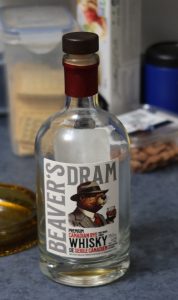
That night I poured a generous couple of fingers over ice, as is my habit, and had a sip.
Ick. What is that taste?
I know that people who do not like whiskey and try it for the first time often say it tastes like medicine. I like whiskey. This was not my first time. Beaver’s Dram tased like medicine.
I kept sipping, hoping it might grow on me. It did not.
I thought about it over night, having meanwhile switched to a nice Canadian Club Rye (CC’s 100% Rye in the green label bottle is very nice and very inexpensive), and then in the morming poured the rest of the Beaver’s Dram into the sink. That’s why the bottle in the photo is empty.
And, I went looking for info about it online, to see if there were any reviews. I know, shoulda done that before I bought it.
Well, I learned a helluva lot. It turns out that whiskey is made by Dunrobin Distillers in Toronto, and is made using the patented Stockhausen Method. What is that, you ask? Here is a paragraph from the Dunrobin website:
The Stockhausen Method accelerates the natural interaction between spirit and wood, focusing on the diffusion of aromas and flavours at a molecular level. Through proprietary processes, including advanced pressure, temperature, and oxygen control, spirits are finished with extraordinary speed—achieving the taste complexity of years-long aging in mere weeks or months.
Or, perhaps achieving a taste like medicine.
So, this Stockhausen guy has ginned up a process that supposedly ages whiskey without taking time. That ‘aging’ exactly means time passing, no matter.
It’s a way to make more money. Having all those wooden barrels lying about is expensive, man, and having to wait for the bucks to come in really sucks. There is stuff on the website about how this method is more ‘sustainable’ than traditional aging. My grandson could see through that bit of horseshit.
From another website titled Dr. Dolf Stockhausen, Noble Innovator (I kid you not) here is a photo of the guy who came up with this fabulous process. And patented it, apparently:

So, I got taken in by a scheme to make whiskey without, you know, actually doing the hard part, concocted by some German guy who was already wealthy. This last website says Dolf was ‘CEO of the Stockhausen family business (the world market leader in super absorbent polymers for hygiene products)’.
Right. That is what the whiskey tastes like – polymer.
I never ever pour whiskey down the drain, that is as close to mortal sin as this lapsed Catholic wants to get, but that stuff was awful. Lesson learned – research before you buy, Al.
- Cigars
As it happens, London is home to two cigar stores, and I can walk to either one from my home in less than a half hour. Sometimes the universe just unfolds as it should…..
I believe one of them has just opened up a new branch further south of me, which I take as a good sign that their business is doing well.
Below is a photo of a cigar I bought from one store on my most recent visit. It’s a cigar I had not tried before. Just as with whiskey I have old reliable brands (Rocky Patel and Alec Bradley, among others) but also like to try something new each visit.

As you can see, it’s The Wise Man cigar, which means it was clearly made for me. The dark blue and green band, with some golden touches is kinda classy, too.
Well, you should know that is not the cigar I was confronted with when I went into the store. That same cigar, sitting in the walk-in humidor at the shop, looked like what you see below:
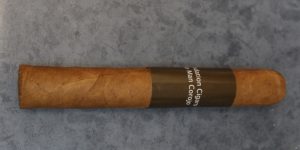
Yes, folks, by Order of the Federal Government, the Plain Brown Wrapper is back. That wrapper is there to conceal from the naïve and easily impressionable public the dark allure of that label that you saw in the first photo.
I am sure you could feel the all-but irresistible pull of that blue, green and gold, commanding you to buy that sexy cigar and just smoke the shit out of it.
So, the Feds are protecting us….well, me, anyway, from that horrible temptation. Those of you that never go into a cigar store never know such evil things exist.
Those mandated brown labels are on all the cigars in the stores, and they are affixed by the people who work there. People who produce cigars certainly wouldn’t put them on, the idea of doing so would leave them rolling on the floor laughing.
They might leave all of us laughing, were it not so goddam sad.
And, of course, I should just be grateful the Feds let me buy the things at all. No doubt the day is nigh when they will not. May I be six feet under when that happens.
Postscript:
The one thing that works in my favour here is that governments are reluctant to outlaw sins like cigars and alcohol because of the tax revenues they bring in. It is a long-appreciated principle of public finance (another course I taught) that the best goods to tax if you want big revenues are goods for which the demand is inelastic. That just means good such that, if you raise its price (by imposing a tax, say) then demand drops by a smaller percentage than the percentage by which you raised the price via taxes.
In advanced economies, that means taxing alcohol, tobacco, and gasoline. I consume rather little of that third thing these days. Interestingly, my research on the British Raj in India in the 19th century has taught me that the Brits found another such good to tax there – salt. Clever, those Brits. Salt doesn’t seem sinful, but on the other hand I remember when my dad was getting older some of his friends referred to salt as ‘white death’. The docs of that era had decided it led to high blood pressure and they should tell their senior patients to avoid it. Turns out that was mostly bullshit, too. I do like salty snacks. My BP runs around 102/68.