What’s Safe No More
I have been thinking about writing something about this for months, as my admittedly-inexpert nose thought it detected a change in the wind. I dawdled about it, as I do, and other things to write about came along, as they do, and so I wrote nothing.
Last week a new academic-adjacent paper came across my vision from The Aspen Institute, an all-around non-profit think tank. The paper is titled ‘America’s Risky Debt: What Markets See That Policymakers Don’t’, is written by one Hanno Lustig, who I know not at all, and will be coming out as a chapter in a longer book eventually.
The paper is thus about the debt of the US Federal government, which I mentioned in my post-midterm post was an ignored topic in all the many many political ads I saw during the campaign.
I have thought US debt a topic worthy of worry for some time, and this Lustig guy says maybe I’m onto something.

Background first. There is over $40trillion in outstanding US government debt floating around the world in the form of bonds sold by the US Treasury, in varying denominations and of various maturities. This is the greatest level of debt ever for that government, as the simple graphic below shows, taken from the US Federal Reserve’s own data source, FRED:
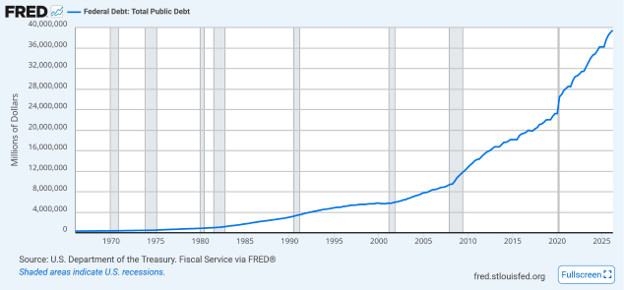
The vertical axis is in millions of dollars, but a million bucks ain’t nothing, so note that 40trillion equals 40million millions.
This is not adjusted for inflation in any way, because US Treasury bonds are just sold in unadjusted dollars.
A quick gaze at this graph tells us that it has had an upward slope since 1970, that slope got steeper in 2008, and we all remember why, and then it got even steeper in 2020, after doing a big one-time jump in that year – we all remember why.
No sign of it slowing down that I can see.
Now, here is what I want to say, and this new paper is all about. US government debt has been growing noticeably since the 1990s, and it has been easy to find people saying ‘This cannot go on, something has to be done to stop all this deficit spending every year’, and yet it has persisted for more than 30 years.
So, one can easily say to someone like me – quit your worrying.
Now, one supposed reason given to not worry about this mounting debt was the claim that so long as the debt’s percentage of US GDP was not growing, there was nothing to worry about. It’s like saying to an individual worker, so long as your total debt is not more than some percentage of your income, you are doing ok.
So here, from good old FRED again, is what that has looked like:
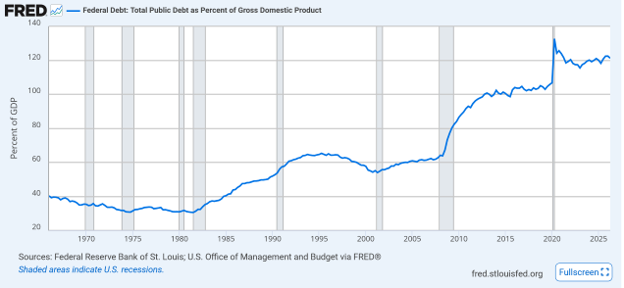
Again, as a percentage of GDP it went on a steep climb after 2008, started to level off a bit, then in 2020 there was a huge spike, (because debt soared and GDP tanked in that one year) after which it fell a bit, before holding steady again at around 120% of US GDP.
Hm. Is that graph more encouraging? Should we be reassured? Whatever else one says, US debt was only 60% of GDP in 2000, and is now twice that percentage, so I think the ‘don’t let the debt become an increasing percentage of GDP’ train left the station long ago.
Additionally, one worry for yours truly is that servicing that debt, meaning paying the annual interest on it, is now the biggest single federal government expenditure after Social Security outlays, and those do not come from the general budget, as I noted last week. So the very practical concern is that those debt payments continue to rise, and the federal government gets to the point where the debt servicing tail is wagging the budgetary dog. The government’s biggest expenditure every year becomes something over which it has no control. That seems to me to be not good if you think government should be making careful decisions every year about what to spend money on.
However, those who wish to really tell worry-warts like me to stop worrying simply point to the following facts, which I take verbatim from the Aspen paper by Lustig:
For decades, the US has been the world’s safe-asset provider, and the dollar has been the world’s reserve currency. As a result, global investors were willing to pay a premium for US Treasurys. US taxpayers benefited because this premium lowered the federal government’s cost of funding.
Simply put, US Treasury bonds that the US government finances its debt with were the gold standard of investment opportunities. They were rock-solid, meaning those who bought them by the billions and eventually trillions every year were willing to pay more for them than for other bonds, and that in turn meant that the US government borrowed at lower interest rates than any other government or other large organization.
So, quitcherbitchin’, ok?
Lustig expands on this in investorese language, which I will translate below:
Treasurys traded at a premium to close substitutes, hedged equity risk, and rallied during stress episodes.
There are three claims there, the first is the one already laid out. People were willing to pay more for US treasury bonds than for those of other seemingly financially-solid countries like Germany.
Second, saying they hedged equity risk meant that when stocks fell in value, Treasury bond prices fell, so investors switched their money into US Treasury bonds. That was called fleeing to safety, as those bonds were a safe investment when the stock market’s returns were down. This meant that a very sensible strategy for someone like me with a retirement fund (if in the US) would be to invest some of it in the stock market and some in US Treasuries. When the value of one falls, the value of the other rises. No-effort hedging.
Finally, when something happened, like a war in Iran or a Covid epidemic, you could count on the price of US Treasuries rising, as people bought those as an again-safe investment in times of increased uncertainty.
Here is Lustig again explaining that those days are gone.
First, US Treasurys are no longer expensive compared to close substitutes like German sovereign bonds or AAA US corporate bonds, especially at longer maturities. Second, the US stock–bond correlation turned positive in 2020. US Treasury allocations no longer hedge the equity risk in an investor’s portfolio. Third, there is increasing evidence that investors no longer flee to the safety of Treasurys when volatility spikes in financial markets. An example of this was the arrival of COVID-19 in March 2020, when the 10-year Treasury yield spiked by 68 basis points in just eight trading days between March 9 and March 18.
Clarifying note: the Treasury yield spiking means the interest rate implicit in the US T bonds being sold went up by 0.68 percent, which is what happens when the price at which those bonds are sold drops. Investors wanted less of US Treasury bonds during that episode, not more.
In short, Lustig is arguing the world has changed, and definitely not for the better for the US government, and hence for US taxpayers. The premium on Treasury bonds that let the US borrow at lower rates than other countries seems to have all but disappeared, and yields on them no longer behave like those of a safe asset.
Now, those T-bill rates move around for a lot of reasons, a big one being what level of inflation is expected over the near term. On the day I am writing this post, a WSJ headline says that the recent report that inflation has been higher than expected caused the yield (interest rate) on two-year Treasury bonds to take the biggest hike in 19 years.
That is how those markets for securities work, and are supposed to work. If people see inflation coming they want a bigger nominal payoff on any investment, Treasury bonds included. Some of us remember the rampaging inflation of the 80s and having our mortgage interest rates set at 12, 15, even 18 percent.
The concern is that the long history of ever-increasing borrowing by the US government is finally coming home to roost, and higher yields on Treasury bonds will become permanent. What does that mean? Well, it certainly will not happen because I think so, or because Hanno Lustig thinks so. The point of his paper is that what is happening in the markets in which those US Treasury and other government and high-end corporate bonds are bought and sold indicates that the large buyers of those securities are getting worried about the ability and/or willingness of the US government to redeem them.
Those premium prices paid for US Treasuries in the past were because no one doubted that the US economy could generate the government revenues needed to meet its obligations, including paying interest on its debt. How big does the interest on that debt have to get (coupled with the looming crisis in Social Security, by the way) before the prices paid for US Treasury bills really start to fall? And then, at what point do US politicians, facing ever-rising interest costs, start to contemplate the formerly unthinkable, like offering bondholders 80 cents on the dollar when its Treasury bonds mature? Or 50 cents?
And, Canadian readers, do not think that we will be spared the consequences of that happening if it ever does. There is not a large organization on the planet that does not have some of its retained funds invested in US Treasuries, precisely because they were for so long the absolutely safest asset one could buy.
Pension funds, life insurance companies, banks and credit unions, not to mention other government’s treasuries, will all take a hit to the value of their asset portfolios if the value of their US Treasury holdings decline.
The Lustig paper has a lot more in it than I have laid out here. Plenty of technical analysis of what has been happening in the bond markets in recent years, and one of the further points he makes is that the US Treasury is currently operating as though a spike in the interest rates on their bonds should be met with the Treasury going into that market and buying up their own bonds to increase their prices and lower those interest rates. Lustig thinks they are either trying to hide what is really going on, or are utterly clueless (or in denial?) as to what is going on. Either way, if the mass of buyers in the bond market think what is happening is exactly what Lustig says, these efforts by the Treasury can not possibly keep the interest rates paid by the US government on its debt artificially low. The piper will have to be paid eventually.
You read it here first, folks. And it could all be wrong. Ain’t nothin’ we can do about it, anyway.