PR vs PR: An Israeli-Canadian Dissection
Ok, still writing about elections here, folks, this time about the one that occurred in Israel last Tuesday.
I know rather little about Israeli politics, to be honest, so what this post will be about mostly is the contrast between the Israeli and Canadian approach to electing a legislature to rule the country.
The governmental systems are similar, each country electing a legislature which has the power to pass laws, and each legislature forms a government in ways that are broadly similar to what happens in the UK parliament.
To form a government, which essentially means putting together a set of ministers to man the Cabinet and perform the executive functions of government, including a Prime Minister to be the chief executive, it is necessary to have the ‘confidence’ of the entire legislature.
In Canada that typically happens if the candidates for one party hold a majority of the seats in parliament – a majority government. If no party has enough seats for that, then the party with the most seats will work out an agreement with one of the smaller parties. That agreement will involve the smaller party agreeing to support whatever cabinet is formed in the face of any non-confidence motion. That may or may not involve members of the smaller party being given some positions in the cabinet.
The Boy King’s Liberals held a minority government in the last parliament, supported by an agreement with the NDP, but no NDP members served in the resulting cabinet.
The rules in the Israeli parliament – the Knesset – are very much the same. What is different is how the two countries elect the members of their parliaments.
In Canada we divide the entire country into districts – ridings – and there is a separate election in each riding to determine one representative – one MP – to go to parliament as the representative of that riding. Parties nominate candidates for each of those 343 separate riding elections, although some, like the BQ, only nominate candidates in certain ridings. In any case, we have a system of geographical representation, which means that each Canadian citizen has an MP who is supposed to represent them in parliament.
The election that occurs in each riding operates by Plurality Rule – PR. That just means that the candidate who gets the most votes – ‘plurality’ means ‘highest total’ – is elected. It is possible, and in some countries it happens, that each riding would elect members using some kind of majority rule. Say, if no candidate gets a majority of votes a run-off election is held between the top two vote-getters. Or, a ranked ballot system could be used. London did that to elect exactly one Mayor a few years back. In any case, one riding, one representative.
Here is where it can get confusing. Knesset members are elected by Proportional Representation. Yea, also PR. (It was great fun teaching this stuff.)
There are many PRep systems, actually, as I will call them here, and Israel’s is what is called ‘closed list proportional representation’.
Israel has political parties too – lots of them – and what happens at each election is that each party publishes a list of members it will send to parliament if elected. The list is long, longer than the number of candidates that party could ever hope to elect. Once the number of candidates each party has elected has been determined by the voting, then the top candidates on their list become the MPs from that party. So if Party Z elects 5 members to the Knesset, the top five names on Party Z’s list go to the Knesset as MPs.
How is it determined how many members of each party are elected? That is the proportional part. Below is the electoral outcome from this most recent Israeli election, taken from Reuters.com.
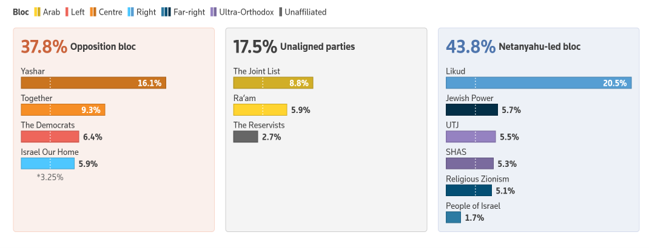
The many parties are organized in the above graphic according to whether they were, before the election, part of the coalition that PM Netanyahu put together to form the previous government – that is the group on the right – or they were part of the coalition of parties in opposition, just like the opposition in Canada’s parliament. That group is on the left. The three parties in the middle were unaligned.
As you can see, the party led by Netanyahu himself, Likud, got the highest single percentage of the vote, 20.5%. Yashar, part of the opposition, got the second highest. That party is led by the fellow who would likely be PM if Netanyahu is not, one Gadi Eisenkot.
In a PRep system, in principle, Likud’s 20.5% of the votes cast implies that Likud gets 20.5% of the 120 seats in the Knesset, so 24.6 seats – and so on for the other parties. Which is silly, of course, as what is six-tenths of a seat? Plus, to get any seats at all, a party must get at least 3.25% of the vote. A party like The Reservists above thus gets zero seats, and the votes they got amount to nothing. The do not go to another party.
Anyway, this means that translating the actual vote into seats in parliament requires a very carefully formulated process to make sure each party gets the right number, without fractions of seats.
According to The Israel Times, below is how the vote outcome above translates into party seats. I figure they got it right…..
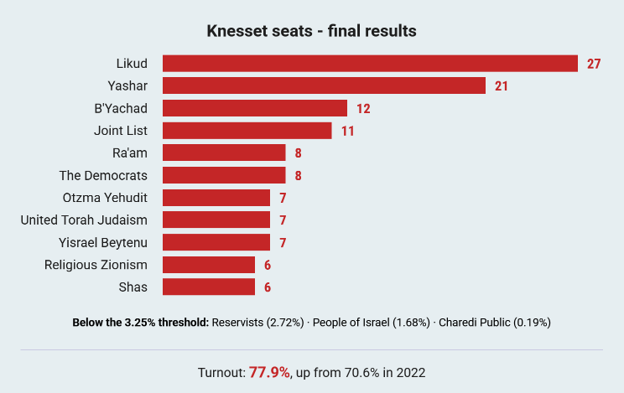
(I assume the reason that Likud got 27 seats rather than the 24+ that I calculated above is that their share of the vote after you throw out the votes for the parties that did not get to 3.25% was greater than 20.5%. But I am not sure.)
Let us take this all back to the perspective of an Israeli going out to vote on October 27. He or she gets a ballot which does not have the names of candidates on it. What it has on it is the names of parties who are in the election. His only role is to choose which party to put his mark next to. The party lists – that is, the list of candidates who each party puts forward – are available to see before the election, but our voter has no say in who is on those lists.
His only choice: given the lists put forward by each party, which party do you choose? (I assume the first name on the Likud party’s list is Netanyahu himself, and so on.)
Note that this means there is no one in the Knesset whose job it is to represent that voter, or any voter. There are no geographic electoral districts. The job of the members of the Knesset is to govern the country, not to represent any particular voters. Peter Fragiskatos, the MP for my fedral riding, has a constituency office in London. I could go there and talk to one of his people, perhaps even talk to him, about some problem I have with some aspect of the federal government. My CPP payments, or mail delivery, or whatever. That is his responsibility, whether or not I voted for him. I did not, but that is beside the point, and he doesn’t know that anyway. There are no constituency offices in Israel, as there are no constituencies.
This is my Objection No. 1 to any notion that we should change our electoral system from PRul to PRep.
People who write about politics, like Andrew Coyne, for example, think our PRul system sucks because, for example, after the recent Quebec election the PQ got some 28% of the vote and won 60 seats, the most of any party. They are forming a minority government (64 would be a majority.). So, they got 28% of the vote and have 47% of the legislative seats, and – that is undemocratic. We should all be appalled.
Well, dammit, that is just wrong. The Parti Quebecois did not get 28% of the vote in that election. The Parti Quebecois was not on the goddam ballot. What happened was that in 47% of the Quebec provincial ridings, the Parti Quebecois candidate got more votes than any other candidate, which means that they were the candidate who the most voters in that riding wanted to represent that riding.
People like Coyne and those in the intelligentsia in general only want to think about an election as a way to form a federal government to run the country. Sure, that is important. But those people have no interest in whether the riding of London West is well-represented by their MP. They care not a whit for that, they want to write and think about Big National Issues.
On the other hand, Coyne, among others, rails at the fact that candidates in local ridings for most parties now have to be approved by the party’s national leader. I think that sucks, too, because it robs us ordinary folks of any say in who represents us. Maybe a lot of people in London West think the candidate for the Conservative party is a thorough asshole. Doesn’t matter a whit if the national party leader thinks he would be useful to him in Parliament.
PRep would be the final nail in the coffin of any notion of local representation in our Parliament.
Ok, on to Objection 2. It is visible in the results of the Israeli election. We have three national parties in Canada, four if you count the Quebec-only BQ, and five if you count the one-seat Greens.
There are 11 parties who will have seats in the new Knesset just elected in Israel, plus the three parties that did not make the 3.25% threshold, but were on the ballot.
Oh, my. You can also see that neither of the two coalitions has enough seats to form a majority this time, which requires 61 seats, although the Netanyahu group has the most, with 53. (Note that Otzma Yehudit in the second graphic is Jewish Power in the first.) OK, folks it’s horse-trading time – what deals is everyone willing to make in both camps to put together a majority?
It will likely be weeks, if not months, for all this to be worked out and a functioning government formed for Israel. If it ever happens, as sometimes it does not, and another election needs to be held.
But, is it necessary for there to be so many parties in a PRep electoral system, or is Israel just unusual (as it certainly is in so many dimensions)?
Nah, many parties is kinda baked into the structure. It’s a feature of PRep, not an Israeli bug. Think about it, if you can just get 3.25% of the national vote, you can have a member in Parliament.
520,00 plus Albertans voted to hold a referendum to separate from Canada this month. 19.5 million votes were cast in the last Canadian federal election, and 520k/19.5m = 2.6%.
Not quite 3.25%, obviously, but there is nothing magical about that lower threshold in Israel, every PRep country has their own threshold. Any move to a PRep system in Canada would require a choice on that score. At 2.5% you could see an Alberta Separatist party with one or more MPs in Canada. And Canada’s Parliament has 343 seats to Israel’s measly 120, so one could easily argue any Canadian PRep system should have a lower threshold.
But the possibilities become endless, which is why this happens. How about an Indo-Canadian party, or a Health Care Reform Party (I might join that one), or the DEIForever party, or the AntiDEI party, and on and on. I bet you can think of a few parties with a shot at 2.5%.
Get a special interest going with above-threshold support, and get a member in Parliament. That is how it goes with PRep. Italy has a PRep system too, and so far as I can determine, it’s Parliament currently has 10 parties with sitting members.
So, no thanks. Canada of all countries does not need a new institution designed to factionalize our politics more than it already is.
As to what will happen in Israel over the coming weeks – Yahweh only knows.