Experiences Unlimited
Readers will know that I subscribe to a number of online media sites, including the Globe and Mail, NYT and the Wall Street Journal. I also use an adblocker on my web browser. For the last month or so, whenever I open the WSJ site, or open a story from the WSJ into a new tab, a large banner opens up at the top of the page, saying something like ‘We see you are using an adblocker. Please turn it off to directly support our journalism.’
An interesting request. The way I see it, I am already directly supporting the WSJ’s journalism by paying them something like $60-$70 Canadian each month for a subscription (the amount varies with the exchange rate). They want me to also see ads, but here’s the thing. All my adblocker does is detect when a website is bringing in content from some other IP address, and blocks it. If the WSJ were to embed any ads they want me to see right into the site – you know, the way ads used to appear in the pages of a newspaper – my adblocker would be powerless to stop them. It can’t tell the difference between an ad and a news story if both are part of the site.
Indeed, the almost-worthless London Free Press website, for which I also have a subscription, is nothing but ads, which must therefore be built into the site. This, plus the minimal news content in The Freeps does put me on the verge of canceling my subscription every time I open it, as the site is all but unreadable due to the ads.
Here’s a screenshot from today’s LFP site:
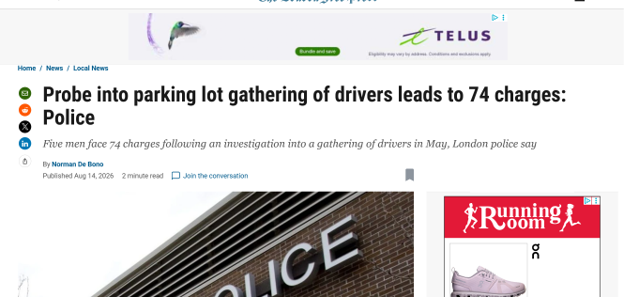
More ads than news is what one is confronted with in scrolling down through the site, as you can kinda see above. Still, I keep the scrip, as I want some source of local news, bad as it is.
Back to the WSJ, my response to this banner popping up all the time has been to ignore it. The content I want to read is all below the banner and free of ads, so it is no more than annoying.. Should the WSJ at any point not allow me to be on the site with my adblocker on, then I would cancel my subscription, but they certainly know that, and so they just go with the annoying banner.
Until today. They have adopted a new strategy now, which I think is called lying. As of today, when I open a story I want to read into a new tab, this appears at the top of that story:
Something is impacting your experience
A browser extension may be affecting how this site works.
Try turning off any ad-blocking extensions to get everything running smoothly again.
In truth, everything is running quite smoothly from my point of view, I can read everything I want to, just as I always could. Why the people in charge of the WSJ site think this is an effective lie to tell their readers with adblockers I cannot imagine.
Now there is one aspect of the WSJ site which is not impacted by anything my browser does, but which I really wish was. As I scroll down, rather than ads popping up, videos are embedded in the site, and when I get to one the site stops me from scrolling down further and turns the goddam video on. I don’t watch videos, I go to news sites run by newspaper people because I expect clear, thoughtful, carefully crafted writing. If I wanted videos there are a thousand podcasts I could watch.
But, neither my browser nor my adblocker is any help with this, I have to shut down each video as I come to it, then click someplace innocuous on the site to resume my scrolling.
I actually complained to the WSJ when these videos first started appearing and trying to force me to watch them, but got no reply.
One final subterfuge in the pursuit of profit, and this one comes from my favourite LBO, the University of Western Ontario. Specifically, it came from this fellow:
Mark Durnin, CPA, CMA, HBA
Director (Facilities Management – Business Operations)
Folks who work at universities, be they bureaucrats or academics just love credentials, so everyone puts as many letters after their names as they can muster up. A recent email announcing some talks by job candidates (I may write more about this faculty opening later) had ‘Dr’ before each candidate’s name and then ‘PhD’ after each name. Y’know, in case you forgot. Actually, the Germans are the best at this, as professors in German U’s have the title Herr Doktor Professor.
Anyway, Mr. Durnin sent out an email about a change in the parking regime at UWO. It does not affect me, as I have an old guy pass that restricts me to paid visitor lots, and this change Durnin is alerting everyone about affects current staff, faculty and students.
Anyone from any of those groups can have any parking permit they like at UWO, as long as they are willing to pay for it. Previously, there were three levels of parking permit you could purchase. The most expensive was Reserved. Paying for that did not actually get you your own reserved spot, but it did guarantee that you could park in one specific lot, and that there would always be a place there for your car, as for each lot, only as many permits as there were spaces were sold.
I had one of those for the Social Science lot during my last 20 years of work. It cost over $100/month, and it was worth it. Some of the other Reserved SS spots were occupied by student-driven BMWs and Audis.
The other two possibilities are a Core permit or a Perimeter permit. Some parking lots are designated as Core lots, those being the ones nearest the buildings at the centre of campus. Other lots are Perimeter lots, and parking there means a long walk. Needless to say, Core parking is preferable, but you gotta pay more for such a permit, so folks had to decide how much they were willing to pay for a shorter walk.
Durnin’s email says the U is eliminating the Core/Perimeter distinction for non-reserved spaces. You get a Reserved permit, or a Non-reserved, and if you choose the latter, you can park in any non-reserved lot – if you can find a space.
So, we know everyone with a non-reserved permit wants to be close to the building they work in, so they will try to park in a Core lot, but not everyone will be able to. Not nearly enough such spots.
So, kids, it’s kinda free-for all time. Folks who tend to arrive early in the morning will have the best shot at the Core spaces, but no guarantee.
Think of it this way. Before there were c people with Core permits trying to find a spot in the C lots that were designated Core, while at the same time there were p people with Perimeter permits trying to find a spot in the P lots that were designates as Perimeter. Once the permits were bought, the two groups did not compete with one another for spots.
Now we have p + c people all competing for spaces in P + C lots. Everyone is competing with everyone for spots. Way more fun to watch, I suppose, but not for those people trying to find a parking space so they can go to work. Durnin’s letter implicitly acknowledges this, by offering the following hopeful sentence:
‘Overall parking capacity remains sufficient to meet the needs of all employees, and lot selection typically stabilizes by Thanksgiving weekend.’
So, a month and a half of chaos, then all should be well. (In fact, student and faculty schedules change every semester, so that is a month and a half of chaos twice a year forever, I expect.)
As I read this, I could not really understand why the Parking gods would do this. Why piss everyone off so? There is nothing in the email to suggest there was any problem with the old system. One can imagine that in doing this they also set a single price for non-reserved permits that generates more revenue than did the old two-price system, but if you just want to raise more revenue from parking, they could have just raised both Core and Perimeter permit prices. They do that every year anyway.
I did not understand the motivation for this until I read this later, less-than-honest sentence in the Durnin email:
‘In response to customer feedback throughout our communications, Parking Services is increasing the number of Reserved stalls in former Core Non-Reserved lots to address greater interest in a Reserved parking experience.’
Once I stopped laughing at the concept of a ‘Reserved parking experience’, the light bulb went on – UWO Parking is adopting the airline strategy!
You know, make flying Coach so unpleasant that more people are willing to pony up for Bus or First Class seats, and to pony up even more for them in order to avoid the nightmare that is Coach.
Indeed, this works even better for parking, because a First Class seat does at least cost an airline more to provide than a Coach seat, since First Class has to mean giving the passenger more room than in Coach. But a Reserved parking spot is the same size and the same cost to provide as any other spot. It just has to get the parking client out of the circus that finding non-Reserved parking will now become.
Ol’ Durnin learned his lessons well when he got that HBA degree. Or maybe it was the CMA. Actually, I don’t know what CMA stands for. Don’t care.
But really, well done, UWO Parking Experience, Inc.