Std Testing
If all the letters in that first word above were in caps, we would be discussing something very different here, but they are not……
This post will likely be a bit long, and it is about post-secondary education, but really about education in general. The facts below come from the US, but I will point out at the end the significance for PSE in Canada, too.
Writing this was triggered by an article in the NYT titled ‘A Great University Undermines Its Mission’ posted on July 6 and credited to the NYT editorial board.
The ‘great university’ referred to coyly in the title is in fact a university system, that of California. Just so all you Canadians and others understand, the state of California does have a pretty highly centralized PSE system. There are a whole whack of publicly funded universities in the state, and the UC system consists of 10 of them, including many you would likely recognize: Berkeley, UCLA (UC at Los Angeles) and UC San Diego. There is a second tier of state universities in California, the ‘Cal State system’ that includes places like Cal State Fullerton and San Jose State – 22 in all. The Cal State system is of lesser prestige and – generally speaking – easier for a student to get into. There is also a large set of community colleges in California, also state funded, and featuring mostly two-year associate degree or diploma programs.
What are not in any of these systems are private universities like USC (the University of Southern California) or Cal Tech, which is also private but subsists largely on government, aerospace and defense contracts. When I visited it some 20 years ago, it had the distinction of having more faculty members than undergrads. It is truly a place for rocket scientists – it houses the famed Jet Propulsion Laboratory, as well as a bunch of economists. And some historians, even. Go figure. Cal Tech is certainly elite, but is not part of the UC system.
Back to the UC system and the NYT editorial, it opens by noting that in 2019…..
‘….the University of California system appointed an 18-member committee to study the use of standardized tests in its undergraduate admissions. The committee included professors from all 10 campuses and a range of disciplines. They spent a year studying the issue and published a 225-page report full of evidence and recommendations.
The committee concluded that scores on the SAT and ACT, the main standardized tests for college admissions, did a better job measuring student readiness for college than high school grades. High test scores were particularly good at finding talented students from low-income families and underrepresented minority groups. For these reasons, the committee recommended the system continue to require applicants to submit SAT or ACT scores.
The university’s leaders disregarded the report.
The ‘university’s leaders’ are its Board of Regents, and they are the ones who ignored the report by declaring that these tests no longer be used for admission into the top-tier UC system.

The EB at the NYT, not exactly a haven for right-wing extremists, write about what has happened since that decision. I will just provide you with quotes from the editorial itself:
At the University of California, San Diego, a faculty group last year reported “a steep decline in the academic preparation” among entering students. Last fall, for example, nearly 12 percent of first-year U.C.S.D. undergraduates were not qualified to take pre-calculus, a low-level class, up from only 0.5 percent in 2020.
Reading and writing skills have also deteriorated, and professors say they must spend time teaching elementary skills. “After the SAT was dropped, I got students who could not write a sentence,” said Janet Sorensen, an English professor at Berkeley.
More than 1,500 science and mathematics professors, including the chairs of more than 60 departments, have signed a letter asking the university to reinstate the test requirement. More than 700 humanities and social sciences professors have signed a similar letter.
Why do these faculty want these tests again used for admissions? Below is a graph which shows the fundamental reason, which can be stated in a sentence:
Scores on these standardized tests are a better predictor of success at university than any other measure available, and in particular better than high school marks.
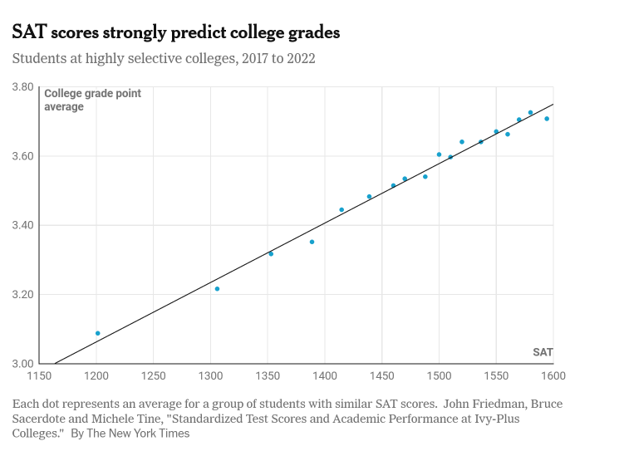
Note please that the students whose data is depicted on this graph includes only ‘students at highly selective colleges’ where colleges is what Americans call universities. But those 10 UC campuses are supposed to be precisely that. The Cal State system is there for less highly-achieving students.
However, let me show you another graph from the article:
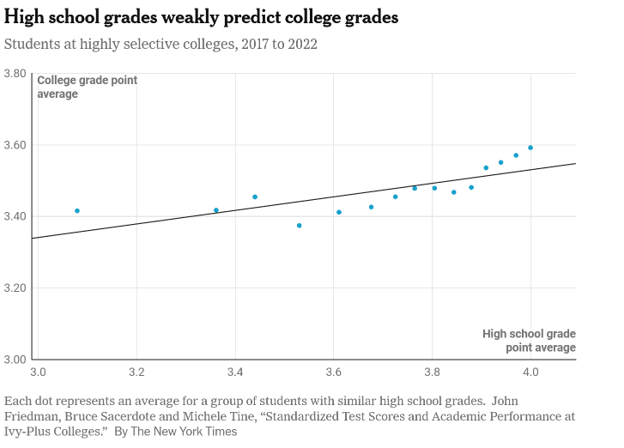
You can see the caption, and no comparative statistics, not even correlation coefficients, are provided by the EB. Although I will grant that I am sure that any such stats would clearly show that the SAT test is better than HS grades at predicting grades in university, it can hardly be said that HS grades are worthless in predicting university grades. They are just not as good, as indicated loosely by the tighter adherence to the line in the first graph.
Fine, fair enough. And, the reason the NYT published this editorial now is that the UC Board is about to meet to consider reinstating the use of these tests in admissions. The EB is trying, as EBs do, to convince them to do so. Again, fair enough.
But what the editorial ignores is the elephant in the story. If it is true that the UC system is admitting thousands of students unable to do even pre-university calculus, or to write a sentence, then is not this story really about what is going on in California secondary schools? Clearly HS students in California are graduating with grades good enough to get into the UC system even though they don’t know basic math and writing.
Reinstating the tests is a solution to this only in the sense that the HS teachers cannot influence the marks their students get on the SAT, other than by doing a better job of teaching them what they need to know to succeed in university – which is what the UC profs want.
I suspect all those distressed UC system professors understand this, and understand that it is out of their power to get the High Schools to do a better job, so they turn to the reinstatement of the tests to do it for them. If a HS finds that many of its ‘top’ students are bombing on the SAT, and so not gaining admission to the UC institutions, parents with aspirations for their kids will get upset, and maybe things will change at the HS level in California. Maybe.
Opponents of standardized tests, including those given to students in the Ontario primary and secondary educational system, are wont to complain that they force teachers to ‘teach to the test’ rather than teaching important knowledge and skills. Well, ok, but in a system in which students are being taught little, ‘teaching to the test’ is a big improvement, as it means something is being taught.
Let me say that I hold no reverence for standardized tests. Their one advantage is that they cannot be gamed by HS teachers, which is why such teachers – and their unions – are mostly against them. They provide a (admittedly imperfect) audit of how good a job those teachers are doing.
I began my career as a University instructor back when the Ontario secondary system still had a requirement that to go to University a student had to complete Grade 13. It was their performance in that year that determined which, if any, Ontario university they could enter.
Coming from the US, as I did, I was (happily) astounded at how good and well-prepared were the students who entered UWO. However that system worked, it was operated with integrity, and did a good job of sorting students out by ability. You don’t need an SAT test, you just need a system that imposes genuine academic standards, and it seems that right now the UC professors see the SAT and ACT tests as their only route to that happening.
Of course, Grade 13 disappeared in Ontario long ago, and I spent 40 plus years witnessing the decline in the abilities and preparation of students at UWO.
That all being said, let me point out something I came across after reading this NYT editorial. It is a paper published by the National Bureau of Economic Research in the US, which means, I hasten to add, that it has yet to be peer-reviewed.
It’s titled REASSESSING THE ROLE OF STANDARDIZED TESTS IN UNIVERSITY ADMISSIONS, is written by four economists (yea, those folks) and it seems to offer a counter to what the EB and the committee of seven years ago in the UC system had to say.
I have not yet read the entire paper, it’s a long one, but in its Abstract is included the following:
Consistent with past work, we find that GRE scores substantially improve predictions of first-year grades relative to predictions based on GPA alone. However, when these predictions are used to inform admissions decisions, we find that test scores only modestly improve the expected academic quality of admitted students.
The GRE is a standardized test used to screen students who already have undergrad degrees and are applying to a graduate program. So, this is not the same kettle of fish as discussed above; the students in question have already succeeded in some kind of undergrad program. And, the authors also note that their study is confined to a decade’s worth of applicants to one master’s program in public policy. (I confess to being suspicious of all PP programs.) Still, there is reason to have a look at this recent research – you can be sure I will – and report back.
Based on my experience as a faculty member, I think the overall problem is the refusal of those throughout the education system in Canada and the US to maintain standards. The inflation of HS grades in Ontario during my career was massive and unmistakable, and Ontario universities have never used standardized tests of any kind in their admission decisions. Basing university admission on HS marks has led to the same problems that the UC professoriate is complaining about – that is my strong opinion.
Stay tuned.