Doing the Reciprocity Shuffle
The things you can learn by reading a book. I have been working my way through The Penguin History of Canada lately. It has been on my bookshelf for ages, and I have no memory of how or from where I got it. It was published in 2006, so it ends with the first Harper minority Conservative government, but starts waaay back with what is known about the first humans to inhabit the current territory of Canada.
It is not a great book by any stretch, and rather condensed, covering hundreds of years of recorded history in just over 500 pages. Still, one can learn things from such a book, and one thing I recently came across that was illuminating was a discussion of The Canadian–American Reciprocity Treaty of 1854, also known as the Elgin-Marcy Treaty.
Now, despite that name, this was legally a treaty between the US and Great Britain, as Canada was not yet a country in 1854. The chief negotiators were James Bruce, the 8th Lord of Elgin for Great Britain, and William L Marcy, Secretary of State for the US, and it did concern trade between the US and what would later become Canada.
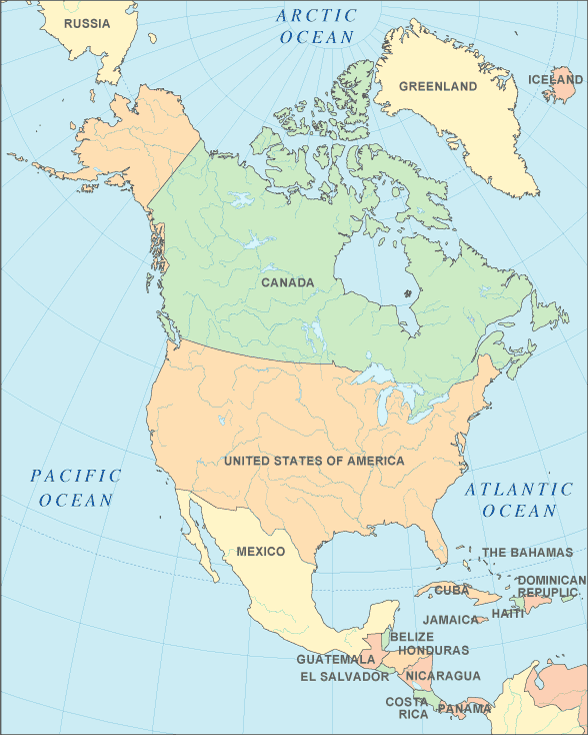
Britain’s North American colonies had up to 1846 done most of their trading with the mother country. Britain in those years had high tariffs on most imports, including those of food and timber, due to what were known as The Corn Laws. The Colonies were given ‘Imperial Preference’ in England, however, and so escaped the tariffs that the Brits imposed on, say, wheat imported from the US. However, in 1846, seized by a fit of ‘Free Trade-itis’, Britain axed the Corn Laws, which meant US grain and other products could be imported free of tariffs, also. This put a big dent in the amount of staples of all kinds that Britain imported from Newfoundland, the prairies, and Upper and Lower Canada.
This gave the merchant and agricultural interests in those colonies the idea to see if they could get access to the US market for their products, which was in those days also protected by pretty high import tariffs. The remarkable thing was that it worked. An agreement was reached, and listed most colonial raw materials and agricultural produce, most importantly timber and wheat, as goods to be admitted duty-free to the US. The treaty ended the US 21% tariff on natural resource imports, at least those from north of the US border.
In exchange, the Americans were given fishing rights off the East Coast. The treaty also granted navigation rights to each other’s lakes and rivers.
In those days, the treaty was championed by the Democrats in the US, but the Republicans, the party of business, opposed it. It should be said also that at this point the Democratic party in the US was the pro-slavery party, while the Republicans would soon nominate Abe Lincoln, the Great Emancipator (as some call him) for US President, marking the start of the Civil War.
I have read a claim, hard to substantiate, that this was one of only three trade treaties signed and ratified (by the Senate, as must all treaties be) by the USA in all the years between 1789 and 1931. That’s a long time.
The general consensus seems to be, as far as I can tell, that this treaty didn’t have much effect on the already-larger US economy, but it did do a lot for colonial exports. They grew by some 33% in ten years, while the US exports north grew by only 7%.
Part of this was due to the fact that when the US Civil War broke out in 1861, the British colonies did a nice business in keeping the northern states of the US supplied with agricultural and raw materials. It is often said that war is good for business, if not for human beings. That being noted, it should also be pointed out by your former-economist correspondent that it is quite difficult to determine how much of that increase in exports to the US can really be attributed to the treaty. There was a lot going on, on both sides of the border in those years.
However, nothing is either all-good or all-bad. The treaty reduced tariff revenues to both the British colonial governments and the US federal government, in an age when tariffs were the primary source of tax revenue for both. Further, the increase in north-south trade reduced east-west trade in Canada to some extent, which reduced the profitability of the recently built canals in the future Canada.
The treaty was set to have a ten-year term, after which it could be abandoned by either side with one year’s notice. In fact, the treaty was abrogated by the US in 1866, a year after the end of the Civil War, and a year before Confederation. I can find nothing coherent regarding why that happened, although it was certainly the case that the Republican Party was the party in power in the US at that point, still.
Whatever the reasons, one source I consulted suggested the abrogation in 1866 did not have all that much effect on British North America. Here’s an extensive quote from one retrospective study in The Journal of Economic History from 1968:
Trade with the United States briefly declined from the stockpiling peak of 1865 but by 1870 was as high as ever. Among the British North American colonies trade expanded rapidly, with exports from [Upper and Lower] Canada to the Maritimes rising from $935,000 in 1863 and $1,571,116 in 1865-1866 to $3,418,000 in 1866-1867. Exports to Britain doubled from 1867 to 1874, and Dominion revenues reflected this prosperity, also doubling over this period. Customs revenues increased by $5 million to $14 million and tax returns increased 60 percent.
Hey, maybe there’s a lesson here. Trade deals with the US might not be the most important thing for Canadian prosperity. Really.
Notably, after Confederation both the US and the new country of Canada put up significant trade barriers. A second reciprocity treaty was negotiated between the US and Canada in 1911, over 40 years later, between Sir Wilfred Laurier’s Liberal government and the US administration of William Howard Taft. Ah, but then…..politics – Canadian politics.
The Conservatives made reciprocity the central issue of the 1911 Canadian Parliamentary election, warning that this new reciprocity treaty would turn the economy over to American control. The Liberals were decisively defeated in that election, and Robert Borden’s new Conservative government refused to sign the treaty.
Ya just never know, eh?