It’s A Bad Idea But Let’s Do it Anyway
That’s a line from a great tune by Tommy Castro, and it applies to a story that came up in the news this week. A company called Quebecor, of which I previously knew nothing, has proposed that it buy Telus for some $31Billion in cash and shares.
Telus I know, as they are the carrier for my cell phone, and also bought up my internet service provider, Start, some years ago. Apparently Quebecor provides cell service to customers in Quebec, and the graphic below gives you a good idea of the relative size of the four wireless companies in Canada, based on revenues.
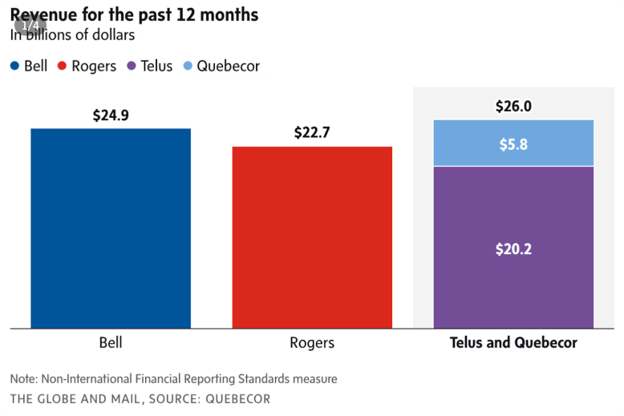
The graphic comes from the Globe, but it is notable that its original source is Quebecor itself, so I advise skepticism. One source I read describes Quebecor as a national wireless carrier rather than one that operates only in Quebec, but if that is true, Quebecor is certainly the smallest of the four by a big margin.
(Apparently, Quebecor provides service through its ownership of Freedom Mobile in Ontario, Alberta and British Columbia.)
I have to admit the first headline I saw about this in the Globe surprised the hell out of me. I have not kept up completely with the workings of competition policy in Canada since I retired, but I know Parliament recently updated the key legislation in that area, known as The Competition Act. That update made the requirements that a merger not increase industry concentration even tighter than they were, and also eliminated the ‘efficiencies defense’ as a way to get a merger approved. The ‘efficiencies defence’ allowed the Competition Bureau to approve a merger if the firms involved could show the merger would lower costs enough, even if those cost reductions did not result in lower consumer prices.
So, my thought was – how can Quebecor possibly think this purchase of Telus would be allowed by The Competition Bureau? A big part of the Quebecor CEO’s initial pitch on this merger centred on the cost savings it would generate – but those no longer count in any decision to approve. Beyond that, one writer on the topic has already run some numbers (which I have not looked into deeply) which suggest allowing this merger would run roughshod over the new, stricter limits on increasing concentration that were just adopted.
How can Quebecor’s brain trust think this can possibly happen?
Well, there is the law, and then there is reality. I am quite sure that the fact that Quebecor is a, you know, Quebec company will get mentioned more than a little, particularly by the firebrand of a PQ Premier who just got elected in that province.
And, for a more national push, the need to have firms in Canada that are ‘national champions’ is sure to get mentioned, as it so often does. Just what qualifies any firm as one of a country’s ‘national champions’ has never been clear, but plenty of people would point at Bombardier as an example. To get an idea of this sort of thinking, here’s a quote from a Globe article on this:
Mr. Péladeau says a combined Quebecor-Telus would invest more, save hundreds of millions of dollars a year and help a Canadian-controlled champion stand up to global tech giants and satellite operators.
Can you just see Péladeau, the Quebecor CEO, striding around a boxing ring with his arms up, having KO’ed some international ‘tech giant’ using the biceps that the acquisition of Telus gave him?
This is not boxing, it is supposed to be about delivering low-cost and reliable cell service to people in Canada.
It would seem this idea has no hope of getting regulatory approval, but these are not ordinary times. Mr. Péladeau has apparently been bandying the word ‘sovereignty’ about in his pitch, also, and according to another Globe article,
The sessions focused on sovereignty and the need for domestic telecoms that can compete with Elon Musk’s Starlink, Mr. Péladeau said in an interview on Monday. He said the politicians listened intently and made no promises. Clearly, no one in Ottawa threw up a stop sign.
The same article notes that –
Ms. Joly, speaking for a Prime Minister who coined the term “rupture in the world order,” opted to use the word “sovereignty” or “sovereign” three times in a brief statement on the potential marriage of Quebecor and Telus.
Also….
At no point did Ms. Joly mention the concept of preserving four domestic wireless platforms as the solution to rising cellphone bills.
Ms. Joly, you may remember, is our Minister for Industry. How having three Canadian national wireless providers rather than four will enhance Canadian sovereignty, I cannot possibly guess.
So, hang on to your phones, folks. Mr. Peladeau has likely figured out that ‘elbows up’ might give him the permission to buy Telus and become a much bigger competitor in the Canadian telecom market. (I wonder if he will get paid more if that happens. Hmmm.)
What do you think such a merger will do to your cellphone bill, kids? No, no, don’t ask Claude, what do you think?