War is Hell, Just Not For Everyone
I write to try and provide some perspective on what has happened recently regarding the ‘tariff war’ between the US and Canada, since it got another boost at the beginning of this month. Most of what I read in the press about it I find deeply uninformative, and I was an economist for a long time. If I’m confused, perhaps you are, too, so this is an attempt to make things clearer. Hopefully…..
Let’s start simple. In 2023 (the most recent annual figure I could find), Canadian exports to the U.S. totaled $368.5 billion. All numbers quoted here will be in US dollars unless otherwise noted, because that is the standard unit used for nearly all international transactions.
The tariffs Trump imposed when the trade talks broke down are levied on 5% of US imports from Canada, we are told. I presume those will be greater by 2026 than that number from 2023. So, 5% of (say) $380B means some $19B of Canadian exports to the US now have these 50% tariffs levied on them by US Customs when they enter the US.
There is no doubt that a 50% tax – because a tariff is indeed a tax – is a BIG goddam tax on anything.
The effect: whoever in the US was buying those tariffed goods is going to buy less, perhaps none, and what they do buy will be more expensive, because the prices will rise. No exporter of those goods from Canada to the US is likely to lower their selling price by 33%, which is what would be required to have the post-tariff price to a US buyer stay the same. [Arithmetic — If you were selling in the US before the tariff for $1, then after the tariff is imposed you can lower your price to $0.66, which, with a 50% tax added once it enters the US brings the price to $0.99]
On the other hand, the harm those tariffs do in Canada is to the firms that were selling those products to buyers in the US. The higher tariff-inclusive prices in the US will mean fewer purchases. If they do lower their prices to absorb part of the tariff, then they will also earn less profit on what they do sell.
The harm in the US is to those who buy those imported goods from Canada, in that they will pay higher prices if they can get them at all. Or, the US buyers might switch to non-Canadian suppliers, but their prices will be higher, because if they were not, the US buyer would have bought from the non-Canadian sellers without the tariff. It is indeed possible that some products will simply no longer be traded between the countries at all, since a 50% tariff could be big enough to make any such trade entirely unprofitable. We are going to find out which ones, I guess.
All of this works in reverse regarding the 50% counter-tariffs Carney put in place in Canada on goods imported from the US. These hurt Canadian buyers of those products in the same way, but also hurt the US sellers by reducing the Canadian demand for their products.
Carney imposed those tariffs on a set of goods whose value as imports came to the same number – about $20 billion. That is what he meant by ‘dollar-for-dollar counter tariffs’.
If you like you can go here and read just which products from the US the tariffs are being imposed on come Sept 8. Note that it states that tariffs are being imposed on $27.6B of goods going each way, but that is the number in Canadian dollars, that being a Canadian government website.
The other thing to note about all this is that in my attempt to explain who and how is hurt by these tariffs and counter-tariffs, at no point did the names Trump, Carney or Ford appear.
Other things worth noting.
- Tariff ‘war’ as an unfair fight. Canada’s David vs the US Goliath.
That characterization refers to the fact that the USA imported $3.35 Trillion in goods from the world in 2024 (the latest year I could find a reliable figure for). Yes, that is Trillion with a T, and if you get out your calculators class, you will see that $20B is about six-tenths of one percent of $3.35T. That is, 20B/3.35T is about 0.006.
In other words, the amount of Canadian goods that the US has imposed tariffs on is a tiny fraction of what they import. The amount of damage done to the US by what Trump did last week will be small, to say the least.
On the other hand, Canada imported some $US564B worth of goods in 2025, so that same $20B worth of US imports that Carney put the 50% tariffs on represents some 3.5% of the value of all goods imported into Canada. Not a massive percentage either, but 0.035 is nearly six times as big as 0.006.
You could do the same calculations for the numbers as a percentage of what each country exports to get a feel for how hard the various producers in each country are being hit. The numbers would be different, but the conclusion that the percentage hit on Canadian producers is much greater than on US ones would stand.
So – David, meet Goliath.
What seems to me to be likely to be more important for determining what happens next in this trade war is the politics of it. As in any war, if regular folks start to get upset about the damage they are taking – and they are always the ones being damaged, just like in a shooting war – the pressure will build on the respective governments to try for a truce.
My impression is that right now Carney has more public support for this war than does DJT, but my impression is also that DJT does not generally give a flying fuck about what the public wants. If he thinks he’s right, and he typically does, that is what counts with him. Maybe the US midterm elections will change that. Again, we will see.
- Targets
Those percentages are of course meaningless for most people. If you are operating a business in Canada that sells nothing to the US and that buys no significant inputs from the US, then the impact on your business and your employees from all this will be pretty close to zero. But if you are very much in the business of exporting to the US or using US-produced inputs (that are on Trump’s tariff list), this all could be very bad for your company’s bottom line. As always, the pain is not going to be spread evenly.
And, let us not forget, some Canadian companies may benefit from these tariffs. If you are selling something in Canada for which a major competitor is a product imported from the US, a Canadian tariff on that product will make it possible for you to sell at a higher price and/or sell more. Same goes for US producers competing with tariffed Canadian imports.
For us Canadian consumers, things are even murkier. You can go to that page above and read through the list of 648 US products that will have a 50% tariff imposed on them by our government as of Sept 8, and try to figure out how much more expensive your future trips to the grocery store or Canadian Tire will be. We Canadians buy a lot of stuff that originates in the US, but then we also buy a lot of stuff that originates in China. The last time I bought lemons (I make kick-ass lemonade in the summer) they came from South Africa.
Canada buys stuff from all over the world, and there is no way to predict how much those 50% tariffs will raise the prices we pay for US-originating goods, as we don’t know how much of those tariffs the sellers will eat. Maybe none, maybe a lot.
It’s complicated, as I often write, but I really really doubt it will be fatal. Some folks will take a big hit, others will be relatively unscathed, and we will all see some price increases.
One thing is quite clear. It was Doug Ford, not Mark Carney who insured that I can no longer drink Bourbon, no matter what price I might be willing to pay for it.
Which brings me to –
- Other strategies.
This comes up only infrequently, I suspect because there is no way our Canadian Federal government would seriously contemplate going this route, but it is an available strategy.
The mirror image of an (import) tariff is an export tax. During the early years of US Prohibition, it was perfectly legal in Canada for Canadian distillers to sell whiskey to the US – so long as they paid the Canadian export tax on it before it left the country. (What happened to it then was of no concern to the Canadian government, after all.)
Well, it is obvious to anyone who knows much about Canada/US trade that if Canada wanted to do something that would not be easily shrugged off by the US economy, it could put export taxes on two goods before they are shipped to the US: crude oil and potash.
Potash is used primarily as an agricultural fertilizer (plant nutrient) because it is a source of soluble potassium, one of the three primary plant nutrients. Canada’s province of Saskatchewan has a lot of potash, and it sells much of it to fertilizer producers in the USA. Here’s a quote from the US publication Fertilizer Daily:
Currently, the U.S. imports about 90% of its potash, predominantly from Canada, the leading global producer.
The US of A would definitely notice the imposition by Canada of a 50% export tax on potash. DJT, being not hopelessly dense, has not put a tariff on imports of potash from Canada.
Nor has he imposed an import tariff on Canadian crude oil, most of which comes from the Alberta tar sands these days.
Here is a graph of the history of US annual imports of Canadian crude oil and other petroleum products. It’s from the US government’s Energy Information Administration.
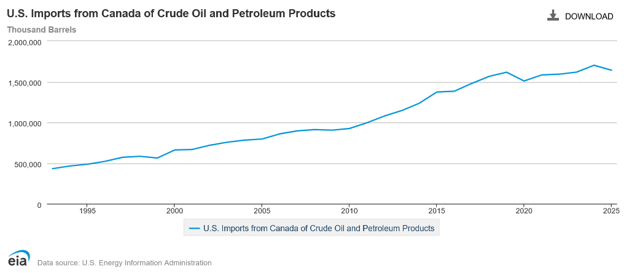
Those imports have more than tripled since 1995. Here’s a line on the most recent year of this history, from Stats Canada:
In 2025, Canada provided 63.4% of the crude oil and close to 100% of the natural gas imported by the U.S.
None of those ‘zero out to two decimals’ numbers here, folks.
So, the US of A would also notice the imposition of a Canadian export tax of 50% on oil and natural gas, especially the latter.
Export taxes are not really different from tariffs, except for the accounting details. Both hurt those on both sides of the market, so these possible Canadian export taxes would hurt US buyers of potash (fertilizer producers, mostly) and crude oil and natural gas (refiners and utility companies, mostly).
They would also hurt the potash miners in Saskatchewan and the oil sands companies in Alberta. Just like in a shooting war, the Big Question is – ‘who’s volunteering to take out that machine gun nest?’
The headline on an August 26 article in the G&M read:
Alberta, Saskatchewan push back on calls for oil, potash export levies in retaliation for U.S. tariffs
Well, sure. Those provincial governments are pushing back against measures that would hurt firms in their provinces.
The quote below from that article refers to the Premiers of those two provinces, Danielle Smith and Scott Moe:
They voiced support for Ottawa’s planned dollar-for-dollar countertariff strategy, while simultaneously railing against the idea of using the industries that underpin their economies in the fight.
Yes, it’s not our job to take out the machine gun nest, but we will certainly voice support for doing so. Interestingly, neither Alberta nor Saskatchewan have pulled US booze from the shelves of their liquor stores. (Too bad for me, here in Ontariario.)
I finish with this quote from the G&M article:
Mr. Moe, like Ms. Smith, emphasized that he is on board with Canada’s targeted retaliatory tariffs.
“But only when those tariffs are focused and targeted to have a minimal impact on Canadian industries and families – and a larger impact on our trading partner that we want to bring back to the table,” he said.
See, that’s the thing. Anything that has a large enough impact on the US (our beloved Goliath of a trading partner) to bring them back to the table must, necessarily, have a large impact on (some of) us.
And a 50% tax on something the US gets 90% or 100% of from Canada – I’d say that qualifies as large, even in the US.
Taking out a machine gun nest is a very risky thing. Hard to find volunteers.