Homelessness and the Globby Mail
It has been my impression for some time that the quality of the Globe and Mail newspaper, not terribly high to begin with, has been deteriorating noticeably in the last couple of years. This is just an impression, fueled partly by the proportion of fluffy articles that appear on its website, like the one titled ‘The Birkin index: Should this pricey handbag be part of your portfolio?’ in today’s paper. Yes, I know, all papers publish that kinda stuff, it’s all about eyeballs.
However, today’s website also included an article on a serious topic, homelessness, with the title ‘Rising cost of low-end rental units driving increase in homelessness, report shows’.
The writer is one Alanna Smith, said to be a ‘Health Reporter’, and she, and the Glob, should be ashamed of themselves.
The article relates the results of a ‘first of its kind national analysis’, contained in a report by The Canadian Alliance to End Homelessness.
Nope, never heard of them either. It’s chief executive is one Tim Richter, and here is what the Glob says he says about the report:
He said it has long been assumed that homelessness is driven by housing-market conditions, but this research is among the first to make that case by comparing changes in the rental market with homelessness rates, using data from 2018 to 2024.
Mr. Richter said the analysis also challenges common assumptions that other factors, such as mental health, substance use and poverty, are the reason behind climbing homelessness rates.
I suspect that author Smith did not actually read the report, as I seriously doubt she would be capable of doing so. More on her below, but I went to that org’s website, and with some difficulty found a pdf of this report. It’s title is ‘Homelessness is a Housing Problem in Canada: Preliminary Findings’.
You say ‘preliminary findings’, I say ‘bullshit’.
Let me explain the basis for the claim in that first quoted sentence above, Saying that they compared changes in the rental market with changes in homelessness rates. These intrepid researchers picked 36 cities, and regressed variable H on variable R for those cities. Variable H is the percentage change in the count of homeless from a federal survey. They have three years of these counts. The variable R is the percentage change in the average lowest-quartile rent, from CMHC data for those same 36 cities.
They used a simple statistical software package on that data – there are many such packages – to do a linear regression of variable H on variable R. Acrobat no longer lets one copy things from a pdf file without payment, so I have reproduced a reasonable facsimile of the graphical display of what this package spit out below, drawn on my own. The original in the report also includes blue dots that are supposed to represent the actual data points, I presume. I did not reproduce those dots here.
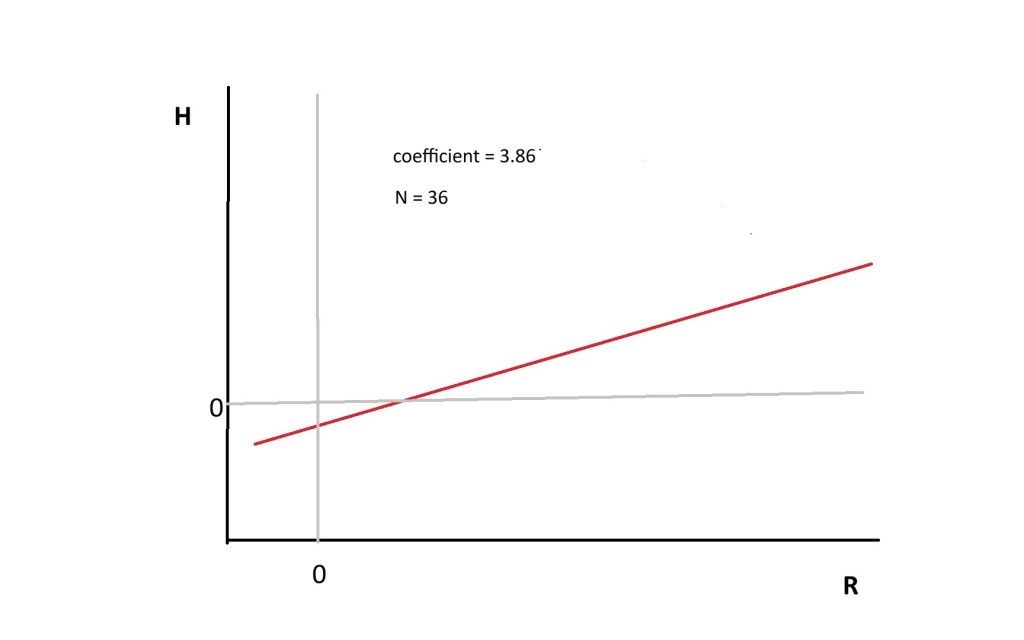
The N = 36 is in the original graph, and this is a puzzle. They claim to have used data from 36 cities, but they also claim to have three observations of the variables for each city. That implies 3 X 36 = 108 data points, not N = 36.
Either way, they ran their data points through statistical software and it produced a linear equation with the coefficient of 3.86. Specifically, it spit out the equation H = a +3.86R, where a is some number that they do not report, but which every such package produces. The coefficient of 3.86 on R, being positive, is why that red line in the graph slopes up, and why they claim that increases in the rents on low-rent housing leads to increases in homelessness. Is that 3.86 coefficient statistically different from zero? Don’t know, nothing is said about that, either. With only two variables and 36 data points (or perhaps 108), it probably is, but that is rather beside the point. Look at the second sentence in the quote above, the one about the ‘analysis’ challenging common assumptions about the other causes of homelessness.
If your analysis includes variables that capture none of these other potential causes, then just how does it challenge those assumptions? These bozos could have gotten data on drug ODs, mental health cases, poverty rates and included those in their regression. That is called multiple linear regression, and any econ undergrad knows how to do it. Of course, with all those other variables now in the analysis, statistical significance becomes rather less likely. And there is no reason to expect the coefficient attached to the variable R would any longer be 3.86 once you added those other variables. Hell, it might not even be positive. But why go to all that trouble, eh?
Nope, get the bullshit result you wanted from the start and publish it.
Actually we could go these folks one better and do a simple regression of their homelessness measure H on any one of a billion other single variables….S, T, U, V, whatever. If we did that, the statistical package would sure enough spit out a coefficient, just as it did for R, no matter how idiotic were the other variables we chose. Stat packages have no brain, you put in data, they spit out numbers. Always. Think of all the ‘causes’ of homelessness we could uncover using this study’s approach. Better, if the package happened to spit out a negative coefficient for any variable we came up with, we would have found a cure for homelessness. More S means less H, hurrah!
Sigh…..
That such utter bullshit would be printed and touted by this org is not surprising. They are a non-profit with no actual interest in ending homelessness – that would put them out of business, eh? – but rather an agenda to push. All’s fair in love and propaganda.
But, for the Globby Mail to uncritically repeat these claims is unforgiveable. Sadly, Alanna Smith’s profile on the Glob includes this: ‘She holds a Bachelor of Journalism and Women and Gender Studies from Carleton University in Ottawa’. So, Ms Smith learned nothing in her time at Carleton that would enable her to ask questions about statistical significance or credible science. I really doubt she read the actual report, because it does have numbers and data in it. Gender studies people don’t do numbers, generally.
Her job is to repeat the party line; it’s not their fault and governments have to give people more stuff.
And The Glob should really be ashamed.