Stay Calm, Everyone
I seem to be writing a lot about traffic of late, but it has become a prime topic of conversation in my fair city. I wrote in an email to my gal a while back saying that ‘I can’t get anywhere in this town’, which she suggested – accurately – sounded like a country music song title. Be that as it may, I am not the only one to express such a sentiment.
A major reason for this is that some years back our fearless city leaders embarked on a plan to cover the city (some of it, anyway) with what they call Bus Rapid Transit. This involves doing many things, including installing previously non-existent dedicated bus lanes on some of our major streets. This, in turn, requires tearing up said streets, for looong periods of time, leading to traffic re-routing leading to traffic congestion. OK, can’t have BRT without breaking some eggs, I get it, but some of the things that have been done have been insane. One street downtown, King, got torn up for months then put back together three different times in two years. Great planning, eh?
But my topic for today kids is what is going on in my general area of Old South. This is bounded on the east and west, respectively, by Wellington Road and Wharncliffe Road, two north-south four lane (or more) thoroughfares.
Wellington Road is set to have the BRT run right down the middle of it, so they are tearing it up going south out of downtown. This too, has been going on for years, but the tearing up has recently reached the area near Old South.
I live between Wellington and High Street, another north-south street that is not a thoroughfare. Two lanes and no traffic lights, although busses do currently use it. A few weeks ago some new structures appeared on High Street, structures that traffic engineers refer to as ‘traffic-calming measures’. The ones nearest where I live are depicted in the photo below:
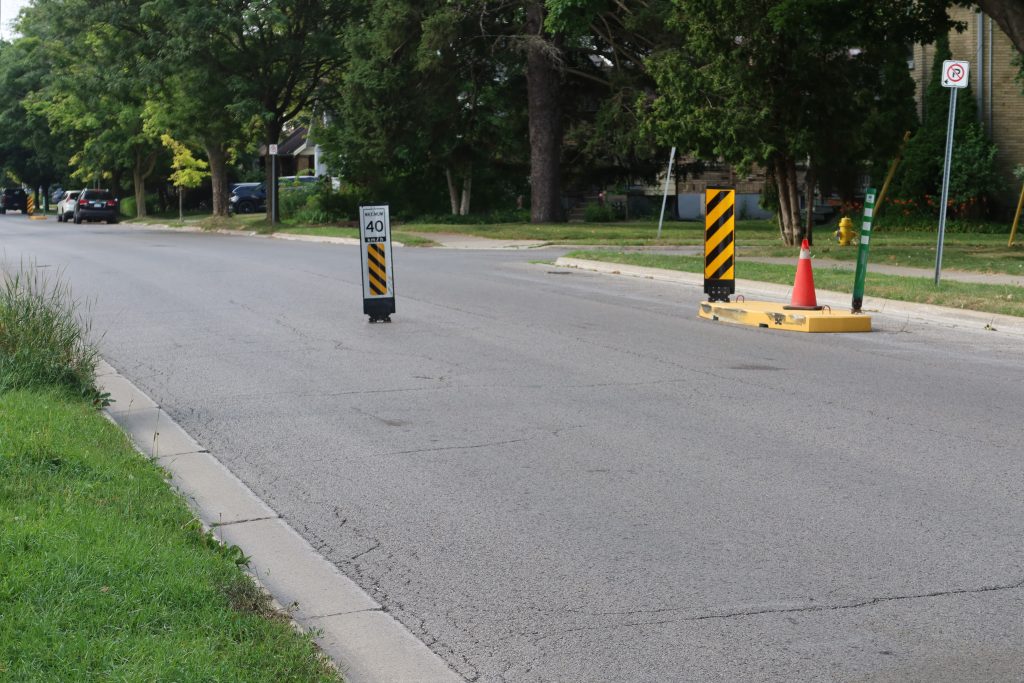
This faces south on High, so traffic heading south is supposed to drive between that 40km/h sign and the yellow island, while the traffic heading north is supposed to go on the other side of the 40km/h sign. There is room to the right of the yellow island for a bike to ride through, also.
Whatever the engineers call it, the point of this is to get traffic on High to slow down, but first let me explain why these suddenly appeared there. I doubt anyone in the City will say it out loud, but once the BRT construction hit Wellington Road and Commissioners (the southern boundary of Old South) and turned one of the busiest intersections in London into a parking lot, people started looking for alternate routes. If you are trying to drive north or south, High street is the first north-south street west of Wellington. So, traffic volumes went way up on High from traffic that would otherwise be using Wellington, and those diverted drivers were pissed off and in a hurry.
Enter ‘traffic calming’, which of course really means ‘traffic slowing’, and the first question for today’s class: do these things slow drivers down?
I have been observing this closely, one of them being a half block from my house, and the answer, as so often out in the world is – yes and no.
I saw some people stop when they drove up to one of these structures, presumably puzzled as to how to navigate it. That is a rare reaction, but in general, people have two reactions. One group, the FDs (Fearful Drivers) invariably hit their brakes as they approach and go through a traffic-slower. Other people (like your correspondent) realizing that the space one drives through is big enough for a city transit bus to get through comfortably, don’t even notice it is there.
I’m gonna suggest that slowing down those FDs is kinda pointless. They are not the people who would be driving at speed through Old South in any case. They find speed (and turning and many other aspects of driving) too frightening to do anything remotely non-calm. The rest of us are not slowed down at all.
However, none of that applies to another kind of structure which also appeared on High Street, but for reasons I cannot figure out, only at the southernmost end. There you will find two consecutive structures that look like this:
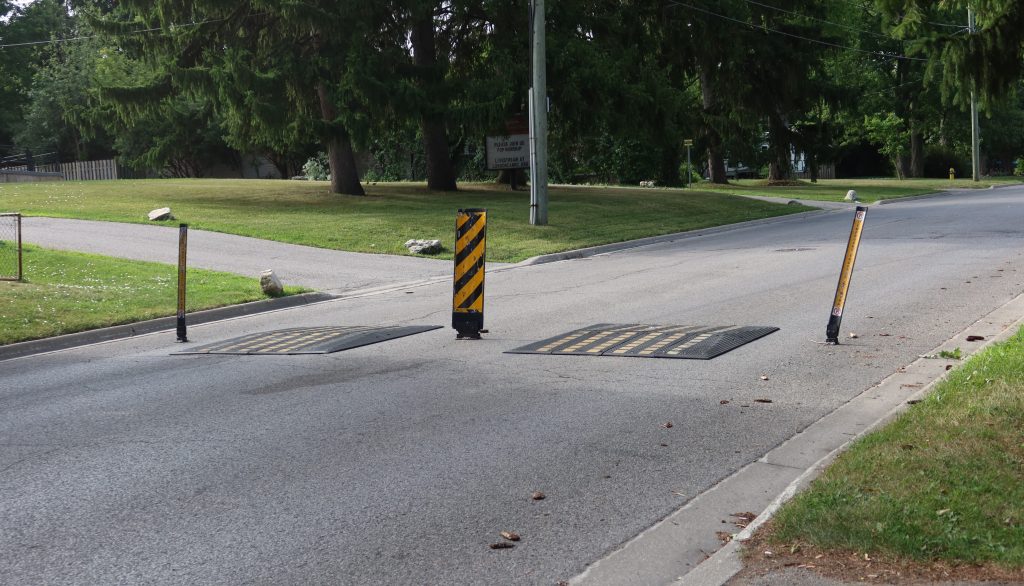
No yellow island, but there are two black and yellow….let’s call them humps….between the center post and outside posts. Traffic in either direction must go over these, and there is the point. London is full of speed humps similar to these, but which are built right into the asphalt. Those asphalt humps don’t slow anyone (like me) down very much at all, as one quickly realizes that if you straddle one evenly as you drive over it, your car’s suspension gets less of a jolt than it does from the average London city street pothole.
Trust me, folks, if you come upon humps like the ones above, slow down. I found out the hard way that going over one of those at even 40km/h will rattle your teeth, and not do anything good for your car’s suspension. I don’t know if they are higher or wider than the asphalt ones or what, but they are definitely designed to be punitive.
So the question now is – why were only two of these put up on High Street, and only at the southernmost end, just north of one of only two stop signs on that street? What is it about that end of the street that called for these more punitive ‘calming’ measures?
If anyone out there has an idea, I would love to hear it.
A final note. One of the side streets that runs off High has a structure on it that looks like this (all photos courtesy of Al Slivinski):
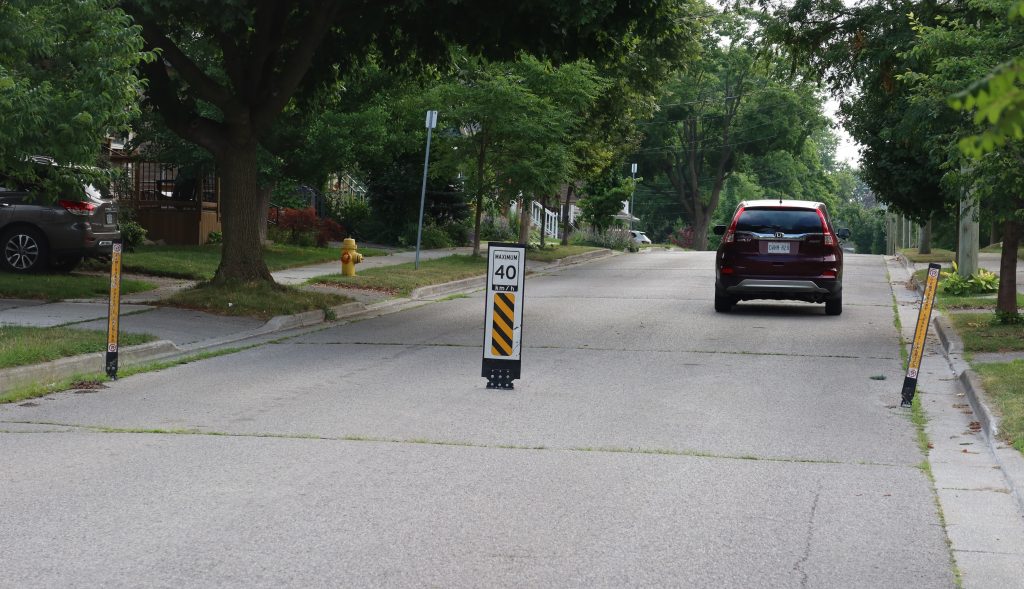
This street runs east and west between High and Wellington, so I imagine the idea is to slow down grumpy drivers who get tired of being on the Wellington parking lot and cut down here to get to High. But c’mon, engineers. No punitive humps, not even a yellow island and traffic cone. That thing won’t slow down even the FDs.
I think this is clearly a case of appearing to do something to appease the folks who live on this street and are upset at the higher traffic volume and speeds. Indeed, that is what all this is about, really. The city does something like tear up Wellington Road for 5 years, this has consequences, so then the city does something else, not necessarily effectively, to at least appear to deal with those consequences.
Note also that all of these structures will be removed come October, because you could not plow the snow off a street on which they remained. By the way, my gal sent me the photo below, from a street called Carfrae that runs north out of Old South.
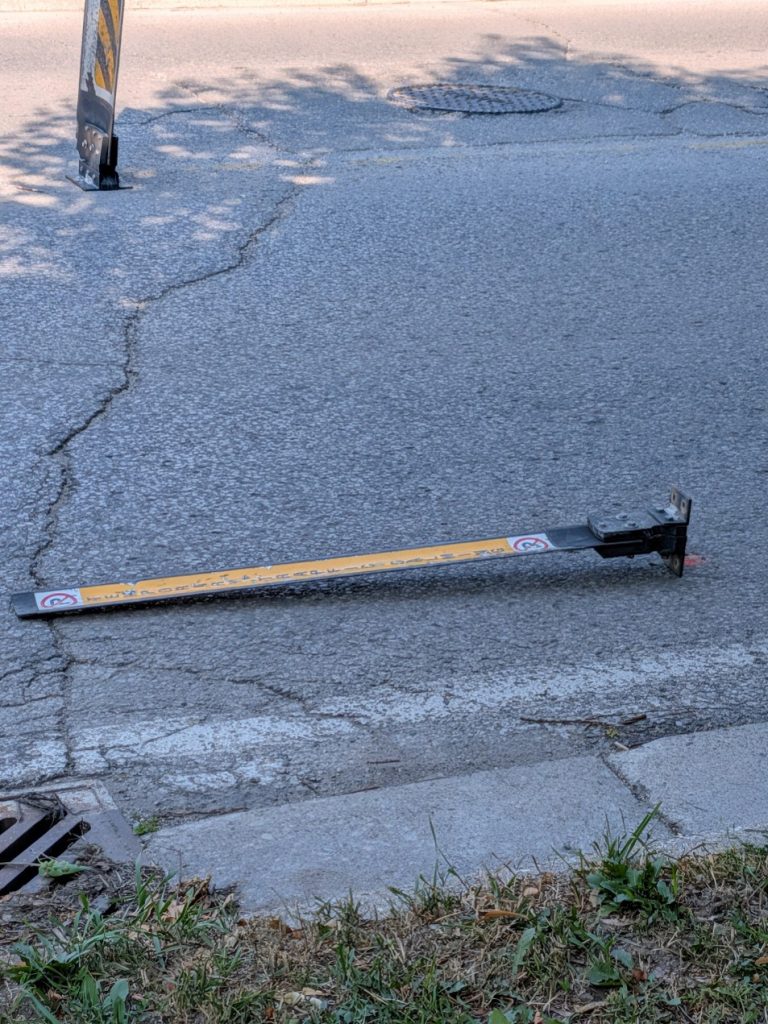
Ooops.
Later, those outer barriers were removed from Carfrae entirely, leaving just the center post. Seems some Londoners just can’t navigate traffic-calming structures. Or, some kids decided to see how well that thing was fastened to the pavement.
I await further calming ideas from the minds of London’s traffic engineering dept.