Doing That UK Shuffle
I was at a gathering of economists recently, both still-working and retired. Not something I do often anymore.
Anyway, it was good fun, and I got to talk with some people I don’t see often and genuinely miss. One of those was a former colleague who I have for years considered ‘the most interesting man in the world’. Remember those Dos Equis commercials?
That is this fellow. You want to know where is a good jazz club in Shanghai? He knows, but it’s in a basement, so you better get directions. They’re complicated. Where to get a first-quality suit made without paying a ridiculous price? He can tell you. And, his knowledge of Economics is the kind that is useful. He knows the stuff I do, but also knows about how it matters in the world when it does.
So, he came up to me at the party and said he had just come back from Jolly Old England. He goes there a lot, loves London. Then he said – ‘They are going down the same goddam path as the US’.
What do you mean? says I. ‘Populist nonsense’, he says.
I thought for all of 10 seconds, and said ‘and for the same reasons’.
‘Yes, exactly’, he said.
This led me to today’s post. I had been thinking about this a bit anyway, and gathered up some data on it, but my old colleague’s comment lit a new bulb in my aging head – I think he’s got a point.
Here’s the logic of it in 6 steps.
1. The Labour Party of England won the last parliamentary election in a landslide, at least if you measure landslide a certain way. Labour now holds 402 of the 650 seats in the British parliament, a massive majority. The next highest number is the 116 seats held by the Conservatives. By that measure, Labour kicked everyone’s parliamentary ass.
There is a caveat. Of all the votes cast in all the ridings in that British election, only 33.7%, were cast for Labour candidates, the lowest of any governing party on record in England.
Now, that is the way the system works, and I have no wish to cast aspersions on the results of that election. When Brits go to the polls, they are voting for one thing only – who will represent them in Parliament. The same is true in the Canadian Parliament and in the US Senate and House.
2. Since that election in 2024, the Labour Party and its Leader, Keir Starmer, appear to have lost popularity. A lot.
According to pollcheck.co.uk, on the day I am writing this, when they asked people ‘For which party’s candidate would you vote if another election were held today,’ they got responses that look like this:

Labour is third, behind Reform UK (more on them below) and the Conservative party, which led the government before the last election. Now if 33% is a small number, 27.9 is even smaller, but 18.1 is smaller still, so what does this mean?
By itself, not much, I would say. Asking people about hypothetical votes when there is no election looming doesn’t tell us much about what would happen if an election actually were called. On the other hand, something more substantive happened in Britain recently, which does not bode well for Labour.
3. England’s government is highly centralized, with most important functions carried out by the federal government. There are no provinces or states. So, the next level of government down is local. Elections for local councils were held last May 1, and unlike in Canada and the US, the national parties put up candidates for these local councils. Elections were held in 136 multi-member local councils, and here is what the BBC says were the results as regards the number of seats held by candidates from each party:
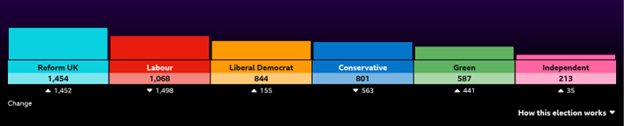
I know the results are small and hard to read, but if you do, there is only one word for this – a thorough, unequivocal ass-kicking. It is worth working through these numbers.
Reform UK had candidates holding two(2) seats on these local councils before the elections. They now hold 1,454 seats. Labour held 2,566 seats before the election, and they lost 1,498 of those, some 40%+. Indeed, the Labour loss of seats is almost the same as the Reform UK gain.
These are real elections, with real people casting votes that count, and Labour (and to a lesser extent, the Conservatives) lost bigtime, while Reform UK surged.
4. One repercussion of that outcome is that the members of the British Parliament from the Labour party are not happy, and, according to the BBC, some 90 of them have called for Starmer to resign as party leader and PM.
We saw a somewhat similar situation in Canada at the end of The Boy King’s reign as PM, but unlike here, there is a process in place to actually replace Starmer. If 81 Labour MPs sign up to support an alternative Labour MP for PM, then a leadership election is triggered. And….wait for it….Labour MP Josh Simmons is voluntarily resigning from Parliament to trigger a by-election in which the current Labour mayor of Greater Manchester, Andy Burnham, has said he will run, for the purpose of opposing Starmer for party leader.
The plot thickens, eh?
5. Here, finally, is where my old friend’s comment about the UK following the US path hits the road. Starmer has insisted he will not resign, and his policy moves since the council election debacle have been, if anything, more leftward. This Burnham fellow planning to challenge Starmer for the leadership seems rather more to the left than Starmer. One source says ‘Burnham positions himself on Labour’s centre-left, championing policies such as wealth taxes, public ownership of key utilities and scrapping the two-child benefit cap.’
In his time as Mayor of Manchester, he has become known as The King of the North, and I have to say some of the things he seems to espouse make a lot of sense. Here’s a quote from a UK newspaper about him.
[Burnham’s] philosophy centres on the argument that Britain’s persistent economic underperformance, high inequality, and degraded public services are the direct consequence of over four decades of overcentralisation — the concentration of both political power in the Treasury and economic power in the hands of private capital — and that the route to recovery is through long-term, collaborative, place-based investment led by empowered regional governments.
Wes Streeting and Angela Rayne are other Labour MPs who might have the support to stand against Starmer, and Streeting resigned as health minister in Starmer’s cabinet just recently. I don’t know enough to evaluate the chances of any of these people, but I also read that many of Labour’s 400 MPs are upset with what they see as Starmer’s cozying up to the US and Trump, and his positions on the Israel/Palestine issue.
6. So here is the parallel my friend saw, and I can see, too. Labour has a leadership contest, Starmer goes down and is replaced by someone who is in general further left, because that is what most Labour MPs want. Maybe Burnham, maybe someone else. That it is Reform UK, led by Nigel Farage, a party they would surely call ‘far right’ that is currently leading in the preference poll would not stop them. That the not-so-far-right Conservatives have nearly the same support as Labour wouldn’t, either. If the Labour-Lefty MPs want a ‘bolder’ set of policies, that is what they will do.
The illuminati of the US Democratic Party saw no problem with avoiding an actual nominating convention and simply anointing Kamala Harris as the new presidential nominee when Biden’s candidacy blew up in their faces back in 2024. That made it easy for the GOP and Trump to paint the Democrats as far left of the average citizen (as indeed I think they were) and so the world got Trump 2.0.
So, in the UK after this leadership contest, Labour swings further left at the behest of its new Leader and many of its MPs, the polls move more against them, they just keep keeping on, and the UK gets Farage the ‘populist’ as PM with a Reform UK majority at the next election.
To be sure, Reform’s current 27.9% voting preference doesn’t look like enough for a majority, but 33.7% never was, either, and besides, the next UK parliamentary election is a long way off. A lot can happen, particularly if Labour keeps tacking further left. My suspicion is that it will matter a lot how, if at all, the current UK government moves to control the illegal immigrants who are coming across the channel in apparently great numbers. That is to my mind the issue that had the most to do with sinking the Dems in 2024. No, immigrants in Ohio were not eating dogs, but that doesn’t mean people were not upset about illegal immigrants and legal refugees.
I should also say that I don’t know enough about Farage to have a meaningful opinion as to what he would be like as PM, or how close to Trump 2.0 he would be. I know he led the Brexit charge, and is accused of spreading ‘misinformation’ during that time, but that is a charge that is levelled at nearly every politician these days. And probably accurately; telling the truth is so 20th century. Or 19th, maybe.
So we shall see how this all shakes out. The US/UK parallel is not exact, but it is interesting.