If You Build it, They Will…?
I offer here a look at two seemingly unrelated stories about housing. They are in fact related, and sadly so, as I think you might see.
First, the Freeps and CBC London have not written anything about this so far as I recall, but a letter to the editor in today’s Freeps put me on to it, surprisingly. There is a housing co-op in East London called Tolpuddle where many of the units are rented on a Rent Geared to Income basis. A story on CTV news from early March, which you can check out in its entirety here, indicates that it includes at least 15 units which cannot be rented out because of the damage done to them by previous tenants. There are photos and video at the link above. The co-op also says it cannot afford to repair these units, and is asking the City to agree to fund those repairs. A number ‘between 1 and 2 million’ is mentioned.
A salient quote from the CTV story:
According to the Co-op President, city hall’s housing access waitlist determines which tenants are chosen for RGI units, but some of those individuals have not had their mental health or addictions stabilized prior to moving in.
That’s led to some chaotic tenancies that attracted drug use, drug dealing, damage, violence, and trespassing.
The story says the building has 134 units, 94 rented on a RGI basis. The article also says there is a ‘multi-year waitlist’ for RGI units in the city.
There was, however, a ‘story’ on the new modular units on Cheese Factory Road on the CBC site last week. CBC found one resident there who was unhappy about the remote location and the no-visitors rule, as well as the amount living there was costing him. Rather typical CBC reporting, telling us almost nothing about how things are going there. A Freeps story reported that all the units there are occupied, with a waitlist of 100 people.
So, we have a significant ‘shortage’ of low-rent units, it seems, the units that exist get trashed by at least some of the tenants who occupy them, and guess what – there are calls to spend more money on such housing; build more units, and repair the ones that have been trashed.
Well, here is the second, seemingly unrelated-but-not-really story, coming to you all the way from NYC. It is all in the graphic below.
A summary of what is in that graphic – I know the numbers are not easy to read:
From fiscal year 2019 to fiscal year 2025, that is six years, real, inflation adjusted spending per homeless person in NYC on services for that population went from $28.4k to $65.8k. Not quite tripling, but keep in mind that is per person and adjusted for inflation. Over that same period, the population served by that spending went up 26%, from 3,588 to 4,504.
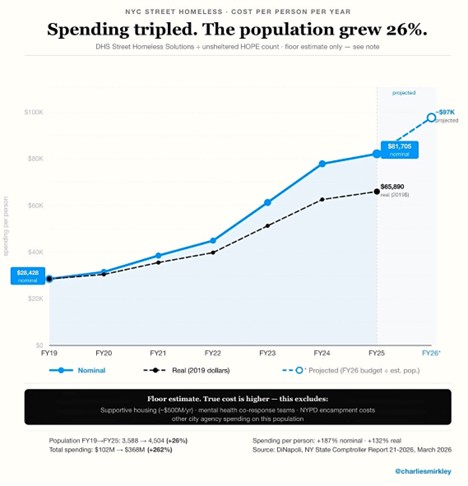
As I say often, the human universe is a very complex thing. One cannot point at those numbers, stark as they are, and say – spend a lot of money on the homeless and you will get more homeless.
However, it can be said unequivocally that those stark numbers also do not support the idea that spending money on the homeless will reduce the number of homeless.