Debtor Nation?
I came across one of those ‘explainer’ stories in the Globe and Mail the other day, titled
Rather than paying down debt, Canadians are happily borrowing even deeper
Being by now rather skeptical of anything the G&M publishes on matters economic, I thought I would see what it said. The theme is clear from the above headline; us crazy Canucks are borrowing more and more. Here is a graphic from the article:
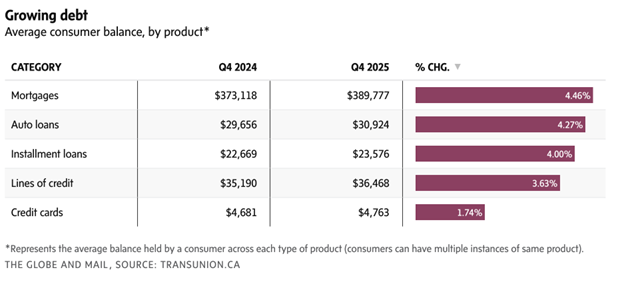
The graphic above is about household debt. There is also some chatter about government debt in the article, which I will get to, but let me separate those two and start with us plain folks.
A. Household Debt in Canada and Elsewhere.
The clear lesson of the graphic above is supposed to be that Canadians were carrying more debt in ’25 than they were a year ago in all categories, although credit card debt showed the smallest increase. That mortgage debt grew the most is slightly surprising, as the graph below from good ol’ FRED indicates that average residential property prices in Canada, after hitting a peak in the first quarter of 2022, have since been dropping. Perhaps people are moving up in the size (hence price) of their houses, now. Hard to say. There are many reasons people might be carrying bigger mortgages, but it does seem they are, on average.
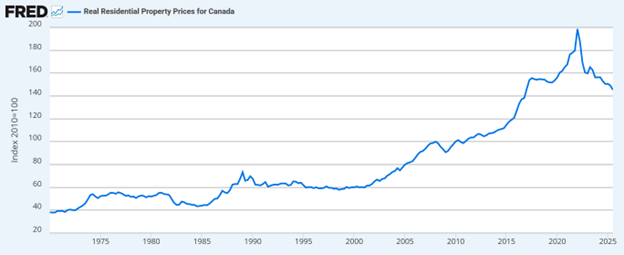
In any case, all that original graphic from G&M tells us is that household debt in Canada has increased some over the year from ’24 to ’25. Is that anything to be concerned about? Is that a big increase? Big compared to what? We need a comparison, so –
Here is an international comparison from an article in The Hub which is where much of the info in the G&M article came from, anyway:
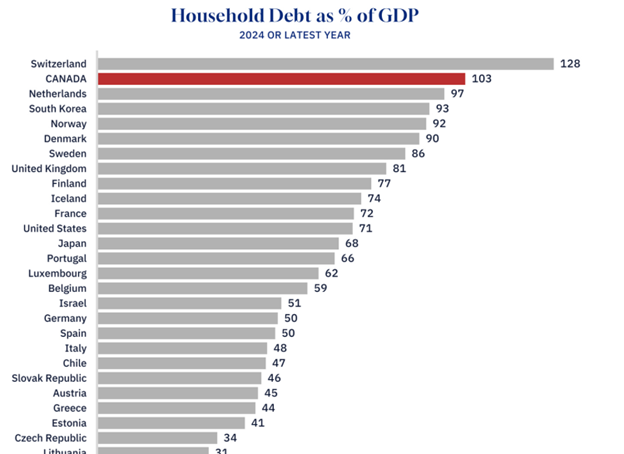
I only included the data from the most-indebted countries here to save space. What this shows is the total household (not government) debt in a country relative to that country’s GDP, which is a measure of how much income is generated in that country. So, Canadians are, by world standards, very highly indebted, indeed, relative to the income they generate. On the other hand, they seem to be in good company. I don’t think that anyone is too concerned that the Swiss or Dutch are in trouble. Do note that Canadian households are much more indebted than those in the US, relative to GDP, however.
My own perhaps idiosyncratic view of ‘debt trouble’ is when folks start running up their credit card debt. That may be misguided, but here is some data on that for Canada from The Financial Post:
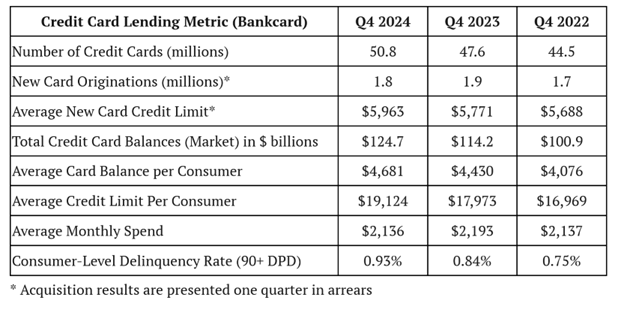
The average card balance per customer has risen some over this two year period, but the average monthly spend not at all, and the delinquency rate – the most worrying sign – is up a bit, but still very low, below 1%. It’s always good to compare oneself to others, so let’s see what the situation is for US credit card holders. The data for the US in the table below is from The Motley Fool, and not directly comparable, but still useful.
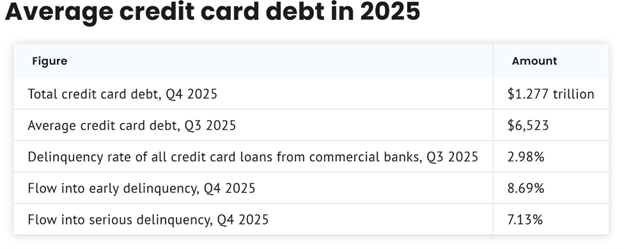
The average credit card balance is clearly higher than in Canada at $US6500, and the flows into early and serious delinquency look much worse, but I believe those numbers indicate the percentage of balances that have gone into delinquency rather than the percentage of customer accounts.
Anyway, the credit card situation of Canadians is, on average, not obviously worse than that for Americans.
I am always interested in not just what the situation is, but how we got there. So, I got to wondering what household debt in Canada looked like in the past, and how it might have changed. As so often is the case, I had to go to FRED to get the info on this I wanted, and it is below.
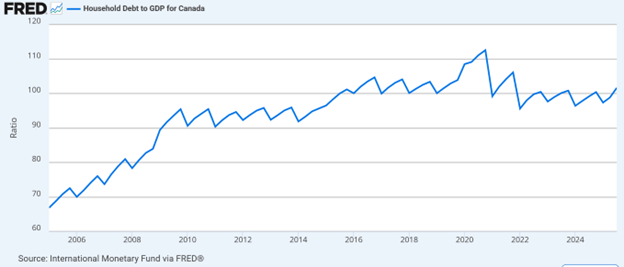
So household debt in Canada was less than 70% of GDP back in 2005, climbed to over 90% in the next five years, and has continued to tick up slowly after that, with some ups and downs along the way.
What about the USA households? Well……
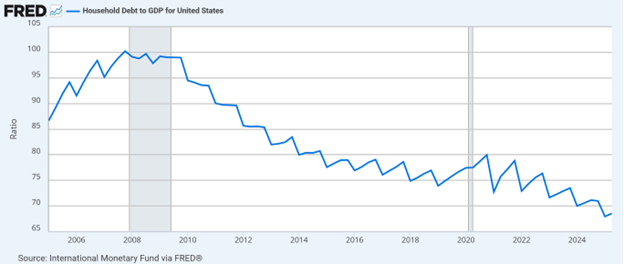
This is a very different history than Canada’s, to say the least. Household debt was very high in the US up until the 2008 debacle, and since then it has trended down, to sit at its current 60-something percent. This got me wondering, so I kept digging. Here is the same info for Germany:
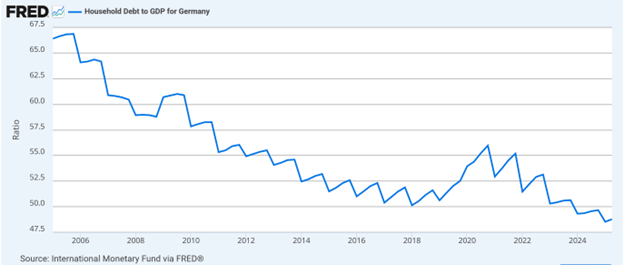
There was no run-up in the years prior to 2008 in Germany, just a long slow decline, except in the years just following the pandemic. The UK looks much the same as the US and Germany. The only developed country I found data on that had that long upward trend was Canada, although I did not check every country, of course.
So….WTF? Canada’s household debt to GDP ratio is very high by international standards, and it got there via a run-up over 20 years during which other advanced economies saw household debt declining as a percentage of GDP. And, the increase in Canada started well before the run-up in real estate prices.
There is one other fact worth mentioning here. Canada’s GDP, and even more, its GDP per capita, has not been doing well in recent years. This is well-known and much lamented, but it certainly raises the possibility that the reason Canada’s household debt history looks so different from that of other countries is not due to debt itself increasing so much as its GDP (the denominator in those graphs) doing so poorly.
B. Government Debt in Canada and Elsewhere
As you might guess, the G&M article went on about government debt in Canada, also. Here is a graphic analogous to the one I started this article out with:
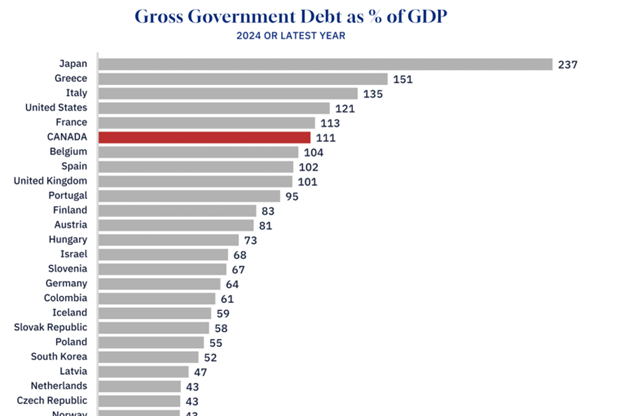
Once again, Canada seems to be a world leader in indebtedness (government this time) although no country comes close to Japan’s 237% of GDP.
However, there is something hidden in those numbers which is worthy of your attention, I think. I discovered this about a month ago after an evening out with the Diners group. We do talk about many things, and on this evening, someone at the table commented on the massive government debt being carried by the good ol’ US of A. I responded that I was pretty sure Canada was in a similar position, and afterwards went to find data to see if I had stuck my foot in my mouth (a not uncommon occurrence).
I came across some info much like what you see above, which indicated that as a percentage of GDP, Canada’s debt was not much below that of the USA. Vindication for Al…..but there’s a but.
I will turn to more historical data from the ever-reliable FRED to show you that – once again – it’s complicated. Below is FRED’s tracking of the history of general government debt in the USA as a percent of GDP.
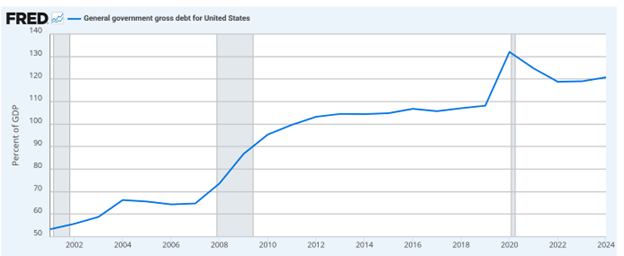
It has surely skyrocketed since 2002, but here is the thing. This is debt by governments at all levels, including the US States. I could also show you a graph of just the Federal US government debt-to-GDP ratio, but it would not look much different from the above. A bit higher, but a tiny bit higher in recent years, because US States don’t borrow much. Indeed, many of them have ‘balanced budget clauses’ in their state constitutions that prevent them from running deficits.
Now let’s have a look at Canada. Below is FRED’s historical data on the borrowing by Canada’s central (i.e., federal) government as a percentage of GDP.
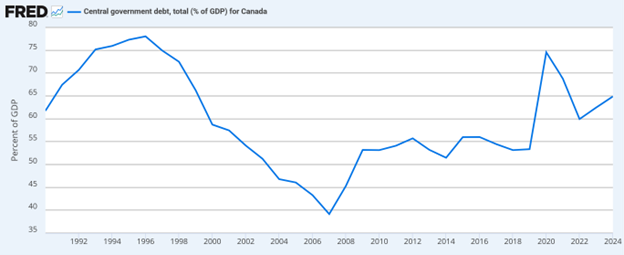
Notice that in 2024 it was around 65% of GDP, not the over-100% we saw in the graphic above. That is because that graphic above is for the total debt of all levels of government. Canada’s provinces, unlike US states, are big borrowers. According to the Fraser Institute, a generally reliable bunch of mostly-economists (I know, I know) the federal government held just over 60% of total government debt in Canada and the provinces just under 40%.
Here is an interesting twist on this. Ok, interesting to me.
If there is a reason to worry about growing government debt, one is that the need to service that debt – that is, to pay the interest on it – begins to override other government spending possibilities. People like to say that governments are not like households but actually, they very much are. If a household borrows too much, eventually its interest payments chew up its income to the point that it cannot afford to spend on, you know, food and shelter. Government is the same. To illustrate the point, here’s a nice cogent line from an article in the National Post from last August:
In 2024/25, the federal government alone spent a record $53.8B on debt interest — more than the $52.1B it paid to the Canada Health Transfer.
As the ‘alone’ in that sentence suggests, the provinces were making significant debt service payments, too.
Now, if that debt service gets too big, and this has happened to governments from time to time in history, what can be done? The Feds have two options. One, default, and two, print money. Not with a printing press, but the Bank of Canada can certainly create more. This second approach is known as ‘inflating the debt away’, or ‘monetizing the debt’. The Provinces have only the one option, as they have no Bank of Ontario, etc, which is in control of the money supply.
Oh, and another often-heard bit of silliness is ‘government debt doesn’t matter because we owe it to ourselves.’
First of all, Canadian government debt is held by all kinds of people and orgs, many of which are not Canadian. You can be sure it matters to them if Canada’s government(s) take the first option and default on their debt. More to the point, if I lend money to my brother, and he decides not to pay it back, in what sense does that ‘not matter’? I was expecting my $20 back, and if I do not get it, it matters, even if it was my brother who bailed on the loan. You probably have Canadian treasury bonds in your pension fund. Would it not matter to you if Canada’s government decided to default on those?
A Summary – sortof…..
I started this out with an investigation of Canadian household debt, and the one clear finding from that is that Canada’s households do seem to be carrying world-class levels of debt, and they got there over the last 20years, while other countries’ households were contracting theirs. Why the difference? Right now, I dunno, but the possibility that this is mostly driven by Canada’s crappy GDP growth cannot be discounted.
Canada’s various governments also hold world-class levels of debt, but what is unique here is that so much of it is the responsibility of provincial governments. One might wonder – if, say, Ontario’s government got to the point of having trouble servicing its debt, what, if anything, would the Feds do to help them out? Again, I dunno, but I am confident that no one else does, either.